England stormed back to the top of the T20 international rankings with an emphatic eight-wicket demolition of Sri Lanka, completing a 3-0 series sweep and leaving the visitors facing searching questions over their tactics, selection and preparation.
Sri Lanka were bundled out for just 124 in the third T20I, before England raced to the target in only 9.4 overs, finishing with 62 balls to spare — their biggest winning margin by balls remaining in a home T20 international.
The victory, achieved under captain Harry Brook and watched by new Test coach Stephen Fleming, underlined England’s formidable white-ball form. It was their 23rd victory in 26 completed T20 internationals since Brook took over the captaincy in the summer of 2024.
England’s fast bowlers dismantled Sri Lanka’s batting line-up before their powerful chase made the contest a formality.
Jamie Overton conceded just 15 runs in four overs while taking a wicket, while young paceman Sonny Baker continued to impress with 2-17. Jofra Archer also bounced back strongly, claiming 2-23 after an expensive opening match.
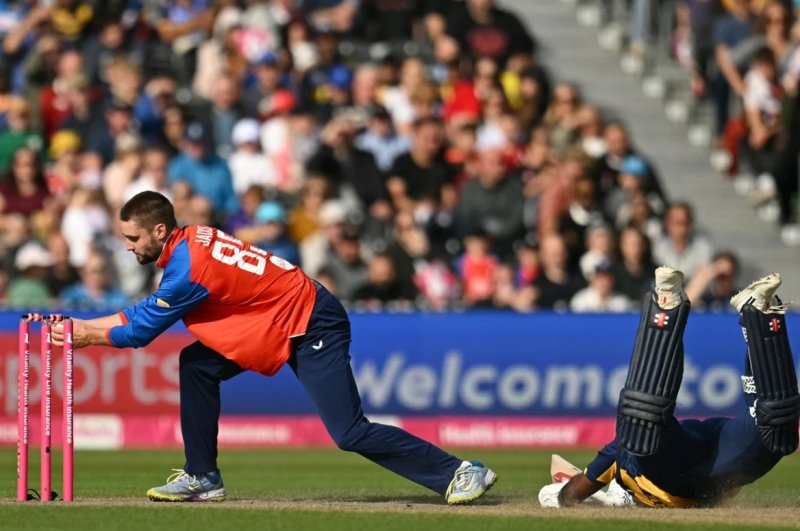
England’s fielding was equally sharp, with Liam Dawson producing a superb direct hit to run out Eshan Malinga.
With Phil Salt and Jacob Bethell absent through injury, England might have been expected to struggle for their usual firepower. Instead, Jos Buttler and Brook took control after Aneurin Donald fell for 13.
The pair added 85 for the second wicket before Brook was run out for 33. Buttler remained unbeaten on 61, ending the contest in emphatic fashion with a six.
Sangakkara: England and Sri Lanka “Miles Apart”
While England celebrated another dominant performance, Sri Lanka’s shortcomings drew unusually blunt criticism from one of the country’s greatest former players.
Former captain Kumar Sangakkara described the gap between the teams as “miles apart”, questioning Sri Lanka’s selection choices, tactical consistency and preparation.
Sangakkara singled out the decision to promote Kamil Mishara to No. 3 and the omission of Maheesh Theekshana, whom he described as Sri Lanka’s best spinner.
“There has to be some consistency in the decision-making,” Sangakkara said, stressing the need to identify the best players, trust them and develop them in clearly defined roles.
His criticism extended beyond selection. Sangakkara pointed to weaknesses in fitness, physical conditioning and batting awareness, arguing that Sri Lanka’s talented players are struggling to match the power and tactical demands of modern T20 cricket.
Sri Lanka captain Charith Asalanka also acknowledged that the team remains some distance from the T20 side it wants to become.
Hussain highlights batting problems
Former England captain Nasser Hussain also highlighted technical issues in Sri Lanka’s batting, arguing that players have increasingly struggled against high pace by attempting to overpower the ball rather than relying on timing and placement.
The numbers from the third T20I painted a stark picture. Sri Lanka endured 50 dot balls and were comprehensively outperformed in boundary-hitting as England turned the match into a one-sided contest.
For England, the performance provided another statement of their white-ball strength. For Sri Lanka, it leaves difficult questions over selection, player development and their approach to the shortest format.
England now face a lengthy wait before the next men’s T20 World Cup, scheduled for 2028, when T20 cricket will also feature at the Los Angeles Olympics.
Their immediate priority, however, shifts to the 50-over format and preparations for the 2027 World Cup in southern Africa.
Those preparations begin on Tuesday, when England and Sri Lanka meet again in the first of three ODIs in Durham.
England leave the T20 series with a clean sweep and the No. 1 ranking. Sri Lanka leave with a much longer list of questions.