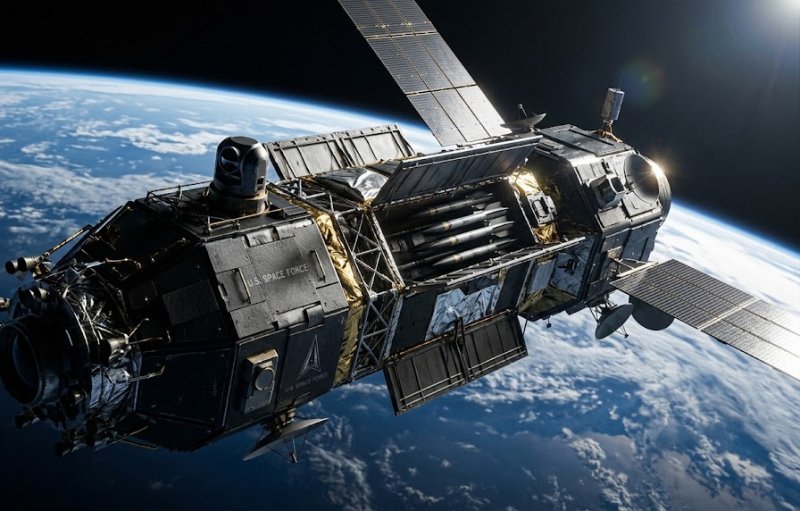
The militarization of Earth’s orbit has long lingered in the shadow of geopolitical discourse. For decades, the space domain was treated primarily as an arena for recon, communications, navigation, and early missile warning.
However, as public admissions confirm that the United States has deployed operational "space-control weapons" into orbit, the conversation has shifted from theoretical doctrine to concrete capability. While specific technical blueprints remain highly classified, analyzing existing technology, defense research projects, and modern orbital tactics reveals the realistic weapon systems the U.S. could have stationed—or currently maintains—above the atmosphere.
The primary candidate for an operational space-based asset falls under non-kinetic counter-space technology. Electronic warfare platforms designed to operate directly in orbit offer significant tactical advantages over ground-based jammers. By placing radio-frequency interference payloads directly in proximity to target spacecraft, these orbital systems can flood enemy sensors with noise, block telemetry links, or interrupt signal transmissions. Electronic attack capabilities provide a reversible, low-collateral mechanism to temporarily disable adversary reconnaissance or satellite communication networks during a crisis without creating long-term space debris.
Complementing signal manipulation are directed-energy weapons (DEWs). Space-based laser or high-power microwave systems represent a potent class of defensive and offensive orbital hardware. High-energy optical lasers can be aimed at opposing satellites to "dazzle" or permanently blind their optical and infrared sensors, rendering enemy orbital intelligence gathering useless. Meanwhile, high-power microwave payloads can emit targeted electromagnetic bursts designed to fry the internal microelectronics and control units of rival hardware. Because directed-energy platforms attack at the speed of light, they allow rapid engagement against fast-moving orbital targets.
Another capability long pursued by military strategists involves rendezvous and proximity operations (RPO) platforms, often termed "co-orbital counter-space systems" or "grappling satellites." These are maneuverable spacecraft equipped with robotic arms, mechanical capture mechanisms, or localized propulsion thrusters. While developed nominally for satellite servicing, refueling, and space debris remediation, the underlying technology is inherently dual-use. In a military context, an RPO satellite can approach a target spacecraft, physically grab or de-orbit it, spray opaque coatings over its optics, or alter its trajectory to push it into a graveyard orbit.
Moving into kinetic capabilities, space-based interceptors (SBIs) represent a classic missile defense concept revitalized by modern tracking constellations. Deployed as part of layered defense initiatives like the Golden Dome system, these orbital platforms carry hit-to-kill interceptor vehicles. Designed to detect and neutralize ballistic or hypersonic missiles during their early boost phase, an SBI launches a small kinetic projectile that destroys incoming targets purely through high-speed physical impact. Placing interceptors in low Earth orbit shortens response windows, offering a defensive shield before adversary warheads complete their trajectory.
Beyond counter-space and missile defense, theoretical concepts also encompass space-to-surface strike platforms. The most infamous among these is kinetic bombardment, historically dubbed "Rods from God." This concept involves an orbital satellite carrying dense tungsten or dense-metal darts. When released, the projectile descends through the atmosphere, guided by satellite navigation, reaching terminal speeds around Mach 10. The kinetic energy released upon impact rivals that of a small tactical nuclear weapon, capable of penetrating deeply buried bunkers or hardened command nodes without explosive chemical warheads or radioactive fallout. Although launch costs historically rendered kinetic bombardment impractically expensive, lowered orbital access barriers keep it within the realm of long-term strategic feasibility.

The spectrum of potential space weapons spans from non-destructive electronic jamming to physical kinetic interceptors. Given the strict constraints of the 1967 Outer Space Treaty—which bans weapons of mass destruction while leaving conventional arms unregulated—the U.S. space arsenal likely emphasizes targeted, highly controllable capabilities designed to protect critical assets while maintaining air and space dominance.