
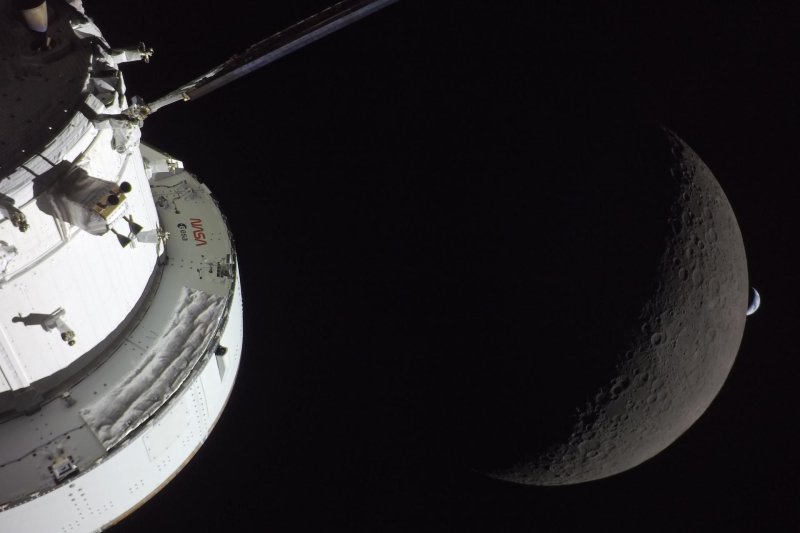











The splashdown is a critical moment for the mission, testing systems that the space agency plans to use in future crewed moon landings, including Artemis III.
To every engineer, every technician that’s touched this machine — tomorrow belongs to you,” said NASA Associate Administrator Amit Kshatriya, during a mission update briefing on Thursday. “The crew has done their part. Now we have to do ours.”
Over the course of their mission, NASA astronauts Reid Wiseman, Victor Glover and Christina Koch, together with Canada’s Jeremy Hansen, pushed beyond any previous human distance from Earth during their journey around the Moon.
Here’s what to know about when the splashdown will happen, where the spacecraft is expected to land and how it works.
NASA says the Orion spacecraft, named Integrity by the crew, will make its return to Earth on April 11 at about 00:07 GMT (8:07pm ET on April 10), when it re-enters the atmosphere and splashes down in the Pacific Ocean off the San Diego coast, the final and most critical stage of the Artemis II mission.
Recovery teams will retrieve the crew by helicopter and transfer them to the USS John P Murtha, the amphibious ship leading the operation.
NASA has set strict “go” conditions for splashdown, including wave heights below six feet (1.8 metres), winds under 28.7mph (46 km/h), and no rain or lightning within a 30-nautical-mile radius. Clear visibility is also essential for tracking Orion and safely recovering the astronauts.
Most of the weather criteria are now in order to have a safe recovery mission by sea and by air.
Artemis II marks the first time since Apollo 17 in 1972 that NASA and the Department of Defense are recovering a crewed spacecraft returning from the moon.
Their Orion capsule will come hurtling back to Earth, hitting the atmosphere at about 34,965 feet (10,657 metres) per second, roughly 23,800mph (38,300km/h), fast enough to travel from New York to Tokyo in less than 20 minutes, according to Space.com.
The Orion spacecraft, Integrity, is already on its way back to Earth using the planet’s gravity to help pull it home.
As it travels, a part of the spacecraft called the service module fires its thrusters a few times to gently adjust its path. These small corrections make sure Orion is lined up perfectly.
This is important because re-entry only works if the spacecraft hits the atmosphere at the right angle; too steep or too shallow can be dangerous.
The final adjustment happens a few hours before re-entry. After that, the astronauts put on their protective suits and prepare for the most intense part of the journey: passing through Earth’s atmosphere and splashing down safely in the ocean.
About 42 minutes before the splashdown, the crew and service modules separate, leaving only the crew module to continue the final descent to Earth. The service module is then discarded and burns up in the atmosphere, while the crew module turns its heat shield forward for re-entry.