As Sri Lanka prepares to celebrate its 78th Independence Day on February 4, 2026, a rare and historic opportunity will be offered to the Buddhist community.
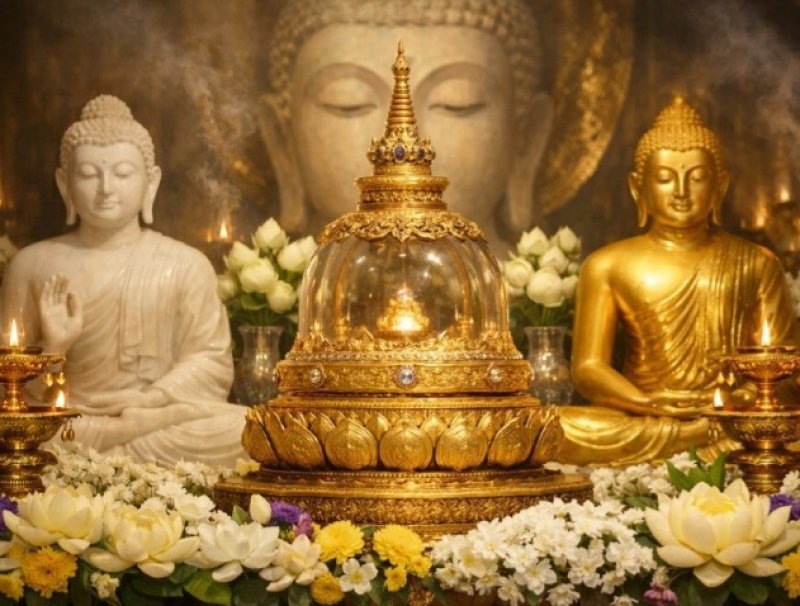
For the first time, the sacred bodily relics (Dhatus) of Lord Buddha will be publicly displayed at Gangaramaya Temple in Hunupitiya, Colombo, allowing devotees to view and pay homage.
The relics were discovered between 1959 and 1963 during extensive archaeological excavations at Devni Mori in the Aravalli district of Gujarat, India. Devni Mori is renowned as a significant archaeological site, hosting a large Buddhist monastic complex. Among the findings at the site was a stupa containing these precious relics of Lord Buddha.
Two valuable caskets (Manjusas) were uncovered at Devni Mori. One of these caskets, made of green schist stone, contained a copper vessel with gold and silver plates along with sacred ashes. An inscription in Brahmi and Sanskrit on the casket identifies it as a repository for the bodily relics of the Buddha. The inscriptions also indicate that the stupa was constructed by King Rudrasena III of the Shaka-Shaspa dynasty, who was noted for his generous support of Buddhism.
The archaeological findings provide evidence of a Mahavihara-style monastery at Devni Mori, confirming the presence of Theravada Buddhist practices at the site.
This exhibition, featuring the stupa, the copper vessel, and the sacred relics, is scheduled to take place from February 4 to February 11, 2026, at Gangaramaya Temple in Colombo. This marks the first time these relics will be displayed outside India, with Sri Lanka selected as the inaugural country to host them—a gesture symbolizing the deep spiritual and cultural ties between India and Sri Lanka.
This initiative follows a promise made by Indian Prime Minister Narendra Modi during his visit to Sri Lanka in April 2025, when he pledged to allow these sacred relics to be exhibited in the country.
The public is warmly invited to witness and pay homage to these rare relics, a truly historic opportunity for Buddhists in Sri Lanka.