Before The Nepal Flood, A Glacial Fall: Tracing The Trigger, And A 100-km Killer Surge
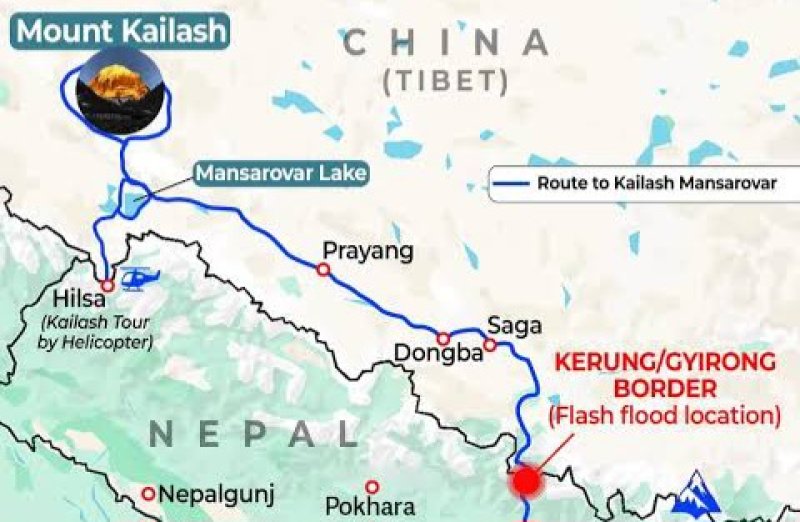
Before ice, rock, mud and water hurtled down one river after another, partly in Tibet (China) and mostly in Nepal, a seismic event occurred where the two countries' borders meet, at an altitude of more than 5,000 metres in the Himalayas. That seismic event is at the centre of multiple theories since, ranging from what caused it in the immediate to what really fell.
The disaster began at 8:37 am Nepal time (8:22 am IST) on August 26 with a tremor recorded by monitoring networks across the region as a magnitude 4.4 earthquake, at first. Three days on, scientists remained divided over what that signal represented. The United States Geological Survey (USGS) later revised its interpretation of that event, saying that the seismic waves were generated by a landslide involving a glacier in Langtang National Park in Nepalese territory. NDTV reported.
The energy released by that landslide ('slope failure') was the equivalent of a magnitude 5.2 earthquake, it said.
India's remote sensing centre offered a different preliminary reading, saying that a magnitude-4.9 earthquake triggered the collapse of a glacier; and that the sequence began on the Tibetan side. The International Centre for Integrated Mountain Development says the trigger remains unconfirmed.
Geological reconstructions of the event, based on satellite images, reported that a part of the glacier slid down the Nepal side of a mountain; debris blocked a river on the Tibetan side; and the blocked water tore through, destroying a border port nearby before the catastrophe entered Nepal.
Today, rescue helicopters of the Chinese People's Liberation Army (PLA) filmed footage near a devastating mudslide hit port of Gyirong (吉隆), along the🇨🇳#China-🇳🇵#Nepal border in China's Xizang Autonomous Region. pic.twitter.com/56w5fiS6tJ
— Shen Shiwei 沈诗伟 (@shen_shiwei) August 27, 2026
The US agency simply said it was "likely triggered by rapid slope failure involving a glacier in Langtang National Park, Nepal, near the border with China". The USGS has not settled on how the landslide occurred, saying, "It is unclear if the initial slope failure was a landslide incorporating part of a glacier or a glacial collapse."