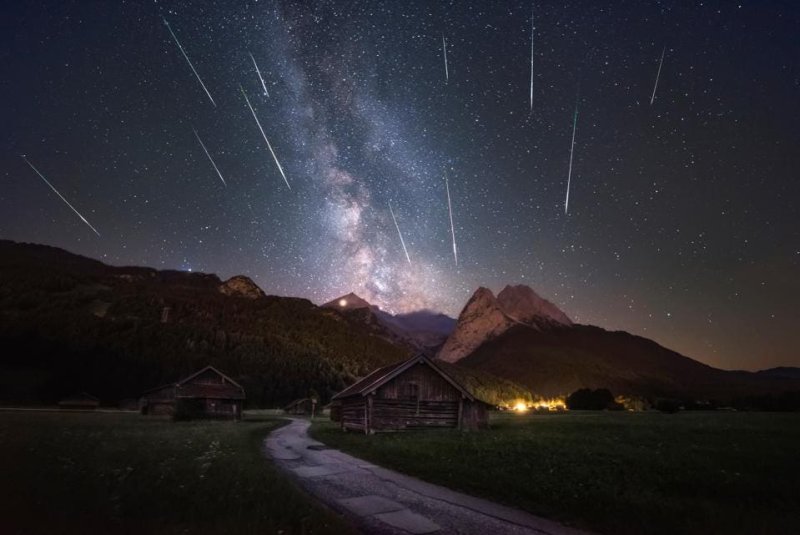
The peak is predicted** for 14 UTC on August 12, 2024. So the mornings of August 11 and 12 are probably your best bets. August 13 might be good as well, but be aware that the Perseids tend to fall off rapidly after their peak.
The moon will be at 1st quarter and 50% illuminated during 2024’s peak of the Perseid meteor shower. So the best time to watch for Perseids will be starting around midnight until dawn. This shower rises to a peak gradually, then falls off rapidly. And Perseid meteors tend to strengthen in number as late night deepens into the wee hours before dawn. The shower is often best just before dawn.
The radiant rises in the middle of the night and is highest at dawn. See chart below.
First quarter moon falls at 15:19 UTC on August 12. And a 1st quarter moon sets around midnight, so you’ll have dark skies after then until dawn.
Expected meteors at peak, under ideal conditions: Under a dark sky with no moon, skywatchers frequently report 90 meteors per hour, or more.
The August Perseid meteor shower is rich and steady, from early August through the peak. The meteors are colorful. And they frequently leave persistent trains. All of these factors make the Perseid shower perhaps the most beloved meteor shower for the Northern Hemisphere.
Around the peak mornings, if you trace all the Perseid meteors backward, they seem to come from the constellation Perseus near the famous Double Cluster. Hence, the meteor shower is named in honor of the constellation Perseus the Hero.
Of course, there’s no real connection between the meteor shower radiant and the constellation Perseus. The stars in Perseus are many light-years distant, while these meteors burn up about 60 miles (100 km) above the Earth’s surface.
The parent comet responsible for the Perseid meteor shower is a rather large comet called 109P/Swift-Tuttle. The comet orbits the sun approximately every 133 years. Lewis Swift of Marathon, New York, visually discovered it on July 16, 1862, using an 11-centimeter (4.3-inch) refractor lens telescope. He did not report it immediately, believing that he was observing Comet Schmidt, which was found two weeks prior. Then, three days later, Horace Tuttle picked it up from Harvard Observatory. Scientists calculated that the comet would return in 120 years. That is, that we would see it again in 1982.
So, 1982 came and went. And the comet didn’t show up. Oops! It was back to the drawing board, and this time, the appearance of a comet observed in 1737 was considered a possible early appearance of the comet. Now, the orbital period was more like 130 years. Brian Marsden published new orbital elements and an ephemeris as to where to find it for its 1992 return.
Meteors that hit the ground intact are called meteorites. But few – if any – meteors in annual showers become meteorites. That’s primarily because of the flimsy nature of cometary debris. Comets are made of ices. Most meteorites, on the other hand, are the remains of rocky or metallic asteroids.
In ancient Greek star lore, Perseus is the son of the god Zeus and the mortal Danaë. It was said that the Perseid shower commemorates the time when Zeus visited Danaë, the mother of Perseus, in a shower of gold.
So think of the ephemeral nature of meteors in meteor showers, as you stand outside watching for Perseids in 2024. Most meteors strike Earth’s atmosphere unseen. You can consider any Perseid meteor you do see in 2024 as there for your viewing pleasure!
By the way, 2023 was a fantastic year for the Perseids: Enjoy this gallery of Perseid meteor photos from around the world, 2023.