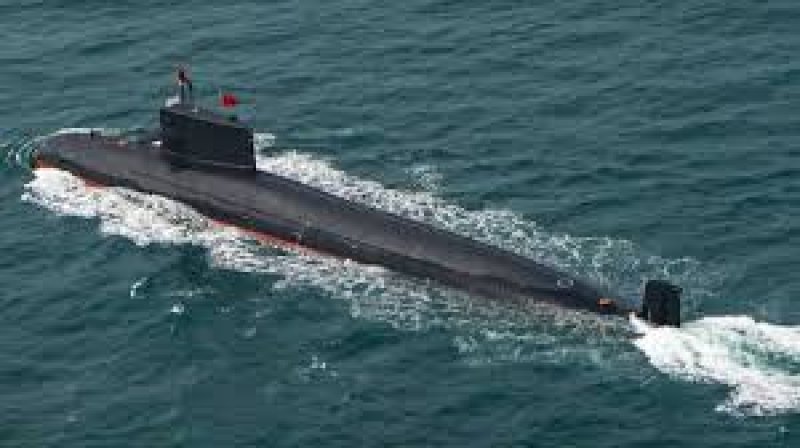
Chinese submarines armed with lasers could take out SpaceX’s Starlink satellites if China’s security was at risk, according to a study by People’s Liberation Army (PLA) scientists.
In the study, a submarine with a megawatt-class, solid-state, laser weapon installed in its midsection could stay submerged while it raised a retractable, “optoelectronic mast” to fire at satellites, before diving back down to depth.
This type of laser attack submarine could be mass-produced in the future and deployed in various oceans to counter military threats to China, said the project team led by Wang Dan, a professor with the Naval Submarine Academy, in a peer-reviewed paper published last month in the Chinese-language journal, Command Control & Simulation.
For anti-satellite missions, the biggest challenge was not hitting the satellite, but hiding the attack, the scientists said.
Currently, the primary means of anti-satellite operations relies on ground-to-air missiles, but this approach has certain issues, mainly in terms of concealment,” Wang and her colleagues wrote.
Missile launches are often accompanied by long trails of smoke. Conducting the attack from a surface location can easily expose one’s own position, leading to destruction by enemy firepower. This is “too risky”, the team wrote.
Taking the satellites launched by the Starlink programme as an example, they are numerous, densely packed and small in size, making the satellite network extremely resilient. Even if a significant number of satellites are destroyed, there are redundancies to replace them. Therefore, using missiles to attack such satellites is highly inefficient,” Wang’s team said.
“Submarine-based laser weapons can solve these issues.”
The paper detailed a step-by-step guide to attacking Starlink-like satellites at sea.
First, one or several submarines equipped with laser weapons are deployed to the sea area where the operation is to be conducted. They enter the target sea area according to the command instructions and wait for the satellites to come within their attack range. The time to raise the laser weapon is determined based on the previously acquired satellite overhead time,” they wrote.
“When the satellite enters the attackable range, the laser weapon is raised. Due to the limitations of the submarine’s detection equipment, other forces are required to provide satellite position guidance for the submarine to attack the satellite. After the attack is completed, the submarine can submerge and wait for the next mission or return to the home port.”
According to official data released this month, China has more than 900 satellites in orbit. The US has seven times that number, most of them part of Starlink.
In 2021, two Starlink satellites approached the Chinese space station in a dangerous manner, prompting astronauts to initiate emergency evacuation procedures. The incident convinced Beijing that the US could use these cheap satellites to hit China’s expensive space assets.
The Starlink satellites are mainly used for communication, but the success of SpaceX’s Starship rocket test flight last month suggested to some Chinese military experts that future Starlink satellites could carry extra payloads for military activities, such as reconnaissance and electronic interference.
The Starshield programme, jointly launched by the Pentagon and SpaceX to monitor China’s hypersonic weapons, has deepened this concern.
The development of laser weapons presents many technological challenges, from energy storage, to heat and optics. But China has sped up its research – and made a number of advances – since Starlink has been used in the war in Ukraine.
These advances include power supply systems that can support high-power, dense launches, powerful yet compact solid-state lasers, an optical fibre straw that can transmit over 10,000 watts of power with high quality, and technology to synthesise a laser beam using hundreds of such optical fibres.
SC Morning