President Ranil Wickramasinghe says that various people inside and outside the parliament are spreading false propaganda regarding debt restructuring and related matters, and when the government is moving forward with the right policy for the country, these critics are creating different stories day by day for the sake of power.
The President said that Sri Lanka is at the forefront of the middle-income countries that have succeeded in the debt restructuring process, and that this is a unique achievement for the country as well as good news.
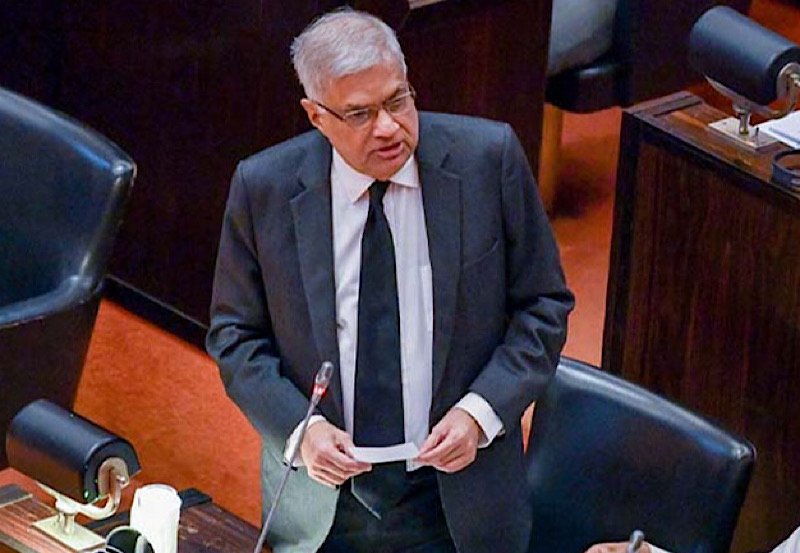
President Ranil Wickramasinghe mentioned this while making a special statement in Parliament today (02) to raise awareness about the debt restructuring process.
In order to carry this good news forward into the future, the President once again invited all the people representing the Parliament to join the challenging exercise of building the country without any colour difference by making the program that the government has started successful.
The President said that he has not been involved in politics for the past two years and emphasized that he always takes decisions for the sake of the country and not for the sake of political power or popularity.
The full speech delivered by President Ranil Wickramasinghe is as follows:
Last week, we were able to reach another important milestone in the challenging journey of providing economic strength to a country that failed to pay its debts in 2022.
On June 26, we were able to reach an agreement with our official creditors regarding the repayment of the loan. Officials authorized by the cabinet signed these agreements and contracts representing our country.
That same night, I pointed out the facts about it to the entire nation through electronic media.
From the day the challenging journey of rebuilding the economy began, I presented facts before the Parliament from time to time. First, we explained the plans we are following in front of the Parliament. After that we explained the progress we have made.
Accordingly, I would like to reveal the information about the current situation before this assembly today.
Honorable Speaker,
About two years ago, after I accepted the challenge of reviving the country's economy, I put our four-step work plan before this Parliament.
1. Obtaining extensive credit facilities in consultation with the International Monetary Fund and establishing financial discipline in the country.
2. Working with the international financial and legal experts, Lazard and Clifford Chance, in coordination with the IMF to prepare the debt stabilization plan and reach an agreement with the creditors.
3. Establish policies, rules and programs to secure foreign investment and strengthen the export economy and create a digital green economy. Preparing and presenting the necessary reforms to promote the country's economy.
4. To become a developed country through a debt-free advanced economy by 2048 through this program.
Since then, we have embarked on a difficult journey. We knew that it would be possible to succeed in the future through that journey. Step by step we went forward. This program was further strengthened by the 2023 and 2024 budget documents.
By March 2023, we were able to get approval for the IMF Extended Credit Facility. We managed to get its first installment on March 20, 2023.
After reviewing our progress, we received the second installment on December 12, 2023 and the third installment on June 12, 2024.
Since the start of the IMF program, we have started discussions on debt restructuring. We continued to get the support of Lazard and Clifford Chance international organizations to get the necessary expertise for this kind of work.
Our foreign debt is 37 billion US dollars. Of that, $10.6 billion is bilateral debt. $11.7 billion in multilateral debt. $14.7 billion in commercial loans. 12.5 billion of which are sovereign bonds.
Different people express different opinions in this House and outside regarding debt write-off, loan grace period, extension of repayment period or restructuring and related matters.
Some of those facts are not true. Some facts are half-truths. Therefore, I would like to clarify the international practice and facts of debt restructuring at this time.
What is this foreign loan? Where do those countries get the money to lend?
They lend us the tax money of the people of those countries. And the savings of the people of those countries.
Many people in our country are suggesting that we should take concessions on foreign loans without making any commitments. But it won't happen. It is not practical. It is not possible to do that according to international practices.
Just like the tax money of other countries, we also have to make a commitment when making decisions regarding their savings. If we do not make a commitment, the people of those countries will not make a commitment for us.
Not only that. Debt restructuring is a difficult exercise. International economic experts say that this task is difficult and painful.
It is a painful process for creditors, debtors, citizens of the debtor country and mediators.
Official Bilateral Creditors never make a cut in the principal amount. We can only get concessions. These concessions are given by extension of loan repayment period, loan concession period, interest rate reduction etc.
But not knowing this reality, some blame the Sri Lankan government for not requesting a basic debt write-off. Others say that when they get power, they will negotiate with creditor countries to cut fifty percent of the initial loan amount. We must understand that both parties must agree for this kind of work.
We also need to understand that creditors will not do what we say. Such statements only show that they have no understanding of international economic systems.
Neither the creditor nor the borrower has the power to make the final decision on the level of debt restructuring. The decision is taken by the IMF.
They decide what kind of restructuring plan is needed to make a country's debt sustainable. They take that decision after an independent assessment of the economic strength of each country.
The IMF warned us long before we were in trouble in 2022 that our country's debt was unsustainable. Also, the methodology followed by the IMF differs from country to country. One way for low income countries. Another method for middle-income countries.
I will give one example. Sri Lanka is a middle income country. Sri Lanka was one of the first middle-income countries to implement debt restructuring using the new debt sustainability analysis framework introduced for middle-income countries.
According to the plan presented by them for Sri Lanka, by 2032, the amount of public debt should be reduced to more than 95 percent of the gross domestic product. The plan they presented for Ghana, which was a low-income country, was different.
According to that plan, by 2028, the current value of their public debt should be reduced to more than 55 percent of the gross domestic product.
The other country that has signed the IMF agreement like us is Ghana. The President of Ghana has signed this agreement and is continuing the program just like us. Accordingly, only our two countries will successfully continue the IMF agreement.
There is a common framework for action for low-income countries. The countries belonging to the common action framework get the opportunity to call all their creditors on one platform and make decisions. But it doesn't matter to us. The reason is that we are a middle income country. Therefore, debt restructuring in Sri Lanka is a complex process.
Against this backdrop, we had to negotiate separately with the Paris Club and India as members of the official creditor committee, and with China's Exim Bank.
But we do not have the permission to do anything special to any of these parties. The biggest challenge before us is to prepare a set of common conditions that are treated equally by both parties.
We faced this complex challenge in the midst of current geopolitical trends. Therefore, moving towards our goal was not easy.
But despite all these difficulties and challenges, we were able to reach an agreement with the foreign bilateral official creditors within a short period of 15 months after the start of the IMF program. We are among the middle-income countries that have successfully completed the debt restructuring process in a short period of time. This is a unique achievement. Good news.
Honorable Speaker,
I would now like to inform this House of the agreements reached with the Official Creditors Committee co-chaired by India, Japan and France and the Exim Bank of China regarding debt restructuring.
• We get a grace period till 2028 to repay the principal loan.
• Interest rates have been brought down significantly. Accordingly, the interest rate is allowed to be maintained at a level of 2.1 percent or less.
• The period for fully paying off the loan has been extended by 8 years. In other words, our debt should be paid off in 2043.
• It is possible to gradually increase the principal loan repayment so that the loan servicing cost can be postponed. As a result, Sri Lanka is left with a debt service of 5 billion dollars.
• By restoring the economy, rebuilding reserves, creating fiscal buffers, and increasing debt repayment capacity, we will be able to grow the economy from a strong position to repay debt in the future. And a significant financial space is emerging.
Honorable Speaker,
In 2023, we completed domestic debt restructuring works. We have been very careful in this process. In such a way that the financial institutions of our country are not weakened and the institutions do not have problems and our depositors are not at risk, we carried out domestic debt restructuring works.
Now we have successfully completed foreign bilateral debt restructuring works worth 10 billion US dollars.
According to international conventions on debt restructuring, multilateral debt is not applicable to this work order.
Next we have to finalize the USD 14.7 billion commercial debt restructuring plan. Discussions about this are currently being successfully conducted.
We expect to complete all these tasks in a very short time. After that, I will submit all the agreements and documents regarding debt restructuring to the State Finance Committee of the Parliament. After that, I request the State Finance Committee to pay deep and wide attention to it. As the Chairman of the Finance Committee, I would like to ask Mr. Harsha de Silva to conduct a thorough analysis of these agreements.
Honorable Speaker, we were able to achieve this kind of progress in a short period of time due to the right course we have taken so far. I would also like to present the benefits to the country due to the successful results we have achieved so far.
After announcing in April 2022 that we are unable to pay the debt, no foreign country gave us loan assistance. Legally they cannot even give loans in such a background.
At this time, as two friendly countries, India and Bangladesh gave us short-term loan assistance. International organizations such as the World Bank and the Asian Development Bank provided concessional loan assistance in various ways. Apart from that, no other country had the ability and permission to give us long-term loans.
Some political groups are spreading false news about our foreign debt through social media. In a post posted by a follower of our MP Anura Kumara Dissanayake, it was as follows.
“The arrangement is good. When Pina took over the country, the total foreign debt was 71 billion dollars. Now it's 100.”
We have debated with MP Anura Kumara Dissanayake. There have been collisions. Of course, he has never insulted me like this in the third class. But some of your followers are working to destroy you too.
I will outline the relevant points in this post itself.
The total foreign debt of our country is 37 billion dollars. But this person says it is 71 billion and it is a false number. They also say that we have borrowed up to 100 billion in the last two years.
But anyone knows that no country gave us a loan after the declaration of default. No country has the legal right to give us a loan. So what is expected from this false socialization? Are your followers trying to put your party in power one day? Think about it.
Honorable Speaker,
After this MoU, the scope of bilateral foreign loans has now arisen again for us. We are given the opportunity to get loan assistance again from our official creditors, Paris Club, Exim Bank of China etc.
Also, a number of projects that were implemented on the basis of foreign loan assistance and stopped in the middle will be able to be restarted. Due to being named as a country unable to pay its debts, many of our development projects stopped due to the loss of money given by each country.
Especially projects in the construction sector. We can start all over again. This is a giant leap in our construction industry. That's why the economy gets a lot of strength. Job income increases. The construction of Kandy Expressway can be completed.
Another result of stopping foreign projects was the decline in our economic development rate. So far we have made progress. We will be able to increase the speed of development even more when the projects are implemented on the basis of world aid.
Honorable Speaker, I would like to emphasize a few points about the myths spread in the society regarding foreign loans.
A developing country like Sri Lanka cannot depend on itself. We still do not generate enough income to support ourselves. So we have to get loans and grants.
But we should invest those loans and aid not for everyday tasks like eating and drinking and increasing salaries. That is one of the main mistakes our country made after independence.
Loans were used to increase wages. Loans were used to get government jobs. Credit was used to give free food.
Loans were used to reduce food items, fuel, and electricity. Loans were used to cover the losses of public enterprises.
But we implemented programs to provide 20 kilos of rice to low-income people, assurama, inheritance free deeds, without taking loans.
Some political groups promise people that they will continue to act in this way. We will raise wages when we come. Taxes will be reduced when we arrive. Concessions are given when we arrive. A thousand and one promises like that. But they do not speak a word about the method of earning money for that.
However, after I accepted these responsibilities, I stopped that wrong thing done by many governments.
Next, I am going to point out the financial benefits we will get from the restructuring of foreign debt.
By 2022, we should have spent 9.2 percent of GDP on debt payments denominated in foreign currency. Between 2027 and 2032, it should be reduced to 4.5 percent. 34.6 percent of GDP for gross financial needs by 2022.
Between 2027 and 2032, it should be maintained at less than 13 percent. This will allow more money to be allocated to government services. Also, the domestic interest rates are allowed to drop further.
Honorable Speaker,
I have continuously requested the members of this House to support the efforts of rebuilding the economy of our country which had fallen into an abyss without any party distinction.
Even those who have been politically opposed to me for a long time openly supported this work thinking about the country. Others offered silent support. Another group continued to interrupt. Criticized.
At the time of this economic crisis, my position was that we should immediately seek IMF assistance. When certain groups of the opposition boycotted the all-party discussion called by President Gotabhaya Rajapaksa, I participated as a single MP. I have expressed my opinion clearly. I said that the only way for us to go is to get IMF assistance.
A few months later, in a background where no one accepted the challenge of building the country's economy, I put my neck to it. I accepted that dangerous challenge for my country. For my motherland. For Mother Luck.
I accepted this challenge by vowing in front of the people that I will somehow cross the dangerous vine bridge. All sections of the population supported this program. I would like to thank them again.
The IMF negotiations were carried forward amid various difficulties. At that time, critics said that the IMF negotiations would never be successful. But we succeeded in those negotiations.
Then the critics changed tracks. One group said that there is no country that has bailed out from the IMF. Others said that when they came to power, they would not respect the IMF agreements, but we continued successfully.
The critics changed tracks again. Citing survey reports, they pointed out that we have not been able to fulfill the IMF conditions. Therefore, they said that our program was a failure. They said that they will not get the second installment even though they got the first installment. But we also got the second installment.
That time, the tracks of the critics changed again. Ahawal Research Institute has said that we have failed to fulfill 18 percent of the IMF conditions. Now they tried to scare the country by saying that we cannot hope for the third installment. But we got the third installment as well.
The track changed again. They said that even if we get the third installment, we will not be able to successfully restructure the debt. Not only that. We also tried to pressure our creditor countries in various ways not to agree to this restructuring. But we succeeded in debt restructuring.
That time the tracks were changed again. Now it is being said that debt restructuring is of no use as the credit ratings have not been raised. That is why we are still a bankrupt country. I would also like to say something about that.
By 2019, we were at level B in the international credit rating. In 2020, Sri Lanka was downgraded to C level. That is, long before the debt is declared insolvent. We did not hit rock bottom after defaulting on debt. It makes it clear to us that there are a number of other criteria on which the rankings are based.
Now we have shown a number of successful results. Successfully completed domestic debt restructuring. Successfully restructured foreign bilateral debt. We will also be able to complete the remaining commercial debt restructuring promptly.
With all this, our economic indicators are rising. International financial institutions will work to upgrade our credit ratings in due course based on our economic indicators. That's when our critics have to switch tracks again.
Honorable Speaker, there is a difference between us in the government and these critics. There is a difference between us in the government and these braggarts. There is a difference between us and these pamporis in the government. They tell stories day after day for power.
There is a group in this parliament that is watching all this with attention and vigilance. Belonging to different political parties, they observe all this independently and impartially. They are patiently waiting for all this.
They have paid close attention to whether they stand for a party or a person, or whether they stand for the country.
Honorable Speaker, what was the situation two years ago? Can we forget that situation? Not only from the economic side. Even in social and political aspects.
That situation has changed and we saw how some people got upset when the good news about debt restructuring came. They behaved like kerosene-stained scumbags. In the language of social media, they ran their body lice. why is that?
Is the success of the IMF program good news? Bad news?
Is it good news that the days of waiting in oil queues, gas queues and kerosene queues are over? Bad news?
Is it a good news that the bank interest which had risen to more than 30 percent dropped to 9 percent? Bad news?
Is it good news that inflation, which was as high as 70 percent, decreased to 1.7 percent at the end of last month? Bad news?
Is it good news that our economy, which has been shrinking for 6 quarters in a row, is starting to grow again? Bad news?
Is it good news that our foreign reserves, which were sitting on the floor until May 2022, have now increased to 5410 million dollars? Bad news?
Is a strengthening rupee good news? Bad news?
Is primary account deficit turning into surplus good news? Bad news?
Is it good news to cover the budget deficit without burning money? Bad news?
Is a current account surplus in the balance of foreign payments good news? Bad news?
Is it good news that the party leaders who were not allowed to go to the Galle face field without being beaten up can go from the southern end of the country to the northern end? Bad news?
Is it good news to bring a country that was so terrorized that they could not even come to parliament, let alone stay in their homes, to a place where no one can live without fear? Bad news? Is it good news for the country? Bad news?
Honorable Speaker, this is the only way for us to proceed from here. This is the only way to carry this good news into the future.
It has been confirmed again and again by our achievements in the past. We must continue the difficult journey of the vine bridge. No matter who comes to power, we have no turning back.
If you turn back and go another way, you will run out of fuel within a month or two. No gas. No electricity. The country is falling into a great disaster. This country is falling into a tragedy that cannot be recovered for 25 to 30 years.
In the story of Hunuvataye, Grusha decides to carry the child and go to Valpalame. There is no other option at that time. At that time, someone nearby asked Grusha.
'Are you going to die? Do you see Hela..! Like the underworld...!!'
But Grusha takes a risky decision. She carries the child and somehow crosses the vine bridge. But many people expect Grusha to fall down from the vine bridge.
But in the end, she crosses the vine bridge safely with the child. A bystander says angrily, 'I was going to fall... Damn….'
There are people who have such miserable thoughts in this society even today. I tell them to change their thinking for the sake of the country and for the future of the country. Let's think about how to build the country without waiting for it to fall. Let's work hard for it.
Like me, dislike me - respect me, respect me, all the members of this honorable council are requested again and again to think about the country. Remember one thing.
I do not make decisions for political power or political popularity. I take decisions for the country. For the last two years, I did not do politics. Decisions were not taken for political gain.
There are many other people in this House who love the country like me. There are many people who care about the country more than their own personal gain.
I request all of them to join the challenging exercise of rebuilding the country. As if to touch these flowers.