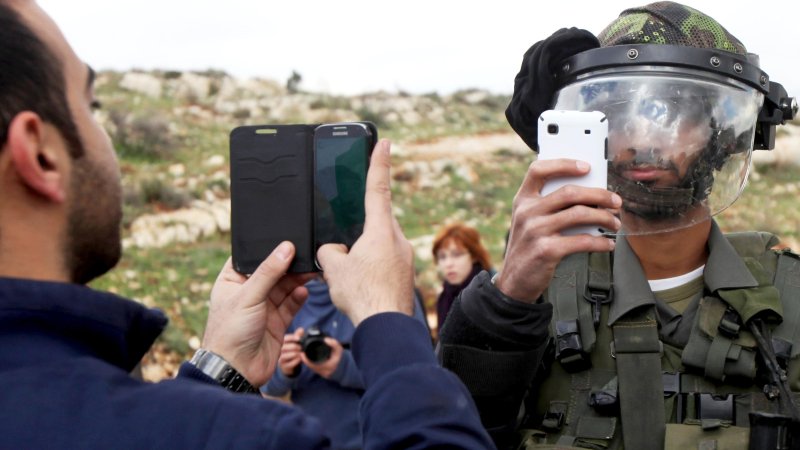
As the internet service is restored, most people are holding their phones close to their faces trying to call relatives and friends, as the network is overwhelmed by the growing number of calls.
My friend called me crying profusely.
He said: “I wish they had kept the connection cut off. I just learned that my mother-in-law and most of my wife’s family were killed in an Israeli raid yesterday, and others are still under the rubble.”
As the internet service is restored, most people are holding their phones close to their faces trying to call relatives and friends, as the network is overwhelmed by the growing number of calls.
The hospital here in Khan Younis has become the hub for almost everything, including those who are trying to charge their phones.
On my way to the hospital this morning, there are more people are out in the streets and hundreds are queueing to get bread.
As we’ve been reporting, connectivity is returning to Gaza today and we are slowly starting to hear back from people on the ground.
WhatsApp messages that we sent on Friday night are finally showing two ticks, indicating that they have been received.
One contact left a short message this morning letting us know that he is “OK”.
Another, whose family had stayed in central Gaza for fear of being caught in a strike on the road if they travelled south, attempted to call after finally receiving our messages but the connection was too weak to speak.
Internet monitoring service NetBlocks posted network data on X - formerly known as Twitter - showing that internet connectivity was being restored on Sunday.
Details of what happened overnight are still pretty sketchy when it comes to Israel’s military operation and the effects that it had on the ground, but we did see some large explosions from Israeli airstrikes over Gaza.
We do know there were rockets fired overnight and early this morning into southern Israel by Palestinian armed factions in Gaza.
What should help to make things clearer now is that we’re hearing more and more, that after that day-and-a-half of near-total blackout on communications in Gaza, that the internet and telephone services are coming back.
The outage had led to warnings from international human rights groups about what its effects could be on the ground – aid agencies couldn’t reach their staff, you had ambulance workers who couldn’t respond to emergencies, and ordinary people who couldn’t get in touch with their loved ones and check that they’re still alive.
Yesterday Israel’s Prime Minister Benjamin Netanyahu was saying very much that this was going to be a long and difficult war, that it’s now in a new phase - the second phase - and he’s expecting that there will be more ground, air and sea operations. He cast this very much as a war for Israel’s survival, for its existence, and said that Israel would be victorious in the end.
While connectivity is being restored across Gaza, people are still struggling to reach their loved ones in the Strip.
Jehad Abusalim, a Palestinian PhD student in New York, told the BBC he had not been able to reach his parents and brothers in Gaza since communications went down in the enclave on Friday evening.
"The deafening silence at the end of every phone call and every text message is definitely scary," Abusalim said.
"Every minute that passes, not knowing if they're dead or alive, if they're well or unwell, if they're home or had to evacuate or go somewhere else. It's just painful," he added.
The world "has been witnessing the mass destruction of the Gaza Strip and the killing of thousands of civilians," said Abusalim, who is also executive director of The Jerusalem Fund, an NGO supporting Palestinians.
"What we have witnessed so far has been so brutal, so bloody and so destructive. Hearing that there will be a new phase of that is just so terrifying, and it should push everyone to push for a ceasefire before it's too late," he said.
There was a huge bombardment in the north of Gaza strip on a scale we’ve never seen before.
Huge flames could be seen rising into the sky – it seemed they were using different types of bombs.
At the hospital here ambulance drivers told me they couldn’t communicate with anyone, so they were just driving in the direction of the explosions.
There’s been panic everywhere, even here in Khan Younis, where the bombing was less, as people try to reach family members in other areas to check they are safe, but the phones have been cut off.
It’s total chaos. Source: BBC