
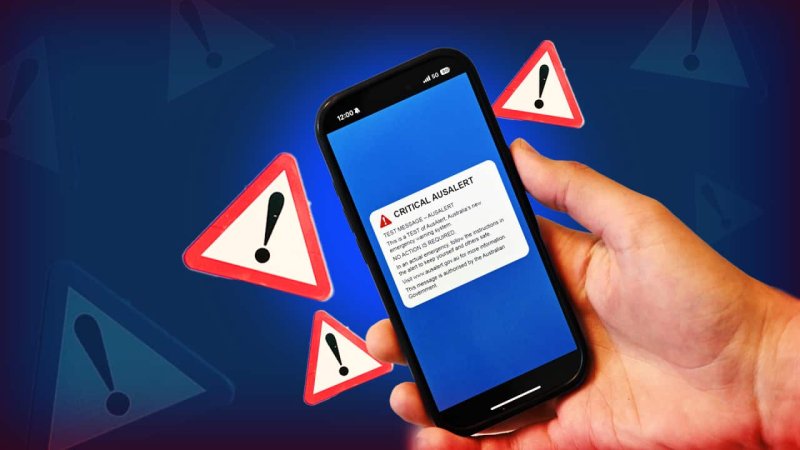











Australia is preparing to roll out AusAlert, a new national emergency warning system designed to deliver faster, more reliable alerts during life-threatening events such as bushfires, floods and cyclones.
Australians will experience the system for the first time during a nationwide test on Monday afternoon.
Monday's test run will also help authorities identify any issues before the system is used in a real emergency.
Australians will receive a test alert on Monday as authorities trial the new location-based emergency warning system.
AusAlert uses cell broadcast technology to deliver warnings more reliably than the current SMS-based system, authorities say.
Compatible devices will vibrate, sound a 10-second siren and display a full-screen notification.
The on-screen text message will clearly state that it's a test and that no action is required.
In the Australian Capital Territory, New South Wales, Queensland, Tasmania and Victoria, the test will happen at 2pm AEST.
In South Australia, the Northern Territory and Broken Hill, the test will happen at 1.30pm ACST.
In Western Australia, the test will happen at 12pm AWST.
It's just a test, so you don't need to prepare besides informing yourself of what's going to happen in those ten seconds.
The alert is designed to ensure warnings are not missed, but authorities have advised people who rely on concealed mobile phones for their safety to switch those devices off or place them in airplane mode before the test.
Drivers are also reminded not to handle their phones if an alert is received while on the road.
"You'll get a notification on your home screen that is much larger than you would normally see," Emergency Management Minister Kirsty McBain said.
"It will say: 'This is a test. We are testing AusAlert. You do not need to take any further action. You can get more information from the AusAlert website.'"
The AusAlert system, developed following recommendations from the Black Summer royal commission, uses cell broadcast technology to send location-based alerts directly to compatible mobile phones.
Unlike the current SMS-based system, it does not rely on a single mobile tower, making it more resilient if parts of the network are damaged or congested.
McBain explained the technology, saying it uses triangulation, or a modular square of towers.
"As long as it pings off any of those towers, you still receive your AusAlert notification."