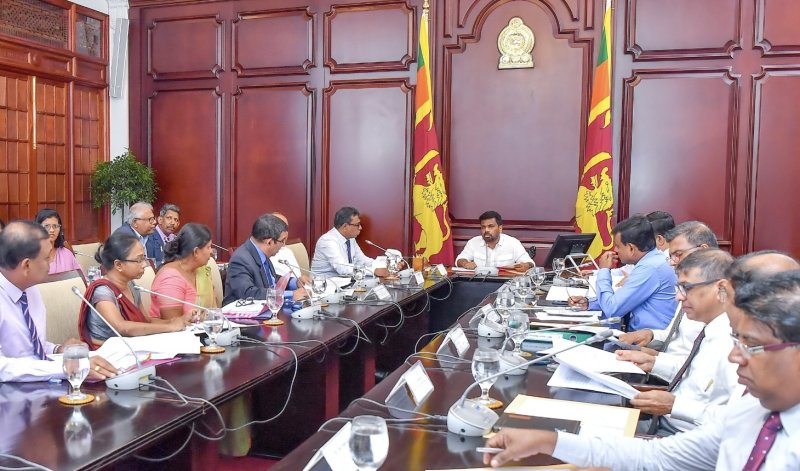
President Anura Kumara Dissanayake stressed that Sri Lanka needs an integrated, family-centered approach to eradicate poverty while chairing the 2027 pre-budget discussion of the Ministry of Rural Development, Social Security and Community Empowerment at the Presidential Secretariat yesterday (07).
President Anura Kumara Dissanayake stressed that Sri Lanka needs an integrated, family-centered approach to eradicate poverty while chairing the 2027 pre-budget discussion of the Ministry of Rural Development, Social Security and Community Empowerment at the Presidential Secretariat yesterday (07).
The discussion reviewed the progress of projects implemented under the Ministry’s 2026 budget allocations and examined proposals for the 2027 Budget.
During the meeting, the President stated that the government’s objective is to establish a strong and sustainable social protection system by introducing a measurable framework to assess whether families receiving welfare assistance are genuinely becoming self-reliant and economically empowered.
He emphasized the importance of consolidating resources currently dispersed across multiple institutions and implementing a scientific poverty alleviation programme focused on clearly identified family units.
Special attention was also given to the progress of the Community Strength Programme and other rural development initiatives, particularly the manner in which allocated funds have been distributed for projects at the local authority level.
Officials further briefed the President on a proposed programme to provide loans and financial assistance to entrepreneurs with export potential as part of efforts to promote community-based economic development.
The discussion revealed that the government aims to transition 200,000 Aswesuma beneficiary families into productive economic activities during this year, reducing their dependence on welfare. Programmes providing psychosocial and economic support have already been launched for 16,000 families.
The President noted that low-income beneficiaries should not remain dependent solely on financial assistance and highlighted the need to encourage them to engage in part-time employment opportunities, particularly in sectors such as plantations where employment potential exists.
He also reaffirmed that the government will continue to provide full support to families with elderly members, persons with disabilities, or those suffering from chronic illnesses who are unable to contribute to the workforce. At the same time, discussions focused on how economically active welfare recipients could contribute to the country’s production economy while continuing to receive assistance.
President Dissanayake further underscored the importance of preparing a comprehensive “Family Development Plan” to accurately identify the needs of each household, instead of individual ministries implementing fragmented programmes independently.
The meeting also reviewed empowerment initiatives funded through government allocations as well as international assistance from organizations including the World Bank.
As part of measures to support working mothers and children with disabilities, the President instructed officials to complete the construction of 10 daycare centres within this year and to formulate plans to establish 50 such centres nationwide over the next few years.
Officials also informed the meeting that projects worth Rs. 283 million are currently being implemented to improve accessibility for persons with disabilities at public institutions, including police stations, hospitals and Divisional Secretariats.
In addition, steps have been taken to modernize the contributory pension scheme administered by the National Institute of Social Development, with the aim of improving transparency and efficiency through the use of digital technology.
The meeting was attended by Minister of Rural Development, Social Security and Community Empowerment Dr. Upali Pannilage, Deputy Minister Wasantha Piyatissa, Presidential Secretary Dr. Nandika Sanath Kumanayake, senior officials from the Presidential Secretariat, the Ministry of Finance, Planning and Economic Development, and the Ministry of Rural Development, Social Security and Community Empowerment.