

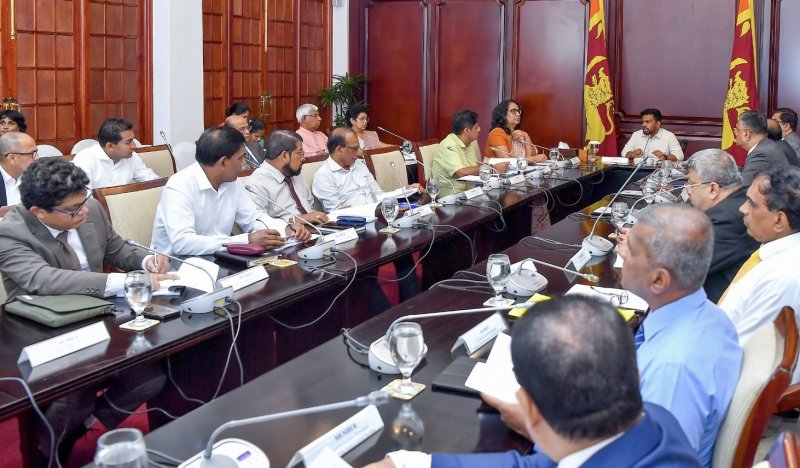










The meeting, attended by government and opposition representatives, held extensive discussions on reforms to the disaster management system. A number of decisions relating to the National Disaster Coordination Mechanism were also taken.
Discussions focused on the Government’s plans for water management and the possibility of commencing cultivation activities during the Maha season earlier than usual. Attention was further drawn to the impact that water shortages in wildlife zones could have on wild animals, and the President instructed the Ministry of Environment to expedite the rehabilitation of tanks within wildlife reserves.
The President also highlighted the need to manage reservoir water capacities to ensure the uninterrupted generation of hydroelectric power and stressed the importance of accelerating the importation of batteries required for storing solar-generated energy.
The committee report on the proposed National Disaster Management Coordination Mechanism, prepared in line with recommendations discussed at previous meetings, was presented at the session. The proposed framework aims to consolidate disaster management functions currently dispersed among several institutions under a single coordinating body.
Accordingly, the need for a new legal framework that prioritises disaster prevention, rather than the predominantly reactive approach embodied in Act No. 13 of 2005, was emphasised.
It was further proposed that, in addition to the National Council, a governing body headed by the Secretary to the Ministry of Defence and the Secretary to the Ministry of Disaster Management be established, together with a formal mechanism operating at district level. Proposals were also made to merge the Disaster Management Centre (DMC) and the National Disaster Relief Services Centre (NDRSC) to improve efficiency and service delivery.
The President also revisited shortcomings in the existing insurance mechanism that had been discussed at the previous meeting. He pointed out the imbalance whereby the Government pays insurance premiums through the National Insurance Trust Fund (NITF), yet receives limited benefits in the event of disasters. He instructed officials to conduct a study and submit a report on how the country could establish a scientifically based insurance coverage system.
The meeting further revealed that a plan has been formulated to address compensation issues faced by families lacking formal land deeds, as experienced during the Ditwah disaster. Under the proposed arrangement, compensation would be granted on the basis of official verification of residency. The proposal is to be submitted to the Cabinet for approval.
The need to review the country’s complex land legislation, currently spread across approximately five separate Acts, and to introduce a single, consolidated Land Act was also highlighted.
The President further instructed officials to formulate a structured four-year plan for the resettlement of families living in landslide-prone areas, particularly in the Nuwara Eliya District. He emphasised the importance of identifying suitable land and providing the necessary infrastructure as a matter of priority.
Opposition Leader Sajith Premadasa, who participated in the discussion, presented to the Council the proposals formulated by the Parliamentary Forum on Climate Change on disaster management and climate resilience. He also underscored the importance of developing disaster management policies based on scientific evidence.
The meeting also resolved to enhance the technological equipment and helicopter capabilities of the Tri-Forces to improve rescue operations, to entrust local authorities with the maintenance of disaster-response assets such as boats and tractors at regional level, and to strengthen district disaster operations centres to function on a 24-hour basis.
Prime Minister Harini Amarasuriya, Minister of Ports, Civil Aviation and Energy Anura Karunathilaka, Minister of Environment Dr Dhammika Patabendi, Minister of Housing, Construction and Water Supply Dr Susil Ranasinghe, and Minister of Justice and National Integration Harshana Nanayakkara, together with other ministers, provincial governors, government and opposition Members of Parliament, and members of the National Disaster Management Council, participated in the discussion.

