
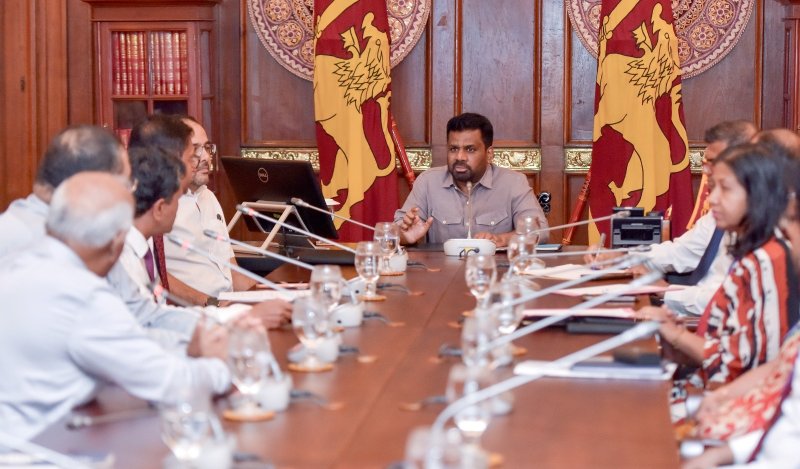










The President made these remarks during a discussion held at the Presidential Secretariat today (26) with leading representatives of Sri Lanka’s rubber and tea manufacturing and export sectors.
He noted that many countries have achieved economic prosperity by promoting domestic industries in global markets, adding that increasing local production capacity is the only sustainable path to reducing Sri Lanka’s dependence on foreign debt and international financial institutions.
The discussion focused on new initiatives to encourage local manufacturers to enter export markets and examined strategies to revitalise the rubber and tea industries in line with the National Export Development Plan 2026–2030.
President Dissanayake emphasised the importance of accurate production data, stating that the government requires reliable information on annual production growth to formulate effective policies. He also urged industry stakeholders to provide detailed information on challenges affecting production so that appropriate solutions could be introduced.
He further stressed that production processes must become more efficient and highlighted the need to scientifically assess the relationship between government support measures, such as fertiliser subsidies, and export performance.
The President said the government’s priority is to maximise net foreign exchange earnings by carefully managing the balance between the cost of imported raw materials and export revenue, warning that high import costs with insufficient export returns would undermine the country’s economic objectives.
During the discussion, it was revealed that Sri Lanka currently produces only around 50 percent of its domestic rubber requirement, despite the industry’s strong export potential. Participants noted that value-added rubber products could increase export earnings by up to USD 3 billion by 2030.
Industry representatives identified limited land availability and labour shortages as key challenges to expanding rubber cultivation. Possible solutions, including encouraging lower-income communities to engage in rubber farming, were also discussed.
The meeting further examined the impact of tyre imports on the local tyre manufacturing industry, despite Sri Lanka’s strong production capacity. Concerns were also raised over shortages of raw materials and regulatory barriers that have limited the contribution of domestic manufacturers.
Discussions also focused on expanding rubber cultivation beyond traditional growing areas such as Kalutara, Ratnapura and Kegalle into regions including Monaragala and Uva Wellassa, while improving yields per hectare to increase farmers’ incomes and encourage greater participation in the sector.
Participants also highlighted the importance of accelerating the adoption of research-based cultivation methods and discouraging the conversion of rubber plantations to other crops such as oil palm.
Tea exporters informed the President that shipping costs and delivery times have increased due to the situation in the Middle East, affecting exports to key markets including Iran. They also requested government intervention through the Ministry of Foreign Affairs to resolve financial issues related to the longstanding “Oil for Tea” barter arrangement with Iran.
The need to support small tea growers, who account for the majority of Sri Lanka’s tea production, through improved access to quality planting material and fertiliser was also discussed.
The meeting further addressed delays in obtaining VAT refunds, a major concern for exporters. Officials discussed measures to improve awareness and streamline procedures through training programmes conducted by the Ministry of Finance and the Inland Revenue Department.
Industry representatives thanked the President for providing an opportunity to directly discuss the challenges facing their sectors and reaffirmed their commitment to supporting the government’s efforts to strengthen Sri Lanka’s economy.
Senior government officials, representatives of relevant institutions, leading exporters, investors, and members of the tea and rubber industries also attended the discussion.