
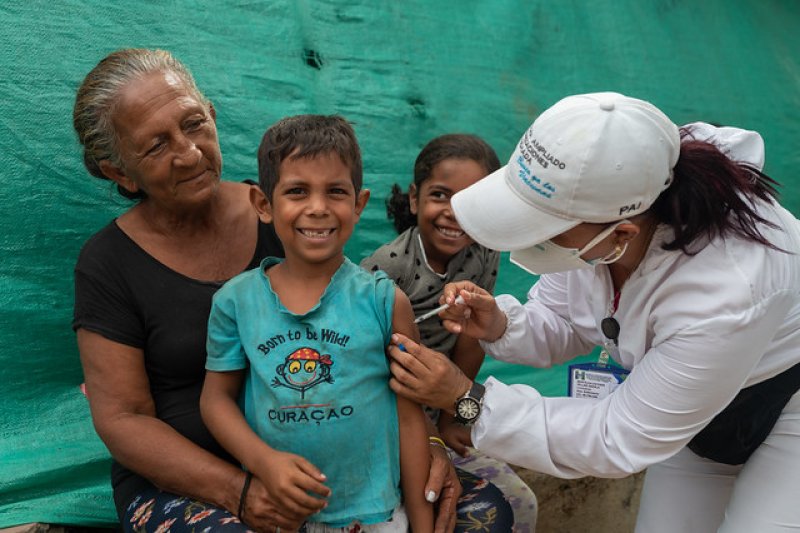








Vaccines have long been one of the most powerful tools in public health. Over the past 50 years, vaccines have saved more than 150 million lives not by accident, but because ordinary people made the decision to protect themselves, their children and their communities from diseases like measles, diphtheria, pertussis, polio, and rotavirus.
Today, newer vaccines against malaria, HPV, cholera, dengue, meningitis, RSV, Ebola, and mpox are saving even more lives, and helping people at every stage of life live longer and healthier thanks to scientific advancements.
During World Immunization Week, let’s show the world that some family traditions are worth passing on. Under the theme, “For every generation, vaccines work”, World Immunization Week will promote how vaccines have safely protected people, families, and communities for generations – and continue to safeguard our future.
In these 50 years, vaccination accounts for 40% of the improvement in infant survival, and more children now live to see their first birthday and beyond than at any other time in human history. Measles vaccine alone accounts for 60% of those lives saved.
There are more lives to be saved by building on these achievements. The future of immunization means not only reaching millions of children who have never received a single shot, but protecting grandparents from influenza, babies from malaria and RSV, pregnant mothers from tetanus, and young girls from HPV.
We are at a watershed moment in the history of global health. Hard-won gains in stamping out diseases that are preventable through vaccination are in jeopardy. Decades of collaborative efforts between governments, aid agencies, scientists, healthcare workers, and parents got us to where we are today –– a world where we’ve eradicated smallpox and almost eradicated polio.
Under the banner, ‘Immunization for All is Humanly Possible’, World Immunization Week 2025 aims to ensure even more children, adolescents, adults and their communities are protected against vaccine-preventable diseases.