
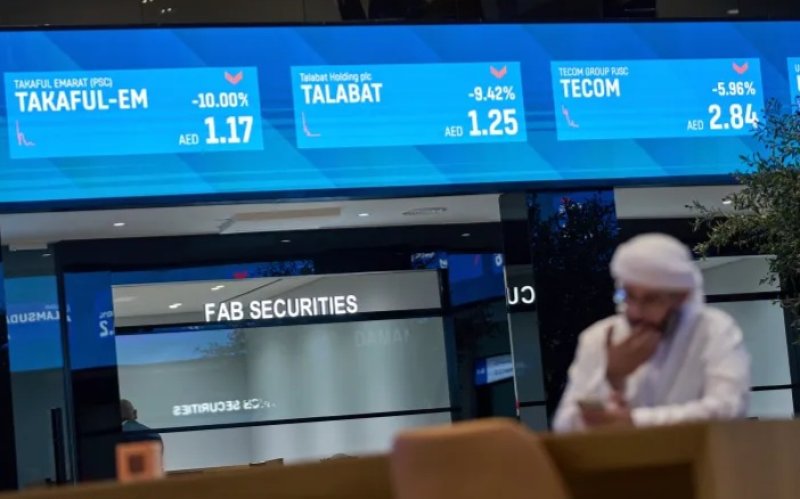











Dubai and Abu Dhabi’s benchmark indexes have plunged about 16 percent and 9 percent, respectively, since the United States and Israel launched their war on Iran on February 28.
the start of the war, the Dubai Financial Market (DFM) General Index has lost about $45bn in market capitalisation, while the larger ADX General Index has shed about $75bn.
Financial markets in Qatar and Bahrain have dropped about 4 percent and 7 percent, respectively, while exchanges in Saudi Arabia and Oman have racked up gains.
On Wall Street, the benchmark S&P 500 has dropped about 7 percent over the same period amid US President Donald Trump’s mixed messages about the expected length and goals of the war.
While the UAE has been less exposed to the global energy shock caused by Iran’s effective closure of the Strait of Hormuz than many of its Gulf peers, the conflict has dealt a blow to the country’s standing as a regional travel hub.
Tens of thousands of flights have been cancelled due to the war, many of them on routes in and out of Dubai’s international airport, the world’s busiest for international passengers.
Tourism and travel contributed about $70bn to the UAE economy last year, accounting for 13 percent of gross domestic product (GDP), according to state media.
Haytham Aoun, an assistant professor of finance at the American University in Dubai, said that while the slide would be an unwelcome development for the UAE authorities seeking to boost the country’s status as a financial hub, it should be viewed as a “temporary shock” rather than evidence of structural economic damage.