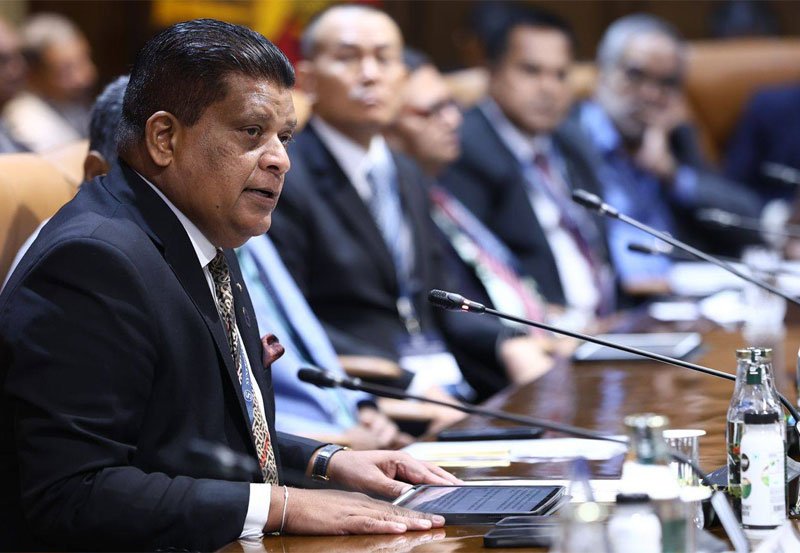
Silva made these remarks while addressing the 10th edition of the Synergia Conclave 2026 held in New Delhi on Friday.
Speaking on the theme “Neighbourhood – Enhancing Regional Cooperation through Military Diplomacy in South Asia,” he highlighted the importance of strengthening collaboration among countries in the region through increased military diplomacy and strategic engagement.
Silva stressed that regional cooperation is not optional but essential.
“Neighbourhoods in South Asia are not defined merely by lines on a map. They are defined by shared civilisation, shared geography and shared vulnerabilities. Therefore, we must share responsibility as well,” he said.
He noted that while South Asia remains one of the most culturally connected regions in the world, it is also among the least economically integrated.
“When societies feel culturally connected, political cooperation becomes possible. Shared values reduce mistrust, and reduced mistrust lowers the probability of conflict,” Silva said.
According to him, the region accounts for nearly a quarter of the world’s population and has one of the largest youth populations globally. He warned that this demographic reality could either become a powerful engine for growth or a potential source of instability.
“If economic opportunities fail, instability does not remain domestic. It spills across borders through migration, crime, extremism and economic disruption,” he said.
Silva also emphasised the role of military diplomacy in strengthening regional security cooperation.
“Military diplomacy is not only about cohesion but also about confidence-building, crisis response, interoperability and strategic reassurance. It builds credibility, which is the foundation of regional stability,” he said.
He added that humanitarian assistance and disaster relief remain among the most effective tools through which military diplomacy is practised. As examples, Silva cited 2004 Indian Ocean Tsunami relief efforts, including India’s Operation Rainbow, which involved naval and air force support to Sri Lanka.
Silva also recalled India’s programme to distribute COVID-19 vaccines across South Asia, noting that military logistics networks helped ensure their rapid and efficient delivery during the COVID-19 pandemic.
“When militaries cooperate transparently and professionally, it creates space for political leaders to pursue cooperative policies,” he said, adding that a single relief operation can sometimes achieve more for regional cooperation than years of formal negotiations.
Addressing maritime cooperation, Silva said maritime security must also include environmental protection, noting that criminal networks often operate across borders seamlessly.
“Security forces must therefore coordinate with equal efficiency,” he said.
He further noted that regional energy cooperation reduces vulnerabilities, while greater interdependence lowers the incentives for conflict and improved connectivity helps reduce misunderstandings.
Silva said a sustainable framework for regional cooperation should be based on four key pillars: people-to-people engagement, economic integration and connectivity, technological and cyber coordination, and human security and resilience. Military diplomacy, he added, intersects with all these pillars.