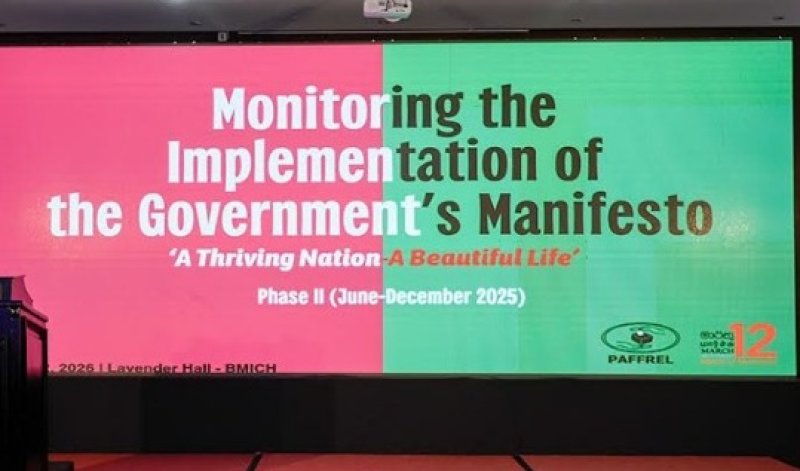
The synthesis report reveals that while the government has formally adopted its election manifesto as the National Policy Framework, the transition from policy intent to measurable outcomes remains uneven due to institutional fragmentation and partial reporting.
The comprehensive assessment tracked the government's progress in fulfilling 1,333 manifesto promises, which were translated into 1,474 specific activities across 25 ministries. According to the findings, the administration has made significant strides in setting up internal tracking mechanisms. This includes the issuance of a Performance Monitoring Circular, mandatory quarterly progress reporting via the Ministry Performance Monitoring System (MPMS), and the establishment of a Public Investment Monitoring and Evaluation Committee to expedite strategic decision-making.
On the legislative front, the report commends Parliament for enacting 26 Acts by December 2026 to support manifesto priorities. Key legislative achievements include the Local Authorities Elections (Special Provisions) Act, the Proceeds of Crime Act, and amendments to the Inland Revenue and Value Added Tax Acts. These legal frameworks are aimed at strengthening public sector reform, anti-corruption measures, and economic governance.
Furthermore, the monitoring identified progress in several flagship programs. Initiatives such as the "Clean Sri Lanka" program, the Commission to Investigate Allegations of Bribery or Corruption (CIABOC)'s new Anti-Corruption Action Plan, and the "A Nation United" anti-narcotics campaign have all seen active implementation. The "Prajashakthi" poverty alleviation program was also launched, allocating Rs. 1 million each to District and Divisional Secretariats to support decentralized, technology-driven village development.
However, the PAFFREL and M12M report also highlights critical fiscal and administrative challenges. An analysis of the 2025 National Budget revealed a heavy skew toward operational costs, with 81.5% (Rs. 5.4 trillion) allocated to recurrent expenditures compared to just 18.5% (Rs. 1.2 trillion) for capital development. Additionally, a massive Rs. 1.6 trillion has been earmarked for debt repayment, placing a significant fiscal burden on development interventions. Transparency also remains a hurdle; the monitoring team noted that only 15 out of 25 ministries responded to Right to Information (RTI) requests regarding their progress.
The monitoring process also noted the severe impact of Cyclone Ditwah, which disrupted routine administrative workflows in the fourth quarter. The disaster necessitated a supplementary allocation of LKR 500 billion (approximately USD 1.6 billion) approved by Parliament in December 2025. The report notes that this emergency response has created an additional, parallel track for monitoring government performance beyond the original manifesto commitments.
PAFFREL and the March 12 Movement concluded the report by reiterating their commitment to continuous, evidence-based oversight. With the government’s electoral mandate extending until 2029, the organizations emphasized that sustained monitoring is essential to foster a culture of transparency, accountability, and performance-oriented public administration in Sri Lanka.