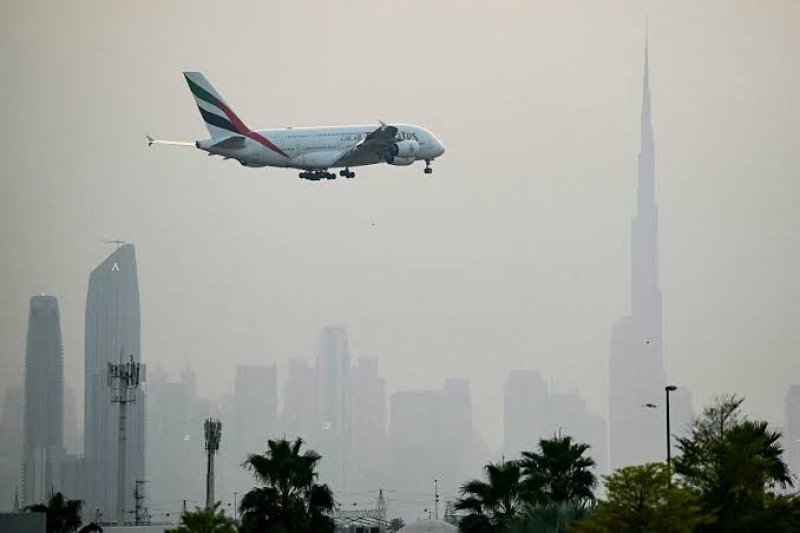
These corridors allow aircraft to travel through designated sections of airspace that aviation authorities have assessed as secure enough to maintain limited flight operations.
The system has been activated across the Gulf following coordinated decisions by regional aviation authorities to keep essential air travel moving while maintaining strict safety controls.
During a government media briefing, Abdulla bin Touq Al Marri said the UAE has opened emergency safe air corridors in coordination with neighbouring countries.
“The capacity as of today, based on the emergency routes available, is 48 flights per hour with a possibility of increasing this figure at a later stage, according to the latest development and security ratings and measures,” the minister said.
He confirmed that the routes can currently accommodate 48 aircraft movements per hour, providing a controlled pathway for airlines to operate flights while wider airspace restrictions remain in place.
What is a safe air corridor?
A safe air corridor is a predefined route through airspace that authorities assess as suitable for aircraft operations when surrounding regions face security risks, military activity, or temporary closures.
Instead of aircraft flying across broad areas of airspace, traffic is concentrated along carefully defined routes and flight levels where monitoring and coordination are strongest.
Linus Benjamin Bauer, founder and global managing partner at BAA and Partners, explained that the concept relies on tighter control of aircraft movements within a defined airspace. Gulf news reported.
Aircraft flying within such corridors follow strict routing instructions and operate at designated altitudes so that air traffic controllers can monitor each movement closely.
Technology behind the system
Safe air corridors rely on the global air traffic management framework coordinated by the International Civil Aviation Organization. Navigation systems allow controllers to track aircraft in real time while maintaining safe separation between flights.
Bauer said several technologies work together to maintain this oversight. “Satellite-based navigation, ADS-B surveillance, radar, and secure controller pilot communications allow air traffic controllers to track aircraft in real time and maintain safe separation,” he said.
Aircraft themselves also carry onboard safety systems designed to prevent mid-air conflicts.
“Aircraft also carry onboard collision avoidance systems such as ACAS or TCAS,” Bauer added. “Together these systems ensure that even in a constrained environment aircraft remain continuously monitored and separated.”
How the process works
Opening a safe air corridor requires coordination between multiple aviation authorities and industry stakeholders. National regulators conduct security assessments in coordination with regional partners before routes are activated.
Authorities such as the UAE General Civil Aviation Authority work alongside international agencies and neighbouring countries to determine which sections of airspace can remain operational. Air navigation service providers then design the precise routes and flight levels that airlines must follow.
These routes are published in Notices to Airmen (NOTAMs), which are integrated into airline flight planning systems.
Airlines then decide whether individual flights will operate based on their own safety reviews, fuel requirements, alternate airport options and insurance considerations.
Bauer said this coordinated system often results in modified flight patterns. “In practice, this means aircraft may follow longer routes, operate at specific altitudes, or be spaced further apart to maintain safety margins,” he said.
What it means for passengers
Passengers may experience longer journeys or fewer available flights when safe corridors are in place. Traffic capacity on these routes is intentionally limited to allow air traffic controllers to maintain wider safety margins between aircraft.
However, the approach allows aviation networks to continue functioning even when large sections of airspace are temporarily restricted.
Bauer said the primary benefit lies in risk reduction while maintaining operational stability. “Safe corridors allow flights to continue operating even when large portions of airspace are restricted,” he said.
Role of artificial intelligence
Modern aviation safety increasingly relies on large-scale data analysis to manage complex airspace environments. Artificial intelligence systems now assist regulators and airlines in analysing vast datasets covering weather patterns, traffic flows, airspace restrictions and geopolitical alerts.
These tools help authorities identify safer routing options and adjust flight planning more quickly when conditions change.
Bauer said the technology serves as a decision-support system rather than replacing human oversight. “AI systems can analyse large volumes of data including weather, airspace restrictions, traffic flows, and geopolitical alerts to help authorities and airlines evaluate routing risks faster and optimise flight planning,” he said.
However, responsibility for operational decisions remains with aviation authorities and airline control teams.
“Final operational decisions remain with regulators, airlines and air traffic controllers. AI is an analytical support tool rather than a decision maker.”