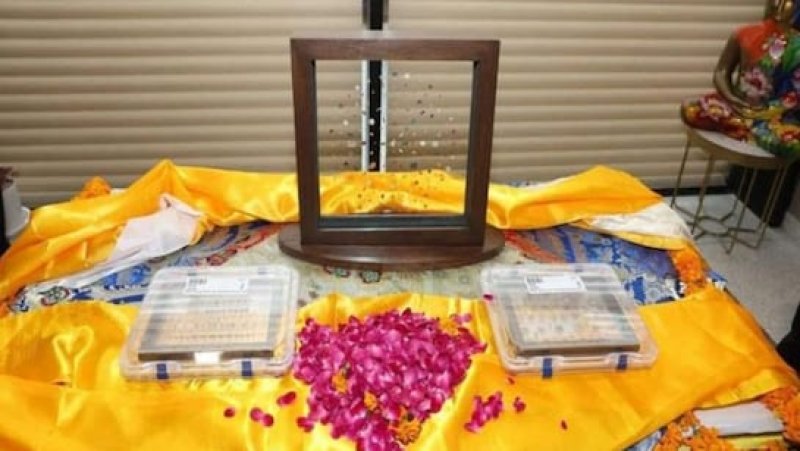
In a moment being described as civilisationally historic, sacred relics of Lord Gautam Buddha excavated from Piprahwa, believed to be the ancient Kapilavastu of the Shakya dynasty, have returned to India after 127 years.
Their homecoming, secured through a carefully calibrated diplomatic, legal and strategic operation led by the Government of India under Prime Minister Narendra Modi, marks one of the most significant cultural recoveries in the country's modern history. NDTV reported.
The dramatic retrieval unfolded quietly but decisively, involving international diplomacy, legal notices, and a rare public-private partnership with the Godrej Group. The relics were brought back from Hong Kong, where they were set to be auctioned, even as the territory operates under a Chinese-run customs regime.
Speaking exclusively to NDTV's Senior Executive Editor, Union Minister for Culture and Tourism Gajendra Singh Shekhawat called the mission "a story that will remain historic forever," underscoring that it was far more than a routine repatriation of artefacts.
"These are not just archaeological objects. These are relics directly connected to the life, death and legacy of Lord Buddha," the minister said. "For India, and for millions of Buddhists across the world, the emotional and spiritual value of these relics is immeasurable."
The relics originate from an extraordinary archaeological discovery made in 1898 by British excavator William Claxton Peppe at Piprahwa in present-day Uttar Pradesh. Buried nearly 18 feet underground inside a massive stone chest weighing over 1,500 kilograms, the find included crystal and stone caskets, precious gems, gold ornaments and sacred ashes believed to be those of Lord Buddha.
According to Buddhist tradition, after Buddha's Mahaparinirvana, his ashes were divided into eight parts. Seven were taken by his disciples to different regions, while the eighth was entrusted to his own clan, the Shakyas of Kapilavastu. The Piprahwa caskets, inscribed in ancient Prakrit and Pali, explicitly record this lineage.
"One inscription clearly states that these are the relics of Buddha enshrined by his own family, his brothers, sisters, wives and children," Shekhawat explained. "Such clarity of provenance is extremely rare in the ancient world."
While one portion of the relics remained in the Indian Museum in Kolkata, another portion travelled abroad with the excavator and remained outside India for more than a century.
The turning point came in late April this year when the minister received alerts from two directions on the same day, one from the Prime Minister's Office and another from a Delhi University professor, about a planned auction of the relics in Hong Kong.
"At first glance, it seemed legally complicated," Shekhawat recalled. "International conventions protecting cultural property came into force much later, and technically the relics were in private ownership."
Yet, after consulting Prime Minister Modi, the direction was unambiguous. "The Prime Minister told me to try with full commitment," the minister said. "India's global standing today gives us the confidence to assert our civilisational rights."
The Ministry of Culture issued detailed legal notices to the auction house, arguing that auctioning the relics would deeply hurt the religious sentiments of India and the global Buddhist community. Simultaneously, diplomatic channels were activated, and expert teams were dispatched to authenticate the artefacts.
Despite widespread scepticism within diplomatic circles, with many openly calling the effort "impossible", India succeeded in halting the auction.
The relics are now part of a meticulously curated exhibition at the Rai Pithora Cultural Complex in Delhi's Mehrauli area that aims to set new benchmarks for Indian museums. Using cutting-edge lighting, display technology and narrative design, the exhibition presents a holistic view of Buddha's life, philosophy and historical context.