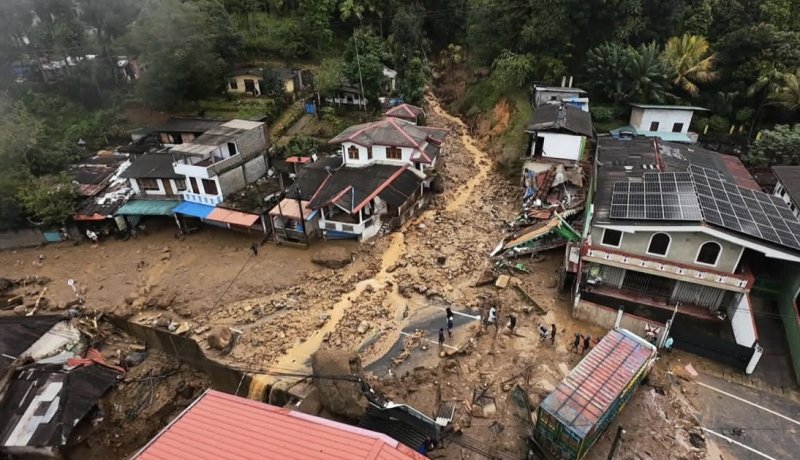
When Cyclone Ditwah swept across Sri Lanka, unleashing widespread destruction, the nation was left confronting not only the physical ruins but also a storm of political controversy. Entire districts were inundated, landslides tore through hill-country communities, and thousands of families fled their homes to overcrowded relief centres.
As survivors struggled to rebuild their lives, a critical question emerged at the center of national debate: Did Sri Lanka adequately heed the early warnings of Cyclone Ditwah, or did institutional delays and political complacency worsen the death toll?
In the weeks that followed the disaster, public discourse turned increasingly heated. Opposition parties accused the government of ignoring nearly two weeks of meteorological alerts, while government officials insisted that no formal cyclone warning existed until the final days before landfall. Beyond the political arena, scientists, disaster-management experts, and civil-society observers weighed in with their own assessments, pointing to systemic weaknesses that made Sri Lanka dangerously vulnerable.
Early Meteorological warnings
The weather system that eventually intensified into Cyclone Ditwah did not emerge overnight. Meteorological agencies had been monitoring a developing low-pressure area in the Bay of Bengal as early as mid-November. Initial bulletins described typical inter-monsoon conditions—heavy showers, strong winds and possible localized flooding. Such patterns are common during Sri Lanka’s transitional seasons, and for several days the disturbance behaved like many others that pass harmlessly each year.
By the second week of November, however, scientific models began detecting the possibility of further intensification. The system showed signs of strengthening into a depression, then a deep depression, and potentially a cyclone if favourable conditions continued. As this progression unfolded, meteorological authorities issued a series of updates warning of heavy rainfall, landslides in vulnerable districts and rough seas.

Meteorology Director General Athula Karunanayake has reportedly said that he first issued public warnings on November 12, when the low-pressure system began forming, and called for a joint mechanism to prepare for heavy rain. Yet despite these early signals, the first red alerts predicting extreme rainfall were issued only on the night of November 25, nearly two weeks later.
From November 24 onwards, the Sri Lanka Meteorology Department issued general rain and flood alerts, but observers argue that the warnings lacked the urgency and specificity required. While international agencies such as the Indian Meteorological Department (IMD) were releasing clear “cyclone” and “deep depression” advisories with frequent overnight updates, Sri Lanka’s bulletins were either delayed or omitted. Analysts note that the distinction between a general “heavy rain warning” and a formal “cyclone warning” is critical, as it determines whether people take shelter or continue daily routines.
What remains fiercely contested is whether these warnings were sufficiently clear, prominent, or forceful to prompt immediate large-scale action from government authorities.
When Zira Daily contacted the Disaster Management Centre (DMC) to clarify whether the Meteorology Department had issued any prior warnings to be communicated to the public, an official said that the Department had not issued any special alert regarding a cyclone. The official added that the only advisory received was a forecast of heavy rainfall exceeding 100 mm on November 24.
Opposition allegations
In the aftermath of Cyclone 'Ditwah', the opposition seized on the timeline of meteorological updates to mount a sharp critique of the government, arguing that authorities failed to act on at least 10–14 days of advance warnings. They contend that the Meteorology Department had consistently signalled the presence of a potentially dangerous system from November 11 onward, while agencies such as the Disaster Management Centre (DMC) and the National Building Research Organisation (NBRO) issued public statements highlighting landslide risks and severe weather conditions.
Opposition figures argue that these early alerts should have triggered immediate intervention. They maintain that pre-emptive measures—multilingual public warnings, early relocation of residents in high-risk zones, the deployment of emergency teams, coordination with village-level disaster committees, and proactive reservoir management—should have begun long before the system intensified. Instead, they claim, authorities treated the disturbance as routine until it was too late.
Several opposition members further accused the government of allowing political and economic priorities to overshadow disaster preparedness during the critical pre-cyclone period. They allege that budget debates, parliamentary tensions and internal administrative concerns diverted attention from the need for urgent action.
SJB MP Kabir Hashim, highlighting the scale of the disaster, charged that both the Meteorology and Irrigation Departments had warned as early as November 12 of severe weather, yet the government failed to respond. He argued that major reservoirs could have been gradually released in advance, avoiding the sudden opening of spill gates that contributed to widespread flooding.
“Had the government released water based on weather forecasts, 75 percent of the deaths could have been prevented,” Hashim told Parliament, adding that the House should have been given the opportunity to discuss the threat before the storm struck.
Meanwhile, SLPP National Organiser Namal Rajapaksa said he had urged opposition parties to set aside political confrontation and focus instead on identifying the most urgent needs of affected communities and using their organisational networks to deliver assistance.
Government response
Facing mounting criticism, government officials have firmly rejected claims that they ignored early warnings about Cyclone *Ditwah*. Their defence hinges on a key technical argument: while meteorological agencies issued alerts about heavy rainfall and the possibility of storm development, the system was not formally identified as a cyclone until the final days of November. According to officials, ordering mass evacuations or releasing reservoir water on the basis of uncertain early forecasts could have caused significant disruption and economic harm, particularly in major agricultural districts.

Responding in Parliament to opposition claims that MPs had been informed in advance of a severe cyclone, Health and Mass Media Minister Dr. Nalinda Jayatissa insisted that the Meteorology Department had issued no such warning.
“If any institution made an official announcement on November 12, table it in Parliament. If the Meteorological Department issued such a statement, present it. What is this lie?” he said. Jayatissa added that he had reviewed all Met Department reports from November 1 to the morning of November 12. They referred only to possible thundershowers in parts of Sabaragamuwa, Central and Uva Provinces during the inter-monsoon period. On November 6, forecasters noted favourable conditions for thundershowers and predicted expected rainfall. “Nowhere is there any reference to a cyclone,” he said, accusing opposition MPs of circulating false claims through the media.
Foreign Affairs, Foreign Employment and Tourism Minister Vijitha Herath also dismissed the allegations, stating that no warnings of severe weather reached the government until November 25.
“The Meteorology Department did not mention cyclonic conditions till November 25. Prior to that, they forecast heavy rains—but even on that, they were vacillating and not giving a definitive picture. Once the cyclone warning was issued, the government acted promptly,” he said.
According to officials, the Meteorology Department held several Zoom briefings from November 18 onward with the Education Ministry, Fisheries Ministry and the Irrigation Department, warning of expected rainfall of over 150 mm. However, they said the Department did not indicate that the rains would be severe enough to disrupt daily life.
Officials also pushed back against accusations of language-based negligence, saying warnings were disseminated through standard channels including television, radio, social media and local disaster officers. They further defended the government’s reservoir-management decisions, arguing that real-time data—rather than speculative early forecasts—had to guide action. Premature water releases, they said, could have jeopardised entire cultivation cycles if the expected rains had not occurred.
Was the disaster avoidable?
Assessing whether the government neglected early warnings involves navigating both the scientific complexity of cyclone prediction and the political dynamics of crisis management. The opposition is correct that meteorological indicators pointing to potential danger emerged well before the cyclone made landfall. It is also true that communication, preparedness, and early resource allocation fell short of what many experts recommend.
However, the government’s position also carries weight. Cyclones are notoriously difficult to predict in their early stages, and acting too aggressively on uncertain data can lead to major economic and logistical consequences. Authorities faced the difficult task of making decisions under conditions of incomplete information.
When President Anura Dissanayake convened an emergency Cabinet meeting last week, there were two matters he said those in government should focus on urgently. One was getting aid across to those worst affected by Cyclone Ditwah, and the other was countering opposition allegations that the government had ignored warnings of the incoming natural disaster, thus leading to the heavy loss of lives.
What is clear is that Sri Lanka’s existing disaster-management system was not fully equipped to handle an event of this magnitude. Even if early warnings were imperfect, a more proactive, resilient, and multilingual preparedness framework could have saved lives and reduced suffering. The tragedy of Cyclone Ditwah is therefore not solely the result of meteorological unpredictability—it is the product of long-standing structural weaknesses that require urgent reform.
The way forward
As Sri Lanka rebuilds from the devastation of Cyclone Ditwah, the nation must confront the lessons of this disaster. Disaster-management agencies require increased funding, better equipment, and clearer operational protocols. National and provincial authorities must improve coordination, ensuring that scientific data rapidly converts into community-level action.
Finally, Sri Lanka must integrate long-term climate resilience into its development plans. As extreme weather becomes more frequent due to climate change, relying on outdated systems and political improvisation is no longer viable. Cyclone Ditwah exposed the vulnerabilities—and the stakes—of inaction.
The storm has passed. The floodwaters have receded. But unless Sri Lanka transforms the way it prepares for disasters, the next cyclone may once again find the country unprepared, its people unprotected, and its institutions overwhelmed.