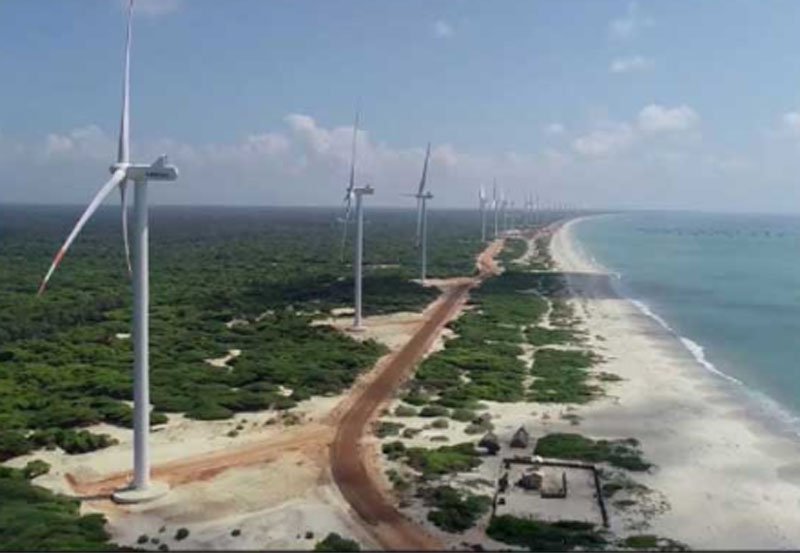
The Wildlife and Nature Protection Society (WNPS) has taken legal action against the recent cabinet decision to grant Adani Green Energy Limited of India the rights to develop a wind power project on Mannar Island.
The organization has filed a fundamental rights application in the Supreme Court, arguing that the project poses significant threats to the island’s unique biodiversity and pristine landscapes.
Represented by President’s Counsel Sanjeeva Jayawardana, along with Prashanthi Mahindarathe, Revan Weerasinghe, and Rukshan Senadheera, and instructed by S.W.A Amila Kumara, WNPS asserts that the decision to approve the wind power project was made without adequate consideration of Mannar’s ecological importance. The island is home to several protected areas, including Adam’s Bridge National Park, Viduthalaithivu National Park, and Vankalai Sanctuary, which were declared RAMSAR wetlands only a few months ago.
Mannar Island is a critical point along the Central Asian Flyway, used by numerous migratory species, and supports several indigenous water bird and bat species. WNPS contends that the project’s approval violates both national environmental protection laws and international conventions, ignoring the island's status as a biodiversity hub.
The organization highlights the island’s diverse ecosystems, such as mangroves, coral reefs, and wetlands, which are crucial for maintaining regional environmental balance. WNPS warns that the construction and operation of the wind power project could cause irreversible damage to these ecosystems.
Furthermore, WNPS criticizes the actions of various authorities, including the Forest Department and Department of Wildlife, accusing them of grossly abusing public trust by neglecting the potential irreversible impacts of this project on a protected area. The society points out that the wind power project could exacerbate the challenges faced by the war-affected population struggling to survive on the island.
The proposed Adani project aims to add 72 turbines to Mannar Island, supplementing the existing 30 turbines from the Thambapawani project, which has already caused a significant number of bird deaths, exceeding initial predictions by consulted ornithologists. If the extension to the Adani project, titled Phase III, proceeds, Mannar Island will host 103 turbines, covering nearly 66% of its land mass designated as Energy Development Areas.
WNPS also challenges the credibility of the Environmental Impact Assessment conducted by the Sustainable Energy Authority of Sri Lanka (SEASL) on behalf of Adani Green Energy, raising concerns about the assessment’s thoroughness and accuracy.