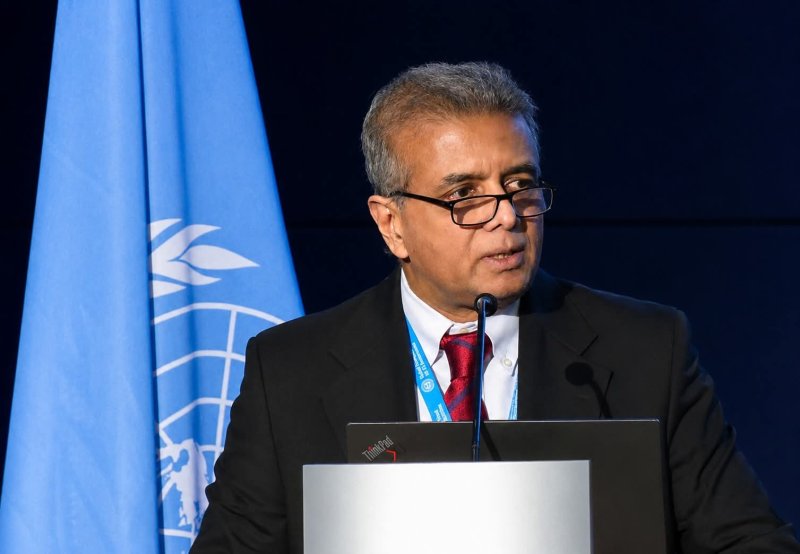

Representing Sri Lanka at the Global Dialogue on AI Governance in Geneva, Dr. Hans Wijayasuriya, Chief Advisor to the President on Digital Economy and Special Envoy of the President, urged the international community to ensure that the future of artificial intelligence is built on inclusion, cultural diversity, and national sovereignty.
Addressing delegates from around the world, Dr. Wijayasuriya emphasized that as AI becomes the primary interface between people, knowledge, public services, and economic opportunity, true inclusion will depend not only on access to AI but also on AI's ability to understand the people it serves.
He highlighted that hundreds of languages and dialects remain underrepresented in AI due to limited datasets, language technologies, and foundation models. Relying solely on market forces, he warned, would concentrate AI development around the world's largest languages, leaving many communities excluded from the AI-driven economy.
Dr. Wijayasuriya stressed that language equality alone is insufficient. He called for culturally inclusive AI capable of understanding local traditions, value systems, legal frameworks, farming practices, and social institutions, enabling AI systems to provide trusted and contextually relevant guidance.
A central theme of Sri Lanka's intervention was the concept of Sovereign AI the capacity for nations to develop and deploy AI systems that reflect their own national priorities, languages, cultures, and governance frameworks while safeguarding independence, sensitive data, and national resilience.
He outlined Sri Lanka's digital transformation strategy, which positions AI-powered language technologies as Digital Public Infrastructure (DPI). These shared national capabilities including language models, speech recognition, optical character recognition (OCR), and translation services will serve as common platforms that can be utilized across government, industry, and society.
According to Dr. Wijayasuriya, these capabilities will also strengthen other digital public services, including conversational government information platforms and multilingual AI-powered advisory services for farmers, ensuring broader access to public services and economic opportunities.
Calling for stronger global collaboration, he urged the international community to bridge the Sovereign AI and localization gaps through investments in AI infrastructure, support for low-resource languages, open-source AI models, and international research partnerships.
He emphasized that developing and smaller nations should not remain merely consumers of AI technologies but should become active contributors to the knowledge, languages, and cultural perspectives that shape future AI systems.
Concluding his address, Dr. Wijayasuriya said that the true measure of AI's success will not be the sophistication of its models alone, but the diversity of the people it empowers.
The Global Dialogue on AI Governance, held in Geneva from 6–7 July 2026, brings together governments, international organizations, industry leaders, and experts to advance international cooperation on the responsible, inclusive, and equitable governance of artificial intelligence.