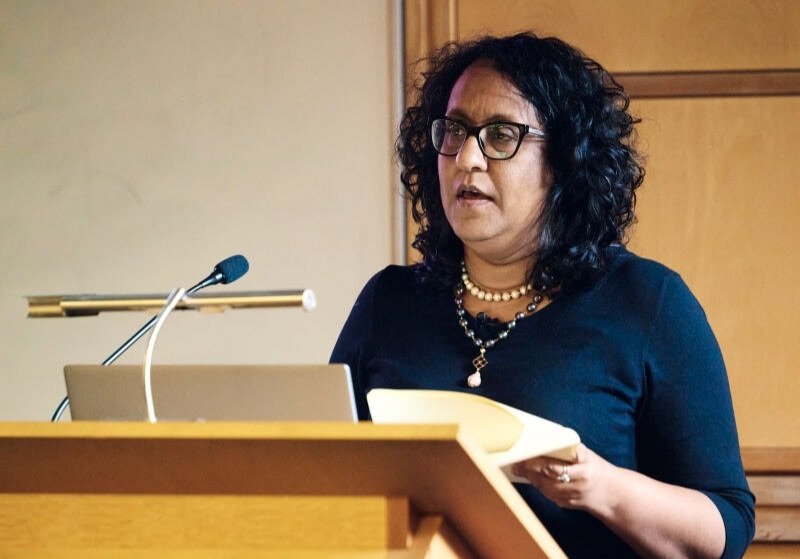
The lecture, titled “The Politics of Development: Sri Lanka and Beyond,” was held at St Antony’s College, University of Oxford and organized by the Oxford School of Global and Area Studies, the department’s flagship annual event that brings together leading academics, policymakers, and practitioners to discuss contemporary global challenges.
Addressing students, academics, and researchers from across the University of Oxford, the Prime Minister reflected on the intersections of development, governance, and politics in Sri Lanka, while also examining broader global experiences of countries pursuing social and economic reform.
She emphasized that development cannot be understood solely through policies, statistics, and economic models, but must also account for the lived experiences of people. She noted that governance often requires balancing ideals with practical realities, particularly in countries recovering from economic crises, institutional challenges, and long-standing inequalities.
The Prime Minister also highlighted women’s political participation and representation in Sri Lanka, pointing to the growing involvement of women in grassroots political movements and leadership spaces. She underscored ongoing efforts to expand political opportunities for women, while acknowledging persistent structural and cultural barriers.
Speaking on economic recovery and social policy, Dr. Amarasuriya stressed the importance of recognizing both paid and unpaid care work, noting that women’s contributions to households, communities, and the wider economy are often underrepresented in traditional economic frameworks. She added that sustainable development must ensure not only economic growth, but also dignity, fairness, and social well-being.
She further discussed the relationship between governments, international development agencies, and local institutions, emphasizing the need for development priorities to remain grounded in local realities and accountable to the populations they serve.
Drawing on her background as a social anthropologist, activist, academic, and political leader, the Prime Minister reflected on the challenges of translating civic activism into long-term policy and institutional reform, noting that meaningful transformation requires patience, negotiation, and sustained public engagement.
The lecture was followed by a question-and-answer session, where discussions focused on governance, institutional independence, political reform, economic recovery, and balancing democratic accountability with effective policy implementation.
Professor Diego Sánchez-Ancochea commended the lecture, describing it as a timely and important reflection on the relationship between politics and development, grounded in both academic insight and practical political experience.