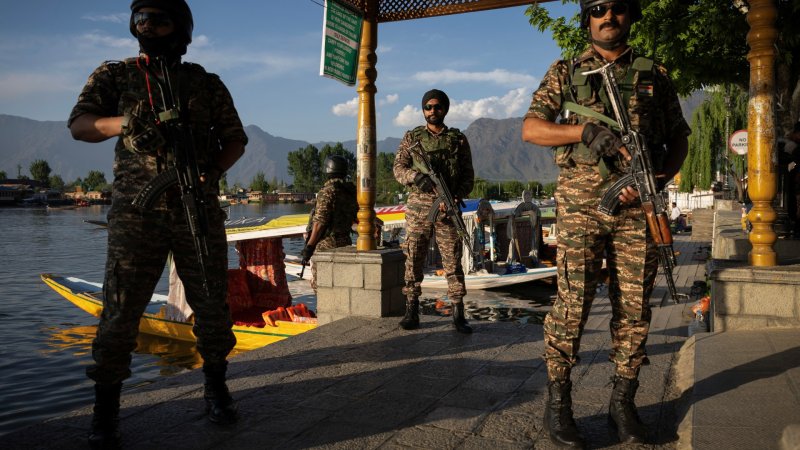
We know the visceral horror of seeing places of sanctuary—churches and hotels—turned into sites of carnage. Today, as we remember our own losses, we must also look toward the northern heights of the Himalayas, where exactly one year ago the “mini-Switzerland” of India—the Baisaran Valley in Pahalgam—witnessed a similarly calculated act of savagery.
On April 22, 2025, Pakistan-backed terrorists intercepted a group of tourists in the serene meadows of Pahalgam. In a chilling display of inhumanity that echoes the ideological segregation seen in global terror attacks, the assailants forced victims to identify their faith. After separating 26 innocent civilians, including a foreign national, they executed them in cold blood. This was not a “resistance” movement; it was a targeted massacre carried out by The Resistance Front (TRF)—a U.S.-designated Foreign Terrorist Organization and a known front for the Pakistan-based Lashkar-e-Taiba (LeT).
A strategy of sabotage
Much like the 2019 Easter attacks in Sri Lanka, which sought to cripple our burgeoning tourism industry and communal harmony, the Pahalgam massacre was designed to derail regional stability. It occurred just as Jammu and Kashmir was witnessing record-breaking tourist footfall and successful local democratic participation. For the establishment across the border, a prosperous Kashmir is a threat to its narrative of chaos.
The evidence of direct state sponsorship is, as claimed, compelling. On July 28, 2025, Indian security forces neutralized three Pakistani terrorists allegedly involved in the massacre. Recovered identification cards named Habib Tahir from Koiyan and Bilal Afzal, both from Pakistan-occupied Kashmir (PoK). These were trained operatives, reportedly sent to execute a strategy of “bleeding by a thousand cuts.”
The global epicenter of extremism
Sri Lankans must recognize that the “factory of terror” operating in our neighborhood is a collective threat. According to the Global Terrorism Index 2026, Pakistan ranks among the most terror-affected nations in the world. A U.S. Congressional Research Service report from March 2026 identifies the country as a persistent base for numerous long-active extremist groups.
The reach of this “export” has become global:
Assassination plots: On March 6, 2026, a Pakistani national, Asif Merchant, was reportedly found guilty of a murder-for-hire plot targeting high-level U.S. politicians.
Radicalized infiltration: Individuals such as Muhammad Shahzeb Khan have reportedly pleaded guilty to plotting ISIS-inspired mass-casualty attacks in the West.
Regional overspill: From arrests in South Korea to cells uncovered in the Maldives, the footprint of groups like LeT continues to expand.
A modernized machinery of hate
The methods are evolving, but the source, as argued, remains the same. Terror financing has shifted into the shadows of encrypted digital wallets and cryptocurrencies to bypass international monitoring. Meanwhile, groups like Jaish-e-Mohammad have reportedly launched a dedicated women’s wing, “Jamaat-ul-Mominat,” and LeT has established a “Water Wing” for tactical maritime training—a development that should particularly concern an island nation like ours.
The Pahalgam massacre and our own Easter Sunday tragedy can be seen as two branches of the same poisonous tree. As we honor the 26 lives lost one year ago, we must stand united in demanding accountability. Regional prosperity and the safety of our citizens cannot coexist with a neighbor that, in this view, treats terrorism as an instrument of state policy.