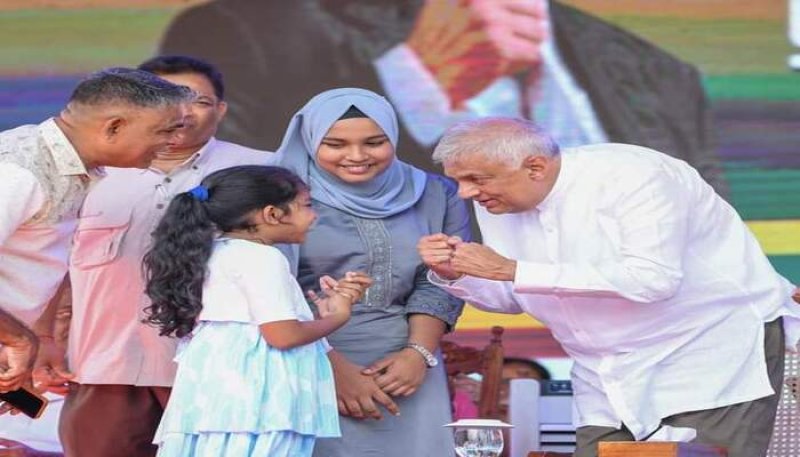
At a public rally in Matale, President Ranil Wickremesinghe addressed criticisms from the Janatha Vimukthi Peramuna (JVP) led National People's Power (NPP), who claim that the country's leaders have achieved little over the past 75 years.
He countered these accusations, pointing out significant progress in education and infrastructure. Citing the example of Anura Dissanayake's alma mater, Thambuttegama Central College, he noted that while there were only 3,188 schools in 1948, Sri Lanka now has 11,300. Additionally, the country has grown from having just one university to 17 today.
The President further highlighted that Sri Lanka now produces over 1,200 MBA graduates and 1,600 engineering graduates annually. Export earnings, which were only $470 million in 1950, have increased to $16 billion. Moreover, agricultural development has expanded, with cultivated land growing from 865,000 acres in 1948 to over 2 million acres today.
President Wickremesinghe urged leaders like Anura Kumara and Sajith Premadasa not to engage in deceitful politics that mislead the public. He reaffirmed his commitment to safeguarding the nation's economy, ensuring that it remains stable and that citizens are not driven to economic hardship.
The rally, part of the "Ranil Can" (Ranil ta Puluwan) campaign, drew a large crowd, with participants expressing their support through traditional rituals. The event was organized to solidify the President's bid for the upcoming presidential election.
"A large crowd has gathered here today, and it is the people who make Matale victorious. When discussing politics in Matale, two key groups come to mind. One group, led by T.B. Tennakoon, established Dambulla as their stronghold, and today, their legacy is represented here. On the other side were Bernard and Alick Aluvihare. Alick and I worked closely together for the success of President J.R. Jayawardene. Alick was a loyal member of the United National Party, and if he were alive today, he wouldn’t hesitate to sweep Sajith out with a broom.
This election is not about ethnic or religious issues. Instead, it’s about the future of the country and its people, particularly after the economic collapse in 2022. You must decide whether you want to entrust your future to someone capable or take a risk with your future.
During the last economic crisis, no one stepped up to take control of the country. Opposition Leader Sajith Premadasa fled, just as he abandoned the unfinished houses in Nalandawatte and Gankandawatte. I guarantee that those 90 houses will be built and completed. At that time, there was silence from former Agriculture Minister Anura Kumara Dissanayake, while Harsha de Silva acknowledged the truth, admitting the issue couldn’t be solved. When no one else accepted the challenge, I stepped up. For the first time in history, this country’s Premiership was going a begging—a Guinness record.
Now, it's up to you to decide whether the future should be entrusted to leaders who avoided responsibility or to those prepared to face the challenges head-on.
During our efforts to address the country's economic challenges, we brought together groups from various political backgrounds. When we negotiated with the International Monetary Fund (IMF), I personally spoke with Managing Director Kristalina Georgieva, who made it clear that Sri Lanka's debt burden was unsustainable and the economy was on the brink of collapse.
When public debt reaches 120%, it’s like forcing ordinary citizens to sell their homes to survive. But through effective management and making tough decisions, we managed to stabilize the economy. I fully understand the difficulties people faced due to tax increases, but we took steps to gradually ease the burden. As incomes rose, the rupee strengthened, and the cost of goods began to drop. While we've made progress, there is still more to be done, and I have set 2025 as the target year to further reduce the burden on people's lives.
We’ve reassured the public by increasing allowances for government employees, and in 2025, there will be further salary increases and tax concessions. Now that our foreign reserves have improved, the vehicle import ban has been lifted, and more concessions will be rolled out in the future. My primary goal is to systematically reduce both the cost of living and the tax burden on citizens.
In comparison, Greece laid off about one-third of its public sector workers and slashed salaries by 50% during its crisis. I avoided such extreme measures here in Sri Lanka. Today, we are advancing the country through a structured plan. Next year, 100,000 jobs will be created in both the public and private sectors, and we are providing training programs to help young people secure employment abroad.
We are also focused on developing the country through the modernization of agriculture. Matale and Dambulla will be transformed into advanced agricultural regions, and we are promoting tourism, as well as tea, coffee, and cocoa cultivation. New industries are being launched, and we are on the right path. We must continue on this course.
Former Agriculture Minister Anura Kumara Dissanayake claimed that under the 2025 budget, the dollar could rise to Rs. 400, and if we lose IMF support, it could hit Rs. 500. Reckless monetary policies like the ones that failed in India will lead us down a dangerous path. Anura invited me to a debate, and I agreed, but I’ve asked him to clarify whether his economic policy is based on an import or export economy. Anura says it’s an export economy, while Sunil Hadunnetthi claims it’s an import economy. I’m still waiting for a clear response.
Anura also suggested closing budget gaps by recovering money from corrupt individuals, but this is misleading. Between 2015 and 2020, the Janatha Vimukthi Peramuna (JVP) was tasked with investigating corruption cases, yet out of 400 files, they only reviewed 15. By the time these cases are resolved, it will be too late to recover the money in 2025 or 2026.
The opposition also falsely claims that increased customs duties will generate Rs.1,500 billion. But with total government revenue at Rs. 4,000 billion, it’s unrealistic to expect that these funds will cover a Rs. 400 billion budget deficit. Following their plan would mean selling the country. These accusations only spread hatred and misinformation.
For example, they claim nothing has been done for the people over the last 75 years. But in 1948, there were only 3,188 schools—today, there are 11,300, with student numbers growing from 1.3 million to 4.4 million. There was only one university back then, but now we have 17. I personally contributed to the development of Thambuttegama Madhya Maha Vidyalaya, where Anura studied. Today, we produce 1,278 MBS graduates and 1,600 engineering graduates annually.
By 1950, our export income was $470 million; today, it stands at $16 billion. In 1948, 875,000 acres were cultivated under irrigation—now, that has increased to 2 million acres. Anura resorts to lies to gain votes because the truth doesn’t support his narrative. The people must decide whether to entrust their future to those who spread falsehoods.
I urge both Sajith and Anura to stop misleading the youth. Sajith’s manifestos contradict each other—one promises a fertilizer subsidy, while the other doesn’t mention it at all. He claims everything will be free, but all he can offer are empty promises. The future of this country cannot be placed in the hands of such individuals.
On September 21st, I ask the people to make a wise choice and vote for the Gas Cylinder to ensure a strong future for Sri Lanka.”