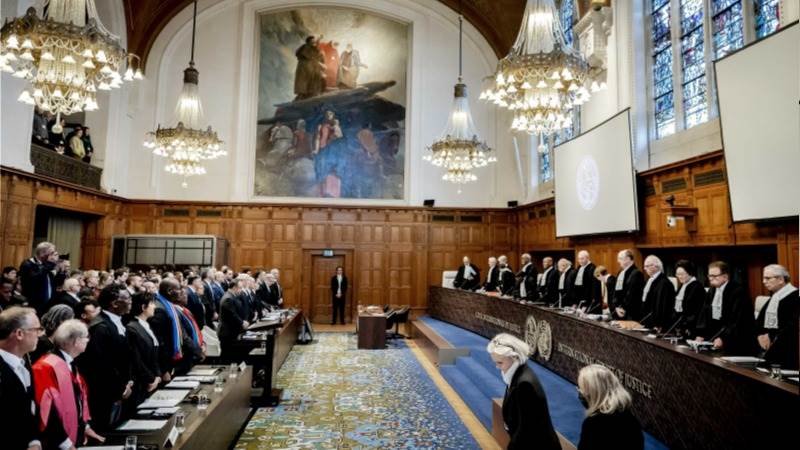
South Africa accused Israel of genocide in an unprecedented case at the United Nations’ top court, saying the country’s leadership was “intent on destroying the Palestinians in Gaza” and calling for the court to order a halt to Israel’s military campaign in the enclave.
On the first of two days of hearings at the International Court of Justice (ICJ), South Africa on Thursday argued that Israel’s air and ground assaults on Gaza were intended to “bring about the destruction” of its Palestinian population, and that comments made by Israeli leaders signalled their “genocidal intent.”
Israel declared war on Hamas after the militant group’s murderous rampage on October 7, when more than 1,200 people were killed and 240 hostages were taken back to Gaza. South Africa condemned Hamas’ attacks but said “nothing” could justify Israel’s response, which has killed more than 23,000 people in Gaza.
The point is not simply that Israel is acting disproportionately. The point is that the prohibition on genocide is an absolute,” said Vaughan Lowe, one of the lawyers representing South Africa. “Nothing can ever justify genocide.”
Israel dismissed the case as “absurd blood libel,” and government spokesperson Eylon Levy said it is “tragic that the rainbow nation that prides itself on fighting racism will be fighting pro-bono for the anti-Jewish racists.
Israel is scheduled to deliver its response in court on Friday. Israeli President Isaac Herzog said the country would make the case that the war was one of self-defense, and would show that Israel is doing its “utmost” under “extremely complicated circumstances” to avert civilian casualties.
The ICJ, based in The Hague in the Netherlands, was set up in June 1945 and hears cases brought by states accusing others of violating their UN treaty obligations. South Africa and Israel are signatories to the 1948 Genocide Convention, meaning they are obliged not to commit genocide and to prevent and punish it.
Experts say it is the first time that the Jewish state is being tried under the Genocide Convention, which was drawn up after World War II in light of the atrocities committed against the Jewish people during the Holocaust.
Countries are unable to appeal the rulings but the ICJ has no way of enforcing them, and other countries who are party to the court have ignored its rulings in the past.
In an 84-page filing to the ICJ, South Africa argued that Israel is committing genocide by killing Palestinians in Gaza, causing serious mental and bodily harm, forced evacuation, widespread hunger, and by creating conditions “calculated to bring about their physical destruction.” It also accused Israel of failing to stem incitement to genocide in the public pronouncements of its officials.
During three hours of oral argument, lawyers representing South Africa asked the ICJ to order a suspension of Israel’s campaign in Gaza to protect the rights of Palestinians in Gaza “from imminent and irreparable loss.”
Such “provisional measures,” as they are known, function as a kind of restraining order to stop a dispute from escalating while the court considers the full merits of the case, which could take years. For provisional measures the court need only decide if prima facie, or “at first glance,” the acts complained of could fall foul of the genocide convention.
“It is not necessary for the court to come to a final view on the question of whether Israel’s conduct constitutes genocide. It is necessary to establish only whether at least some of the acts alleged are capable of falling within the provisions of the convention,” argued Adila Hassim, one of the lawyers representing South Africa. CNN