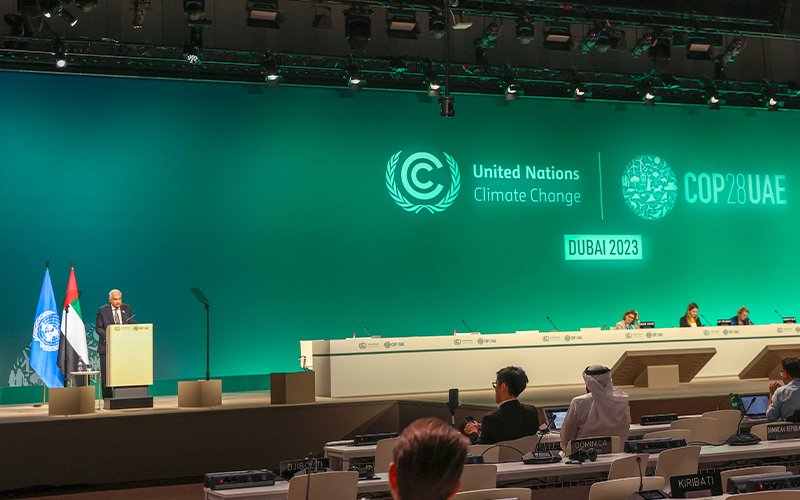
Hundreds of world leaders and climate experts gathered at this year’s United Nations climate conference to witness the approval of a climate disaster “loss and damage fund” and a disputed agreement on transitioning away from fossil fuels while countries faced crushing assessments of their carbon emissions.
States attending the 2023 Conference of the Parties or COP28 were under pressure to adopt a new climate agreement amid controversy over the appointment of Sultan al-Jaber as president because of his position as a United Arab Emirates’s oil tycoon and his alleged questioning of climate science. Countries were also found to be falling behind in the first review of their progress towards reducing emissions to keep global warming in check.
more than 100 of the 200 attending countries had expressed support for.
“Phasing out” fossil fuels would mean putting a complete stop to fossil-fuel burning through goals such as reaching net-zero carbon emissions by a specific year. “Phasing down” fossil fuels involves gradually cutting down on fossil fuel burning without setting targets for the amount and deadline to achieve net zero.
The final text was able to secure a majority consensus within the 200 attending countries to include language to “transition away” from fossil fuels, which are responsible for nearly 90 percent of global carbon dioxide emissions, according to the UN.
It also calls to “phase down” the “unabated” use of coal. Targeting “unabated” coal use is contested as it allows unfettered levels of coal burning as long as the carbon dioxide it generates is more frequently removed from the atmosphere and stored underground – which climate experts say is insufficient for reducing the impact of emissions.
The resolution is marred by loopholes that offer the fossil fuel industry numerous escape routes, relying on unproven, unsafe technologies,” said Singh in a public statement.
The conference started on a positive note with the approval of a climate disaster “loss and damage fund” that was first tabled at COP27 in Egypt last year.
The fund is meant to support vulnerable communities and developing nations which are struggling to cope with the impact of climate disasters such as the destruction of crops caused by floods. However, developed nations have been criticised over the amount of money they are willing to extend.
Several countries have pledged a total of $700m, which falls far short of the estimated $400bn damage caused by climate change each year. In September, a group of developing countries had asked for at least $100bn to be committed to the fund.
The UAE pledged $100m, which was matched by Germany. Italy and France promised more than $108m, while the United Kingdom pledged $50.8m. The United States and China, despite being the world’s largest emitters, extended only $17.5m and $10m, respectively.
Aside from gathering pledges, attendees at this year’s summit discussed how to operate the fund in a meaningful manner, while its board is expected to meet in January to finalise the framework and begin operations, according to Rishikesh Ram Bhandary, assistant director of the Global Economic Governance Initiative at Boston University.
The need for new climate plans and more robust, multilateral climate change mitigation projects has become even more pressing in light of growing gaps in meeting Paris Agreement goals, said Bhandary. Some 196 countries have signed the binding international agreement, which was adopted in 2015.
COP28 concluded the first assessment of progress each state has made towards reducing emissions for the agreement’s central tenet – limiting the global temperature rise to 1.5 degrees Celsius (2.7 degrees Fahrenheit) above pre-industrial levels.
Adhering to the Paris Agreement is “crucial” for motivating countries to devise renewed climate plans and “bring us closer to where we need to be”, said Bhandary. The next global assessment of Paris Agreement targets is expected to take place at COP33 in 2028. Source:Aljazeera