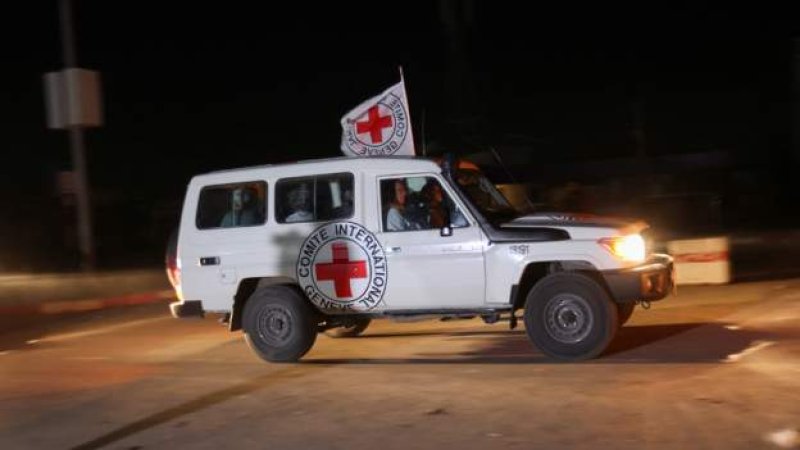
This is the moment jeeps carrying the hostages released from Gaza were taken into Egypt. The Red Cross has confirmed 24 hostages have been released. They were accompanied from Gaza by eight ICRC staff and a doctor.
The Red Cross says 24 hostages have been released from Hamas captivity in the Gaza Strip today.
In a post on X, a spokesperson for the Qatari ministry of foreign affairs says the group comprised 13 Israeli citizens, 10 Thais and one citizen of the Philippines.
Qatar has mediated the deal between Israel and Hamas.
Earlier Thailand's prime minister said 12 Thai nationals had been released by Hamas
An Israeli security source tells me the hostages are now in the hands of Israeli security services after crossing into Egypt.
The Red Cross has confirmed an operation to "re-unite hostages and detainees with their families" has begun.
The organisation has not yet confirmed how many hostages it has retrieved, but describes the work as a "multi-day" operation which will include the delivery of humanitarian aid to Gaza.
We expect a further statement from the ICRC, with more details of hostage numbers, later today.
More now on the 12 Thai hostages who were released from Hamas captivity in Gaza a short time ago.
Thai media reported that the hostages had crossed into Israel through the Rafah crossing and were being taken to the Shamir Medical Centre (Assaf Harofeh) south of Tel Aviv in Jerusalem.
There they'll receive medical care and reportedly stay for 48 hours.
They were freed under a separate agreement mediated by Qatar and Egypt with Hamas, an official briefed on the talks said.
The official said the 12 Thai hostages were all men.
The crowd held on as darkness fell at the Beitunia checkpoint - families and supporters standing and waiting for the prisoners to arrive.
A small victory, some said, in a worsening situation here.
“It’s a sign of hope for Palestinians and Israelis,” Mohammed Khatib said, “that the ceasefire will continue and the killing will stop”.
“We would have liked this to happen without the hostages taken by Hamas,” he told me, “but without them, Israel would not let these people out.”
The road by Beitunia checkpoint, near Ramallah, is sharp with the smell of tear gas. This is the place where the 39 Palestinian detainees are due to be transferred after being released from Israeli jails.
Groups of Palestinian men and boys are facing the Israeli army lined up on the road ahead.
As we arrived, the army fired rubber bullets and tear gas towards the crowd, to push them back.
Some of the young people gathered here threw stones and tear gas canisters back towards the troops.
An uneasy calm has settled here now, as families begin to arrive. But the growing crowd is edging closer to the checkpoint again, shots have again rung out. Nerves here today are live, tension is tight in the air.
It is not clear if all Israeli hostages have been handed over to the Egyptians.
We are expecting 13 women and children who were taken hostage by Hamas on 7 October to be released today.
We will bring you more details as soon as we have them.
Today will be an “emotional rollercoaster” for all the families whose loved ones are being held in Gaza, says Prof Hagai Levine, from the Hostages and Missing Families Forum, an umbrella volunteer group formed after the 7 October attacks.
He says that some received phone calls last night from the Israeli government saying they expected family members to be released today.
"They will have to see with their own eyes that it's actually happening after seven weeks," he told BBC Radio 4's World at One programme.
He adds that that others received messages saying their loved ones are not expected to be freed.
“We need a personalised approach and treatment – many of them are children," Prof Levine says. Source:BBC