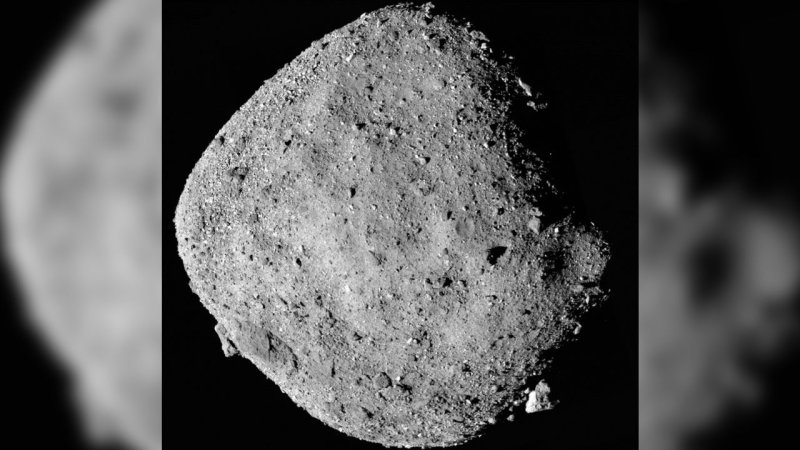
When the OSIRIS-REx spacecraft swings by Earth on Sunday, it is expected to deliver a rare cosmic gift: a pristine sample collected from the near-Earth asteroid Bennu.
If all goes according to plan, the spacecraft will release a capsule containing an estimated 8.8 ounces of asteroid rocks and soil from space toward a landing zone in the Utah desert.
NASA will provide a live stream of the sample delivery beginning at 10 a.m. ET Sunday. The capsule is expected to enter Earth’s atmosphere at 10:42 a.m. ET, traveling about 27,650 miles per hour (44,498 kilometers per hour). It will land in Utah about 13 minutes later.
After releasing the capsule, OSIRIS-REx will continue on its tour of the solar system to capture a detailed look at a different asteroid named Apophis.
The sample is expected to land in the Department of Defense's Utah Test and Training Range, where recovery teams have been training for months.
Studying the sample can help scientists understand key details about the origins of our solar system because asteroids are the “leftovers” from those early days 4.5 billion years ago. But the sample can also provide insights into Bennu, which has a chance of colliding with Earth in the future.
Returning NASA’s first asteroid sample collected in space to Earth has been years in the making. Here’s a look at the mission milestones so far — and what lies ahead.
OSIRIS-REx, which stands for Origins, Spectral Interpretation, Resource Identification, Security-Regolith Explorer, has been on quite a journey over the past seven years. Launched from Cape Canaveral in 2016, the NASA spacecraft arrived in orbit around Bennu in December 2018.
The first US mission sent to a near-Earth asteroid, OSIRIS-REx made history several times over. It performed the closest orbit of a planetary body by a spacecraft. Bennu became the smallest object ever orbited by a spacecraft.
OSIRIS-REx surveyed the asteroid in its entirety to determine the best location to collect a sample. Bennu, a rubble-pile asteroid shaped like a spinning top, is about one-third of a mile (500 meters) wide and composed of rocks bound together by gravity.
An illustration depicts the OSIRIS-REx spacecraft as it descended toward the rocky surface of asteroid Bennu
The views of Bennu provided by the spacecraft afforded the mission team unprecedented insights about the asteroid, which included the discovery of water ice locked within Bennu’s rocks and carbon in a form largely associated with biology. The team also witnessed particles from the asteroid releasing into space.
The spacecraft spiraled closer and closer to the asteroid until it went in for a historic TAG, or Touch-and-Go sample collection event, on October 20, 2020.
Along the way, challenges threatened the success of the mission, including that the sample collection head on the spacecraft collected so much material that the container couldn’t seal properly, leaking precious asteroid material into space.
During the historic collection event, the sampling head of the OSIRIS-REx spacecraft sank 1.6 feet (0.5 meters) into the surface of the asteroid. Apparently, Bennu’s exterior is made of loosely packed particles that aren’t bound together securely, based on what happened as the spacecraft collected a sample. If the spacecraft hadn’t fired its thruster to back away after its quick collection of dust and rocks, it might have sunk right into the asteroid.
That’s when the mission team learned that the asteroid’s surface is similar to a pit of plastic balls.
The OSIRIS-REx team was able to meet and overcome these challenges, and the spacecraft is slated to return the largest sample collected by a NASA mission since Apollo astronauts brought back lunar rocks decades ago. CNN