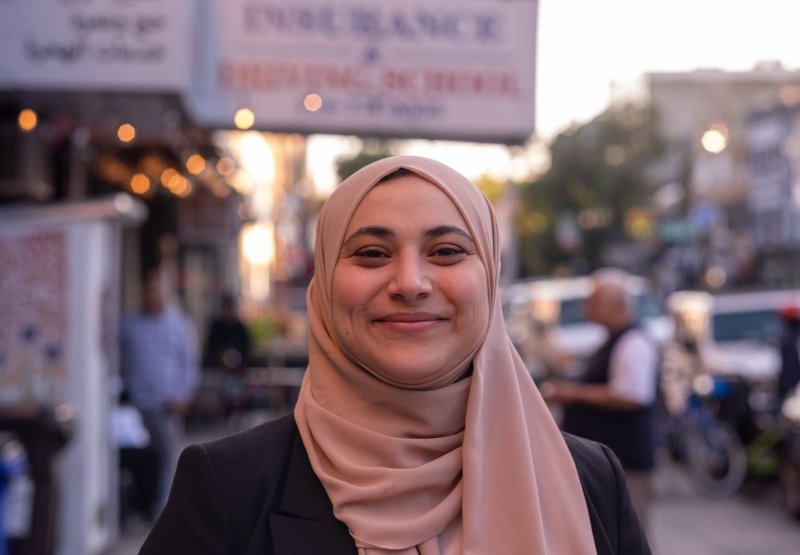
Kawas, 34, made history as the first Palestinian, and the first Muslim woman, in the New York state Senate and the state legislature. She won the seat representing district 12 in northwest Queens, home to one of New York City’s largest Arab communities, where nearly half of residents were born outside the United States.
As her speech ended and chants of “Free, Free Palestine” rang through the garden, Stylianos Karolidis, a DSA organiser on Kawas’s team, stepped up to remind supporters that she really, really had not wanted to run for office. The DSA had to “hound her non-stop” until she acquiesced, he said.
Kawas had worked with New York City Mayor Zohran Mamdani when he was in the state legislature, so they knew her organising skills.
Kawas said she did not initially think it was possible to run for office without compromising her commitment to Palestinian liberation. Her victory, with 74.5 percent of the vote against Republican Han Khon To, was part of a broader tide of wins for pro-Palestine and democratic socialist candidates in the midterm elections, including Senator-elect Abdul El-Sayed in Michigan and Mayor-elect Nithya Raman in Los Angeles, California.
“This midterm election showed a politics of human rights that includes Palestinians is a winning platform,” said Institute for Middle East Understanding policy project executive director Margaret DeReus. “For millions of Americans, holding Israel accountable for genocide and supporting Palestinian freedom are the litmus test.”
Days after the election, Kawas reflected on the DSA’s first approach and her doubts about entering a political system she had long distrusted. In her Queens home, a poster honouring Palestinians who had been killed hung above shelves of books on Islamic liberation, the Palestinian movement and US politics. But she ran because the political climate had shifted, she told Al Jazeera.
“It felt like being pro-Palestinian was the most important thing to run on.”
Kawas’s parents were uprooted from their homes in Palestine during the mass expulsions. Her father was uprooted in 1948 and her mother in 1967. They grew up as neighbours in Jordan before falling in love, marrying and moving to the US with their infant son in the 1990s. They later had three daughters. Aber is the third child of the four, sandwiched between her two sisters. “Which is why I have a lot of politician skills,” she said, laughing.
But when she was in the seventh grade, her father was detained by US Immigration and Customs Enforcement (ICE), which her mother described as a regular occurrence in New York’s post-9/11 Muslim community. His detention meant weekend visits to prison, and it left the family struggling.
“I had to work whether I wanted to or not; you have to become both man and woman, father and mother,” her mother, Manal Abu Samaha, told Al Jazeera.
When Kawas was a teenager, she said she travelled to Albany to tell her family’s story, hoping to expand opportunities for undocumented students like her older brother, who was ineligible for a college scholarship. Lawmakers seemed uninterested, Kawas recalls.
The state senator-elect credits the experience with launching her advocacy career and shaping her goals as a politician. “It’s not upending systems, but it’s meeting real, immediate material needs for people,” she said. “That’s maybe a little kernel of what got me to run.”
Backed by Mamdani and the DSA, Kawas’s campaign said it mobilised more than 1,000 volunteers to knock on doors, make calls and campaign on affordable housing, healthcare and public transport, as well as the Palestinian solidarity work that has shaped her life.
Kawas recalled that, while Mamdani was warned that supporting Palestine would end his political career, the stance instead helped him earn voters’ trust. Seeing this, she said, made her less wary that entering politics would require her to compromise her beliefs.