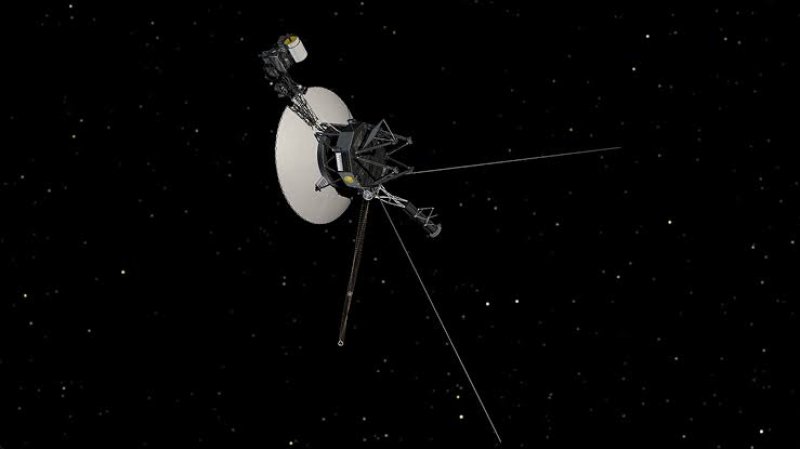
This morning, November 18, 2026, humanity reached a milestone. We can now measure the progress of our spacecraft out into the Milky Way Galaxy not in light-hours, but in light-days. That’s because Voyager 1 has now reached a distance of 1 light-day from Earth. Voyager 1 is the most distant human-made object. The spacecraft launched on September 5, 1977, and visited Jupiter and Saturn before heading on to the outer reaches of the solar system. It officially crossed out of our solar system, passing the heliopause — the sphere of the sun’s influence — back in 2012. And at 4:16:07 a.m. CST (10:16:07 UTC) on November 18, 2026, Voyager 1 reached a distance of 1 light-day from Earth. That’s the distance it takes light to travel in 24 hours.
This historic milestone of 1 light-day is equal to about 16.1 billion miles (25.9 billion kilometers), or 173.14 astronomical units (AU). If we could peer at the tiny spacecraft through a telescope on Earth, the light we see would have left Voyager 1 24 hours ago. We’ll be seeing it a full day in the past.
And how long did it take Voyager 1 to travel 1 light-day? It took 49 years, 2 months and 11 days to travel that distance from Earth. Keep on reading for how to celebrate this milestone.
Here are some future dates to keep in mind!
- February 4, 2027: Voyager 1 will be 1 light-day from the sun
- November 1, 2035: Voyager 2 will be 1 light-day from Earth
- June 24, 2051: Voyager 1 will be 36 light-hours from the sun
- December 13, 2075: Voyager 1 will be 2 light-days from the sun
- February 16, 2097: Voyager 1 will be 80 billion km from Voyager 2
- October 1, 2099: Voyager 1 will be 40 billion miles from Earth
celebrate, the Planetary Society will host a free public livestream from 7 to 8 p.m. CST on Wednesday, November 18, on its YouTube channel and in its digital member community. That’s 1:00 to 2:00 UTC on Thursday, November 19.
During the broadcast, legendary space artist Don Davis will reveal a never-before-seen illustration depicting what Voyager 1 looks like from one light-day away, rendered in painstaking scientific detail. The livestream will be the first place anyone can see the new work. Watch in the player below or on The Planetary Society’s YouTube channel.
Mat Kaplan, space science journalist and presenter, will be joined by three members of the Voyager mission team from NASA’s Jet Propulsion Laboratory — Project Manager Suzanne Dodd, Mission Manager Kareem Badaruddin and Project Scientist Linda Spilker — who will share stories from their decades on the mission. Additional special guests will appear throughout the program.
Bill Nye, chief ambassador of The Planetary Society, was a student in Carl Sagan‘s class while the Voyager spacecraft were being assembled. Nye said:
To mark Voyager 1’s milestone of 1 light-day distant, NASA organized a worldwide Shine Bright celebration. After sunset on Tuesday, November 17, people participated by pointing a flashlight, phone, glow stick or other light toward the sky and flashing the letters V-G-R for Voyager in Morse code.
So how do you spell V-G-R in Morse code? V is dot, dot, dot, dash. G is dash, dash, dot. And R is dot, dash, dot.
NASA hoped the worldwide light display would celebrate humanity’s remarkable achievement in sending a spacecraft farther into space than anything else it has ever built.