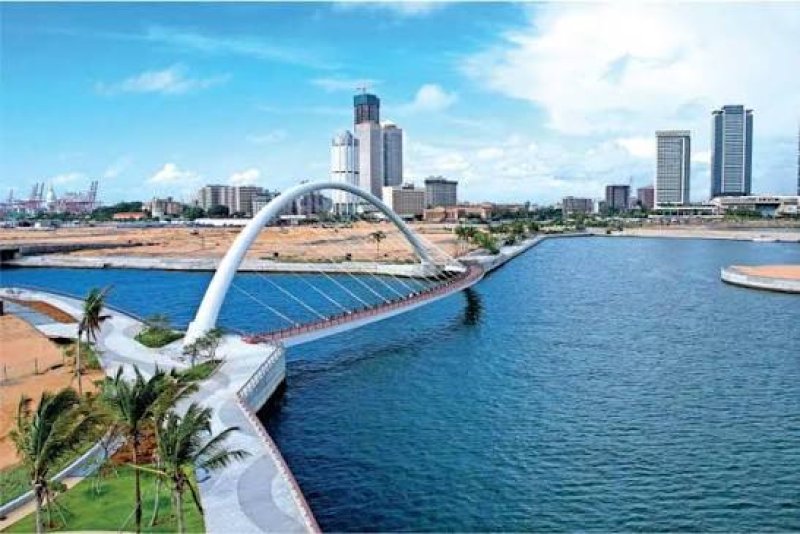
The legality of selling freehold apartments at Colombo Port City, where the underlying land is held on 99-year leases, has come under parliamentary scrutiny, with the Committee on Public Finance (CoPF) seeking the Attorney General’s opinion on the legal basis for such transactions.
The issue was discussed at a committee meeting on October 8, with Parliament reporting on the proceedings on October 15, 2026. The central concern is how freehold ownership of individual apartments operates alongside the long-term leases governing the land on which the development stands.
Colombo Port City Economic Commission Chairman Harsha Amarasekera, President’s Counsel, told the committee that the Colombo Port City Economic Commission Act, No. 11 of 2021, permits condominium parcels to be transferred on a freehold basis, including those situated on land leased to the project company.
He said the Commission must participate in the conveyance of the property to the final purchaser.
However, Opposition MP Ravi Karunanayake questioned how freehold ownership could operate alongside the 99-year land leases. Committee Chairman Dr Harsha de Silva said Parliament could consider amending the law if the issue arose from the existing legislation. A government representative noted that the Attorney General’s Department had examined the Bill before it was passed.
Sections 38 and 39 of the Act deal with freehold transfers of condominium parcels, with different provisions applying to transactions conducted in designated foreign currency and Sri Lankan rupees.
The Attorney General’s opinion is expected to clarify how these provisions interact with the underlying land leases. The request does not, in itself, mean that existing apartment titles are unlawful or invalid.
The main concern for prospective apartment buyers is whether their ownership rights will remain enforceable when the underlying land lease expires.
The answer depends on the applicable legislation, the terms of the master lease and the legal documents governing individual apartment transfers. Buyers need to establish whether ownership of their apartments and rights over common facilities will continue independently after the lease expires or whether an extension or renewal will be required.
The relevant documents should also clarify who has the authority to renew the lease, whether an extension is automatic or discretionary, and who would bear the associated costs. The potential impact of disputes or contractual breaches involving the project company on apartment owners must also be considered.
These questions do not establish that apartment titles are defective or that the properties must automatically revert to the State when the leases expire.
According to Parliament’s account of the committee meeting, officials said nine land plots belonging to CHEC Port City Colombo (Pvt) Ltd had been leased for 99 years, with a combined value of approximately US$1.12 billion. Another six plots, valued at around US$1 billion, were being planned for lease.
The Commission was also preparing to bring four government-owned plots to the market, representing approximately one-seventh of the total land allocation.
Officials said the leased land had an average value of approximately US$3,000 per square metre. Parliament’s report stated that Rs.398 million, equivalent to about 1% of the total lease payments, had been received at the time of the discussion.
The committee also examined safeguards for advance payments made by apartment buyers, with Dr de Silva questioning whether the existing framework provided sufficient protection.
He noted that presales were not restricted by construction milestones and that developers were not required to publicly disclose their balance sheets. He urged the Commission to consider introducing escrow accounts to protect buyers’ funds.
Escrow arrangements can keep payments separate and release them when specified conditions are met, reducing risks associated with construction delays and developer financial difficulties.
The Commission said escrow arrangements had been discussed and that it was reviewing condominium management regulations with the Legal Draftsman for possible revision.
Prospective buyers should establish how their payments will be held and released and carefully examine contractual provisions covering construction delays, cancellations, refunds and developer defaults. These safeguards are separate from the question of whether the final apartment title is legally valid.
The committee also reviewed funding requirements for Port City projects. Officials said the full construction cost of a primary project must be funded through foreign currency raised outside Sri Lanka under the framework described at the meeting.
Apartments may be sold in Sri Lankan rupees to local buyers, while foreign investors must channel their purchases through an Inward Investment Account. Developers that fail to bring in the required foreign currency risk losing exemptions provided under the Act.
The committee also discussed a project whose public valuation had reportedly been stated as US$300 million, while its gazetted value was US$152 million. Amarasekera said its US$110 million construction component had to be brought in as foreign currency and that the Commission would audit actual construction costs.
Lawmakers also examined 68 secondary Businesses of Strategic Importance gazetted in April 2026. Most reportedly did not list a parent company, while many were incorporated in the British Virgin Islands. Dr de Silva raised concerns about investment thresholds and potential tax benefits.
The Commission said it screened applications and collected beneficial ownership information. The discussions formed part of a wider examination of investment transparency and regulatory oversight, but did not establish wrongdoing by any particular developer.
According to Parliament’s account, Dr de Silva said five of the 10 investment approvals he reviewed had been withdrawn. The Commission disputed whether some of the projects identified had formally been gazetted.
One proposal reportedly involved a seven-star hotel and a vertical art gallery. It had paid a US$10,000 application fee, while a token deposit to the project company was believed to have been forfeited.
The cases highlighted the importance of distinguishing between announced projects, regulatory approvals, actual investment and progress towards completion.
Prospective purchasers are advised to obtain independent legal advice before committing funds to Port City apartments. A property lawyer should examine the original land lease, master lease, Commission approvals, apartment transfer deed, condominium plan and purchase agreement.
Buyers should establish precisely what ownership rights are being transferred, whether the relevant documents are properly executed and registered, and whether further approvals are required. Particular attention should be paid to provisions governing lease expiry, renewal, termination, refunds and dispute resolution.
The key question remains whether ownership of individual apartments and rights over common facilities will continue after the master lease expires or whether an extension will be necessary.
The Attorney General’s opinion could clarify how the freehold provisions of the 2021 Act operate alongside the 99-year leases and whether additional legislative or regulatory safeguards are needed to protect purchasers.