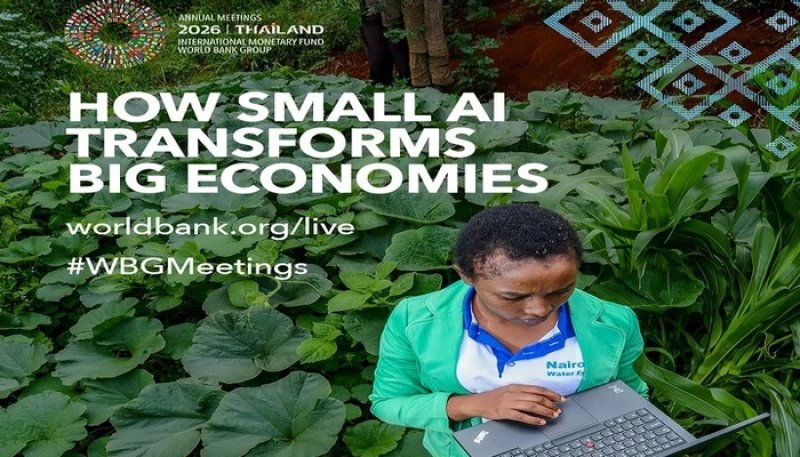
Artificial intelligence (AI) is rapidly reshaping agriculture, business operations and public service delivery, creating new opportunities for developing countries while also raising questions about access, skills and employment. World Bank Group President Ajay Banga is expected to join global leaders, technology innovators and government representatives for discussions on how countries can expand the use of AI and move promising pilot projects into practical solutions that deliver broad economic and social benefits.
A central theme of the discussions will be the concept of “Small AI” practical, affordable and locally adapted applications designed to work within the language, infrastructure and budget constraints of developing countries. Unlike large, resource-intensive systems that require substantial computing power and data, Small AI tools can be tailored to specific community and sector needs.
Such applications could support farmers with localized weather and crop advice, help small businesses manage inventories and payments, assist health workers with basic diagnostic information, and improve access to government services. In education, AI-powered tools could provide learning support in local languages and help teachers manage administrative tasks.
The approach reflects a shift away from focusing exclusively on the most advanced AI models. Instead, it emphasizes technologies that can address everyday challenges, improve productivity and expand access to digital services. For countries with limited connectivity or computing infrastructure, smaller and more efficient systems may offer a faster and more affordable path to adoption.
The discussions are also expected to examine the conditions needed for AI to deliver lasting benefits. These include reliable digital infrastructure, affordable internet access, data protection, responsible governance and investment in education and workforce training.
While AI could automate some routine tasks, it may also create new employment opportunities in areas such as software development, data management, digital services, technical support and AI system maintenance. Developing countries could benefit by building local talent and encouraging businesses to use AI to expand rather than replace human capabilities.
Small and medium-sized enterprises are likely to be a major focus. With access to affordable AI tools, these businesses could improve customer service, reduce operating costs, reach new markets and make better use of financial and market information. Increased productivity could support business growth and contribute to job creation.
However, experts have warned that the benefits of AI will not be automatic. Countries that lack digital infrastructure, skilled workers or clear regulatory frameworks could face a widening technology gap. Ensuring that women, rural communities and low-income groups can access AI-enabled services will be essential to making the technology inclusive.
The World Bank has increasingly highlighted the importance of supporting digital transformation in developing economies. Its work includes financing infrastructure, strengthening public institutions and helping countries develop policies that encourage innovation while managing risks associated with emerging technologies.
The upcoming discussions will explore how governments, development institutions and the private sector can cooperate to scale successful AI projects. Participants are expected to consider financing models, partnerships with local technology companies and ways to measure whether AI initiatives are improving livelihoods and creating meaningful economic opportunities.
The broader objective is to ensure that AI becomes more than a tool for technological advancement. By adapting applications to local needs and investing in people, developing countries could use AI to improve public services, raise productivity and support new forms of employment and economic development.