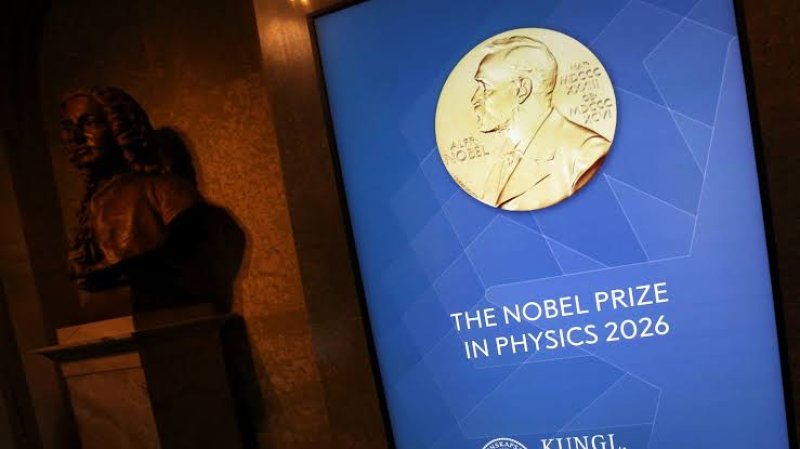
Francis Halzen won the Nobel Prize in physics on Tuesday for his contributions to the IceCube Neutrino Observatory and his discovery of high-energy neutrinos of astrophysical origin.
"Francis Halzen has led an international team of researchers and engineers who have provided us with a fantastic instrument. His tenacity and scientific vision has paved the way for a new kind of astronomy," Mark Pearce, chair of the Nobel Committee for Physics, said in a news release.
Halzen spoke to the committee by phone from Italy on Tuesday.
"It was a great surprise and I obviously didn't expect it," he said.
Born in Belgium, the 82-year-old scientist is affiliated with the University of Wisconsin-Madison in the U.S. Efforts by The Associated Press to reach him were not immediately successful.
The IceCube Neutrino Observatory is a research facility located at the South Pole in Antarctica, according to its website, and the University of Wisconsin-Madison is its lead institution.
Halzen's research into capturing neutrinos at the South Pole dates back to the 1980s.
The Royal Swedish Academy of Sciences announced the award in Stockholm.
The prize money this year is 12 million Swedish kronor (about $1.2 million), whether for an individual, a small group of laureates or an organisation.
Last year, three scientists won the Nobel Prize in physics for research on the strange behaviour of subatomic particles called quantum tunnelling that enabled the ultra-sensitive measurements achieved by MRI machines and laid the groundwork for better cellphones and faster computers.
The announcements of this year's prizes began Monday with the Nobel Prize in medicine being awarded to three scientists whose work led to a tool that uses lig