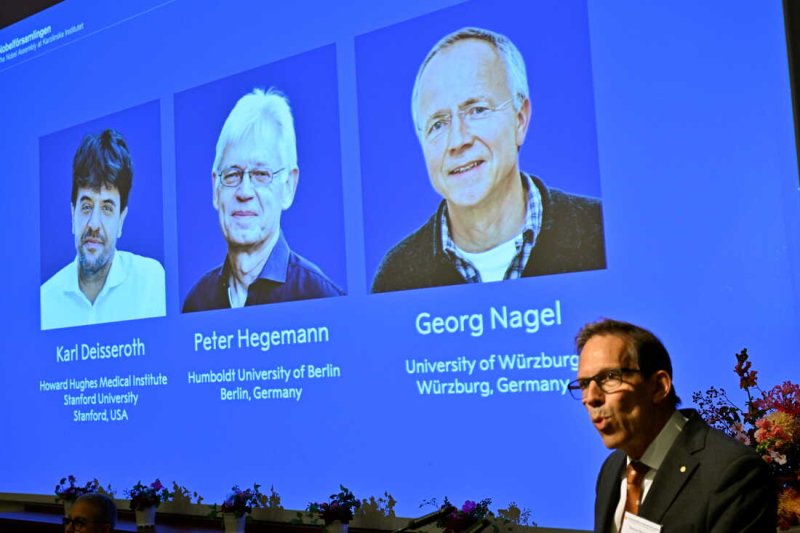
The Nobel Prize in medicine was awarded Monday to three scientists working on the mechanisms the brain uses to switch on, or off, the activity of individual nerve cells.
Karl Deisseroth, 54, Peter Hegemann, 71, and Georg Nagel, 73, have carried out research into light-gated ion channels and optogenetics. They are based at universities in Germany and the United States.
The Nobel Assembly lauded their work, writing on X that the method "is now being used in laboratories around the world to reveal the brain's mysteries."
The assembly said Deisseroth is based at Stanford University in California, while Hegemann is at Humboldt University in Berlin and Nagel at the University of Wurzburg, also in Germany.
Thomas Perlmann, the secretary of the medicine committee, said he was able to reach all three winners by phone Monday. The Associated Press' efforts to reach the winners were not immediately successful.
Optogenetics opened what the Nobel assembly called a new era in neuroscience, the discovery of a light-controlled switch to turn on and off nerve cells and circuits in the brain to better learn how it works - to start unraveling the pathways that lead to behaviour and disease.