The Committee on Public Finance has approved the 2027 budget estimates of the Commission to Investigate Allegations of Bribery or Corruption (CIABOC), following a review of its financial and operational requirements.
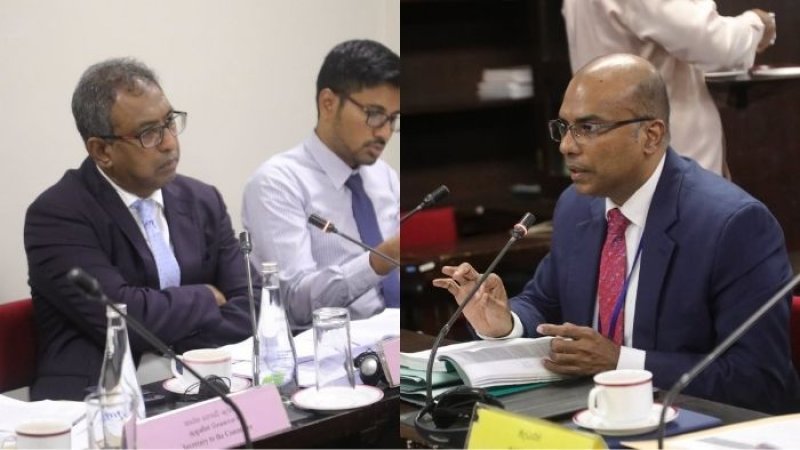
The estimates were considered at a meeting of the Committee on Public Finance chaired by MP Dr Harsha de Silva at Parliament on September 29.
CIABOC Director General Ranga Dissanayake and other officials, along with representatives from the Ministry of Finance and the Attorney General’s Department, participated in the meeting.
The committee discussed the approval of CIABOC’s annual budget estimates, its financial and operational independence, funding arrangements and administrative issues.
Under Section 31 of the Anti-Corruption Act, No. 9 of 2023, CIABOC’s budget estimates are required to be submitted directly to the Speaker, rather than through the Ministry of Finance. The Speaker is required to obtain the observations of the Minister in charge of Finance and submit the estimates to Parliament, through the Committee on Public Finance, within 10 days.
The committee also discussed delays in submitting the 2027 budget estimates to Parliament. As the estimates reached the committee only in September after obtaining the observations of the Minister of Finance, it was noted that such delays could affect the overall budget preparation process.
It was agreed that in future, CIABOC would submit its budget estimates to the Speaker by May 30 to ensure that the budget process is completed within the required timeframe.
The committee also discussed concerns over a 2024 Treasury circular applicable to regular line ministries and departments and its potential impact on the functions of independent commissions.
Restrictions on vehicle purchases and leasing, renting buildings for regional offices and undertaking foreign travel required for official duties were among the issues discussed. CIABOC Director General Ranga Dissanayake pointed out that requiring prior approval from the Ministry of Finance for such activities could affect the commission’s independence.
The nature and use of the CIABOC fund were also discussed. The meeting considered the separate fund established for the commission under Section 31 of the Anti-Corruption Act, as well as arrangements for payments through the Consolidated Fund and the commission’s general fund.
Committee Chairman Dr Harsha de Silva stressed that CIABOC should be provided with all necessary provisions to carry out its functions independently as stipulated by law.
The committee also inquired into the commission’s operational activities. Dissanayake said CIABOC had begun expanding its operations in line with International Monetary Fund commitments and the country’s anti-corruption action plan.
Accordingly, steps are being taken to recruit 971 staff members, while inspections have been carried out through district secretaries to identify existing government buildings that could be used for the establishment of 23 regional offices by December 31, 2026.
Some of the buildings are expected to be renovated and used by the commission, while others will be obtained on a rental basis, he said.
Dissanayake also said arrangements had been made to obtain technological equipment worth Rs. 109 million, including computers and photocopy machines required for the regional offices, under a US$2.5 million grant provided by the Government of Japan through the United Nations Development Programme (UNDP).
Meanwhile, nearly 34,000 individuals required to submit asset and liability declarations under the new law have been identified for the recovery of late fees. The Director General said fines collected through the process would be credited to the commission’s fund.
The committee also discussed the salary structure of the CIABOC Chairman, members and Director General. It reiterated an earlier committee recommendation that the Chairman’s salary and allowances should be equivalent to those of the President of the Court of Appeal.