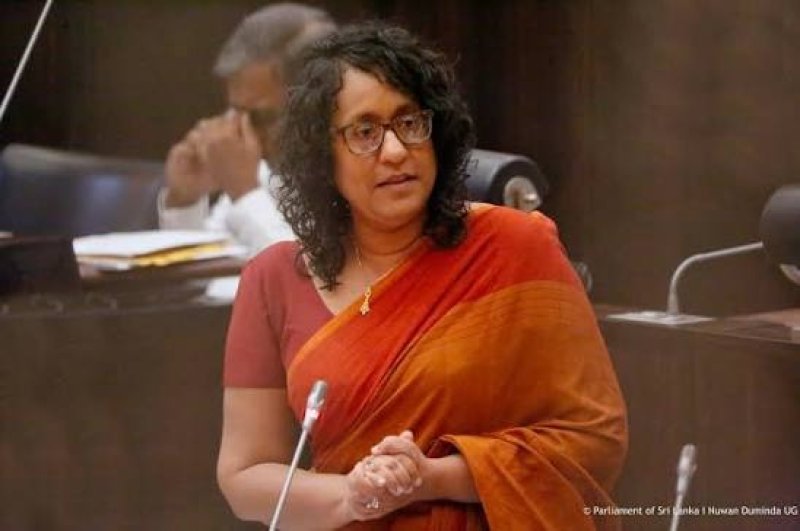
Steps are being taken to provide accommodation facilities for around 16,000 university students through a new hostel construction programme, while the Government is also formulating a comprehensive policy to regulate student accommodation, Prime Minister Dr. Harini Amarasuriya told Parliament today.
Responding to questions raised in Parliament, the Prime Minister said a total of 55 new hostels are scheduled to be constructed during 2025 and 2026 and in the period ahead.
The University Grants Commission (UGC) allocated Rs. 376 million in 2025 for the renovation of university hostels and Rs. 453 million in 2026, while the Ministry of Education, Higher Education and Vocational Education allocated a further Rs. 400 million in 2026 for hostel renovations and Rs. 1.5 billion for the construction of new hostels.
She said these projects were being implemented using domestic funds without resorting to borrowing. In addition, allocations have been made under foreign loan financing for the construction of new hostels.
This includes Rs. 321 million in 2026 for hostels under the Wayamba Urban Development Project, funded through a Saudi Development Loan, while Rs. 331 million has been allocated under the same loan facility for a hostel under the project to establish the Faculty of Medicine at Sabaragamuwa University.
A further Rs. 10.46 million has been allocated for hostel renovations under the Wayamba Urban Development Project.
Accordingly, Rs. 466 million was allocated in 2025 and Rs. 662.46 million in 2026 for these projects, the Prime Minister said.
She said priority had been given to universities located away from urban areas, where accommodation shortages are particularly acute.
The programme commenced with two hostels at the University of Vavuniya, while priority has also been given to the University of Jaffna's Kilinochchi Campus, South Eastern University, Uva Wellassa University and Sabaragamuwa University.
Meanwhile, the UGC is formulating an overall policy on accommodation facilities for students of Sri Lanka's state universities, including guidelines governing privately operated student accommodation.
The Prime Minister said there were currently no established guidelines governing private hostels or rented houses used by university students, including standards relating to accommodation charges and minimum facilities.
The proposed policy is aimed at ensuring fair, transparent, safe, affordable, accessible and inclusive accommodation facilities for students, while preventing them from being subjected to economic exploitation.
Special attention will also be given to the accommodation requirements of students with disabilities.
Under the proposed policy, students unable to secure university hostel accommodation may obtain accommodation in registered private hostels.
Minimum standards are expected to be introduced for private hostels covering accommodation facilities, sanitation, safety, accessibility, affordability and student welfare.
The policy will also include provisions for the fair allocation of accommodation, with priority given to students with disabilities, the establishment of a committee to oversee private student hostels, regular inspections and action against hostels that fail to meet the required standards.
The draft policy is currently being reviewed by state universities under the UGC. Following consideration of observations and recommendations received from the universities, the draft will be revised and subsequently submitted for finalisation.
The Prime Minister said the Government is also considering the construction of additional student accommodation through public-private partnerships, particularly in areas where private accommodation is limited.
Under such an arrangement, the Government could provide land under an agreed framework to facilitate the construction of additional accommodation facilities. Discussions are currently being held with universities on the proposal.
Dr. Amarasuriya further said steps are being taken to examine hostel facilities and student welfare activities at vocational training centres, the Ocean University of Sri Lanka and the University of Vocational Technology.
The programme will be implemented by the UGC in direct collaboration with state universities, and there are currently no plans to involve local authorities.