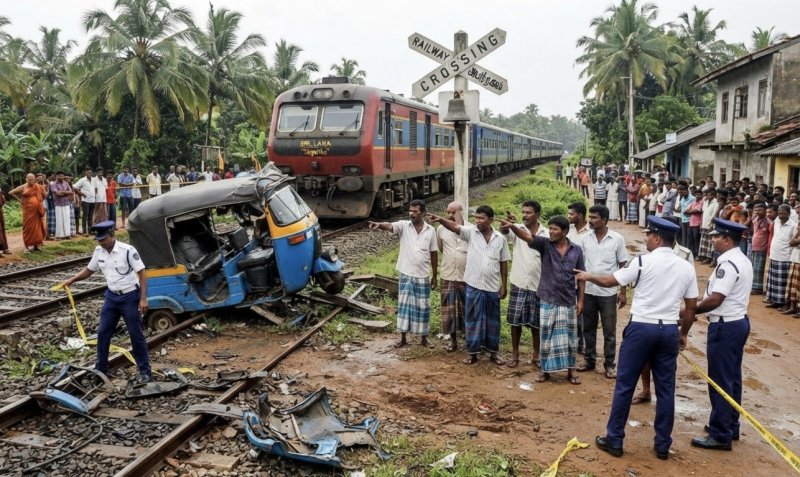
The fatal collision at the Ganegama railway crossing in Aluthgama has once again highlighted concerns over the safety of unprotected railway crossings across Sri Lanka.
The accident involving the “Sagarika” express train claimed the life of a three-wheeler driver and seriously injured a passenger. The incident also triggered protests by residents, who blocked the coastal railway line demanding immediate action to improve safety at the crossing.
Residents have raised concerns that the crossing operates without a physical safety gate and relies mainly on warning bells and signals to alert road users to approaching trains.
Although train services resumed after authorities intervened and assured residents that remedial measures would be taken, the incident has renewed attention on the wider problem of unsafe railway crossings across the country.
According to official data and parliamentary disclosures, Sri Lanka has more than 1,100 railway level crossings, with around 400 to 440 reportedly classified as unprotected or unsafe.
Such crossings remain particularly dangerous for motorists, three-wheeler drivers and pedestrians, especially at locations where visibility is limited and trains approach at high speeds.
Railway crossing accidents continue to result in deaths and injuries each year, adding to concerns over the overall safety of the country's aging railway infrastructure.
In many communities, serious accidents have been followed by protests and calls for the installation of gates, improved warning systems or permanent railway crossing attendants. However, the implementation of such measures can face delays due to funding, administrative and procurement issues.
Authorities and other stakeholders have previously considered measures including automated electronic gates, improved warning signals and advanced road signs at high-risk crossings.
The latest tragedy in Aluthgama has once again raised questions over how quickly such measures can be implemented.
With hundreds of railway crossings still considered vulnerable, calls are growing for permanent safety infrastructure rather than temporary assurances after accidents occur.