










President Anura Kumara Dissanayake has stressed that the government’s goal is to transform Sri Lanka’s healthcare system into one that meets international quality standards, moving beyond basic reforms, and assured that the necessary financial allocations will be provided to achieve this objective.
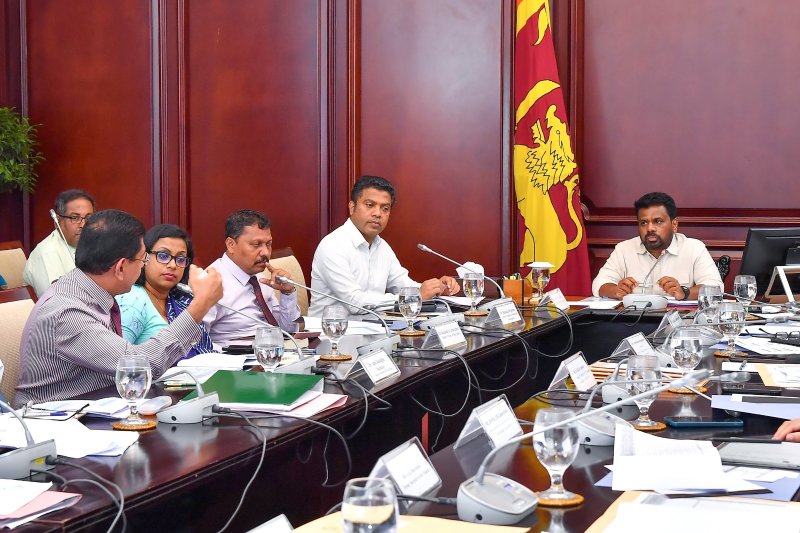
The President made these remarks during the 2027 pre-budget discussion for the Ministry of Health and Mass Media, held at the Presidential Secretariat yesterday (08), where the progress of projects implemented under the 2026 budget and proposals for the 2027 budget were reviewed.
During the meeting, attention was given to the progress of the “Arogya Suwa Seva Centres” programme aimed at strengthening primary healthcare services. The President instructed officials to place greater emphasis on improving primary healthcare across the country.
The progress of projects undertaken by the various divisions of the Ministry under the 2026 budget allocation was reviewed individually, while funding requirements and priorities for 2027 were also discussed.
President Dissanayake instructed officials to submit science-based strategic proposals to improve the quality and efficiency of Sri Lanka’s healthcare system.
Special attention was also paid to technological transformation within the hospital network. The President noted that expanding access to advanced medical technologies throughout the country would significantly enhance the quality of public healthcare services.
He pointed out that strengthening the public healthcare system would enable citizens to receive efficient, standardized healthcare while reducing the financial burden of seeking treatment from private healthcare providers.
The discussion also focused on further strengthening the Suwa Seriya ambulance service and ensuring that future ambulance procurements meet international standards by acquiring fully equipped, technologically advanced ambulances instead of conventional vehicles.
Officials revealed that 26 large-scale healthcare infrastructure projects, which had been halted after previous governments suspended capital expenditure, have now been restarted under the current administration. These include the five-storey building complex at the Monaragala District Hospital and emergency treatment units at the hospitals in Trincomalee, Ampara and Chilaw. In total, 48 healthcare construction projects are currently being implemented.
The meeting also discussed measures to ensure an uninterrupted supply of medicines by addressing procurement challenges through technological solutions, expanding the Ministry’s capacity to test the quality of pharmaceuticals, and ongoing programmes supported by international organisations such as UNDP and UNICEF.
Progress on key digital health initiatives was also reviewed, including the Patient Health App, telemedicine services, and the establishment of a National Electronic Health Record, which will enable patient records to be accessed from any government hospital.
It was also decided to conduct a comprehensive review of healthcare staffing, address issues faced by newly qualified doctors during the process, and discuss recruitment challenges with the Ministry of Finance.
The discussion further reviewed progress on providing physical resources to the Government Film Unit, journalist training programmes, and the establishment of school media societies. Attention was also given to a proposal to establish a dedicated media operations centre to facilitate information sharing between the government and all media institutions.
In addition, President Dissanayake underscored the need to modernise the Department of Posts and the Government Printing Department by moving away from outdated systems and adopting modern technologies.
The meeting was attended by Minister of Health and Mass Media Dr. Nalinda Jayatissa, Deputy Minister of Mass Media Kaushalya Ariyaratne, Deputy Minister of Health Dr. Hansaka Wijemuni, senior officials from the Presidential Secretariat, the Ministries of Finance and Health, and other government institutions.