The horrific violence that erupted at the Negombo Prison is not just an isolated tragedy; it is a damning indictment of Sri Lanka’s broken penal system.
The horrific violence that erupted at the Negombo Prison is not just an isolated tragedy; it is a damning indictment of Sri Lanka’s broken penal system. The fatal unrest began on a Sunday evening when a fierce confrontation exploded between two rival inmate factions—one allegedly protecting entrenched drug trafficking operations within the facility and another fiercely opposed to them. What began as a localized turf war rapidly deteriorated into anarchy by Monday morning. Inmates breached internal security, ransacked high-security blocks, and managed to seize firearms from the prison itself. The fallout has been staggering, with the death toll rising to 25 people—including four prison guards who were killed trying to contain the madness—and over 100 others left wounded by gunshots, severe lacerations, and trauma.

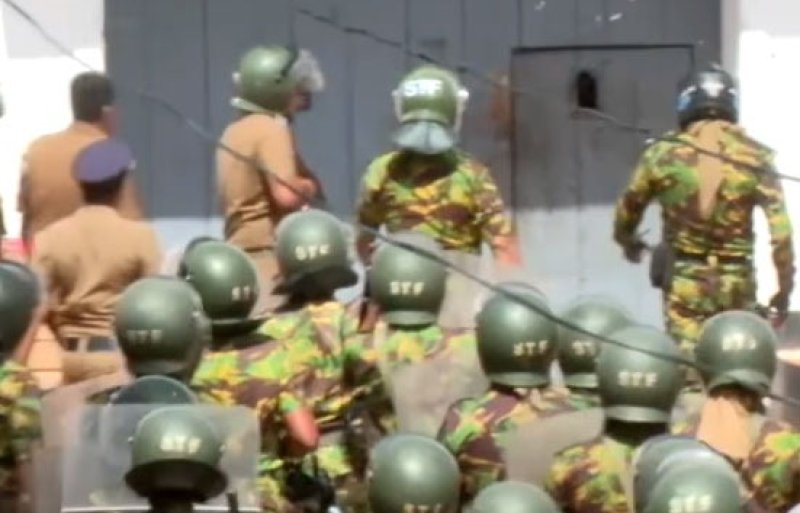
The sheer chaos inside the facility was illustrated by the panic spreading to the adjoining women’s wing, where desperate female inmates scaled the roof to demand their release, only for a section of the structure to collapse and cause further injuries. It ultimately required a massive, militarized intervention by the Police Special Task Force (STF) and the Air Force—deploying surveillance drones and helicopters—to reclaim control of the perimeter. Yet, while the state may have temporarily restored a fragile peace, the underlying rot that fueled this massacre remains completely unaddressed.
Echoes of Welikada and Mahara: Different triggers, same failure
To fully grasp why Negombo became a slaughterhouse, we must view it through the lens of Sri Lanka’s history of prison revolts, most notably the devastating clashes at Welikada and Mahara. Each of these tragedies represents a different manifestation of a failed state apparatus. The Welikada riot was characterized by a direct, militarized collision between the state and the criminal underworld. It erupted when inmates violently resisted a targeted, aggressive contraband search operation by STF commandos, leading to prisoners breaking into the prison armory and initiating a full-scale shootout. In contrast, the Mahara Prison riot was a tragedy born out of existential terror and systemic neglect. There, inmates revolted not over gang territory or contraband, but out of sheer panic over exploding virus transmission rates in their congested cells during the global health crisis, begging for PCR testing and medical segregation.
Negombo, however, exposes an even more alarming structural decay than either Welikada or Mahara. It shows a prison system so deeply compromised that the multi-billion-rupee illicit drug empire is no longer just smuggled past the gates—it actively fights for territorial sovereignty inside them. While Welikada was a battle against state authorities and Mahara was a desperate cry for healthcare, Negombo was an unmitigated gang war fought on state property. The fact that inmates could easily force open high-security cells to execute rivals and systematically seize state-issued firearms reveals a catastrophic collapse of internal discipline, institutional security, and administrative oversight.
The overcrowding time bomb
Despite their differing immediate catalysts, the bloodbaths at Negombo, Welikada, and Mahara all share a glaring, undeniable denominator: severe, unmanageable overcrowding. Sri Lanka’s prison network is currently holding over 41,250 inmates inside infrastructure built to safely house roughly 10,000. When you pack thousands of remand prisoners and hardened convicts into tightly confined spaces, you are not running a correctional system—you are managing a tinderbox. Overcrowding destroys human dignity, strains security personnel to a breaking point, and allows powerful criminal cartels to easily exploit the chaos and recruit vulnerable inmates.
The horrors at Negombo must serve as the final wake-up call for comprehensive, systemic penal reform. Simply deploying elite commandos to lock down the perimeter after the blood has already been spilled is a failure of governance. The state must aggressively tackle overcrowding by reforming bail laws for minor offenses, eradicating the rampant corruption that allows drug kingpins to run cartels from their cells, and completely overhauling internal prison security. Until the government treats these recurring prison riots as symptoms of a deeply diseased system rather than isolated security breaches, the walls of Sri Lanka's penitentiaries will continue to echo with the sound of gunfire.