

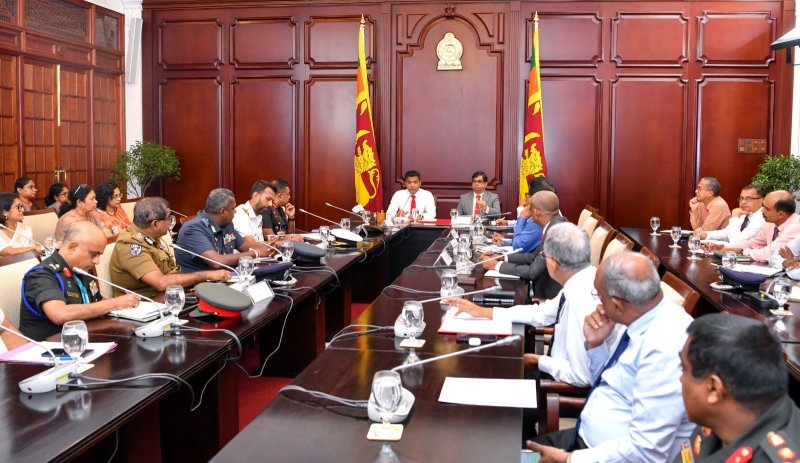










Accordingly, it was decided to issue a circular outlining the measures to be taken for short-term dengue control, covering government institutions, schools and local government bodies. It was also decided to implement dengue control programmes across 600 Grama Niladhari divisions during the three-day period of June 24, 25 and 26.
In addition, the meeting decided to establish a monitoring unit under the leadership of the Tri-Forces, strengthen legal enforcement measures and further reinforce dengue prevention activities through the Community Empowerment and Public Safety Committees that have already been established at the local level.
The discussion emphasized the urgent need to accelerate short-term interventions, as schools, factories, government institutions and places of worship have been identified as major breeding grounds for dengue mosquitoes.
The participants also held extensive discussions on long-term measures required to prevent similar outbreaks and trends in the future.
Among those present were Chief of Staff to the President Prabath Chandrakeerthi; Senior Additional Secretary to the President and Secretary to the Ministry of Energy, Russell Aponsu; Additional Secretary to the President and Head of the Clean Sri Lanka Secretariat, S.P.C. Sugeeshwara; as well as officials representing the Ministry of Public Administration, Provincial Councils and Local Government; the Ministry of Education, Higher Education and Vocational Education; the Ministry of Health and Mass Media; the Ministry of Public Security and Parliamentary Affairs; the National Dengue Control Unit; the National Institute of Infectious Diseases; the University of Sri Jayewardenepura; the Regional Director of Health Services Office; the Colombo Municipal Council; the Department of Government Information; and the Sri Lanka tri-forces.

