
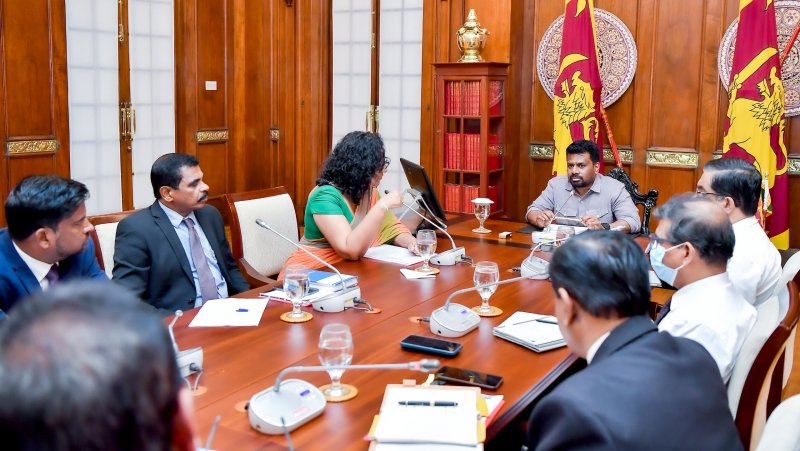










The President issued these instructions during a discussion held at the Presidential Secretariat on the education policy concept paper presented by the National Education Commission (NEC).
During the meeting, the Chairman of the National Education Commission stated that the current education reform process is being developed across key pillars, including early childhood education, general education (primary, secondary and tertiary), higher education, vocational education, technical education, digital education, and non-formal education.
The discussion also reviewed Sri Lanka’s existing education system, previous education reforms implemented over the years, and the social changes they have brought about. The President instructed officials to carefully evaluate those reforms and incorporate the valuable lessons learned into the formulation of the new national education policy framework.
Commission members noted that since the establishment of the National Education Commission in 1991, several education policies have been introduced. They pointed out that a significant portion of the 1997 education policy had been implemented in primary education.
It was also observed that although a policy for general education was introduced in 2016, it was not implemented, while the education policy prepared in 2023 was never formally adopted as the country’s national education policy.
The meeting further highlighted that previous education reforms had largely been based on programmes introduced by education-related institutions rather than being guided by a comprehensive national policy framework.
President Dissanayake stressed that while a new education policy framework is being prepared, reforms should be introduced without disrupting the continuity of the existing education process.
Describing the task as a significant challenge before the National Education Commission, the President said it would be incorrect to regard Sri Lanka’s education system as either entirely successful or entirely unsuccessful.
He emphasized that policymakers must carefully identify both the strengths and weaknesses of the current system. The President further noted that the success or failure of education reforms cannot be judged in the short term, as their true impact can only be assessed over time through the social changes they produce. Therefore, he stressed that education reforms require greater caution and long-term planning than most other policy reforms.
Discussions also focused on ensuring that the new education policy framework addresses future social challenges by equipping students with the skills and qualities required to become responsible citizens in a changing society.
Special attention was also given to the need for a regulatory framework covering sectors of education that are currently not properly regulated, including private education. The meeting also discussed the importance of conducting further research on higher education reforms and the regulation of private universities.
Prime Minister Dr. Harini Amarasuriya, Deputy Minister of Education and Higher Education Dr. Madhura Seneviratne, Deputy Minister of Vocational Education Nalin Hewage, Presidential Secretary Dr. Nandika Sanath Kumanayake, Senior Additional Secretary to the President Kapila Janaka Bandara, Secretary to the Ministry of Education, Higher Education and Vocational Education Nalaka Kaluwewa, Chairman of the National Education Commission Professor A. Sarath Ananda, members of the National Education Commission, and several senior officials attended the meeting.