











ads
Rs. 1.2 Billion Compensation Awarded to Nilwala-Affected Farmers

Rs. 1.2 Billion Compensation Awarded to Nilwala-Affected Farmers

zira-fb
zira-twitter
zira-whatsapp
zira-viber
zira-fb
zira-twitter
zira-whatsapp
zira-telegram
zira-viber
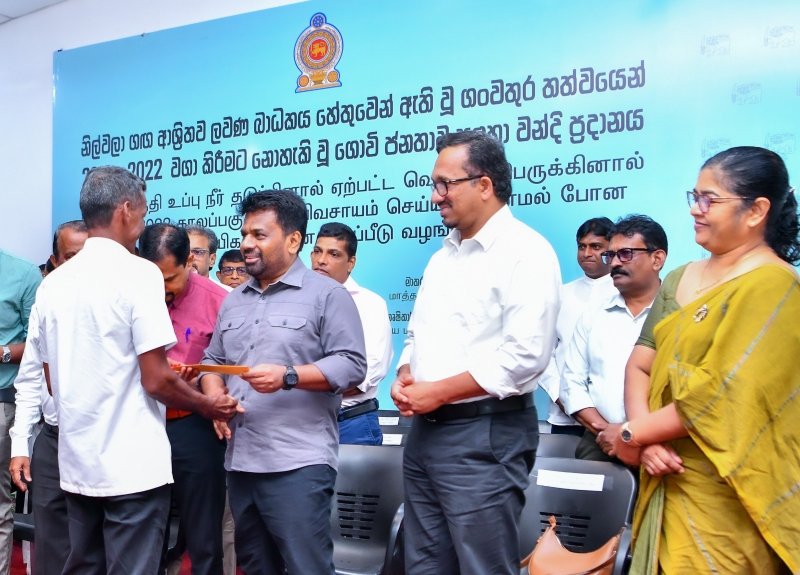
Compensation was awarded this morning (27) under the patronage of President Anura Kumara Dissanayake to farmers who were unable to cultivate their lands between 2019 and 2022 due to flooding caused by the salinity barrier in the Nilwala River. The event was held at the Malimbada Pradeshiya Sabha Auditorium in Matara. The salinity barrier, constructed in 2019, caused continuous damage to agricultural lands in several areas of the Matara District, including Kamburupitiya, Kekanadura, Malimbada, Wilpita, Madiha and Thalalla. Although previous governments failed to provide a proper solution to the issue, the present Government allocated Rs. 1.2 billion in the 2026 Budget to compensate the affected farmers. Accordingly, compensation is being paid for seven consecutive cultivation seasons, from the 2019 Yala season to the 2022 Yala season. All farmers who had duly reported crop damage to Agrarian Service Centres during the relevant cultivation seasons are eligible for compensation. Payments are to be made in respect of 12,800 acres of uncultivated farmland. Compensation was symbolically awarded today to 250 farmers by the President, while payments to all eligible farmers are expected to be completed within the next 14 days. Addressing the gathering, President Anura Kumara Dissanayake stated that the country has now established a strong economy founded on discipline and accountable governance, enabling the Government to provide the highest compensation payments in the nation’s history during times of hardship. He stressed that the Government’s policy is to provide compensation within a short period whenever damage occurs. At the same time, he noted that the Government has initiated programmes not only to address the immediate concerns faced by the public, but also to gradually strengthen their economic conditions and integrate them into the national economy. The President further pointed out that Rs. 90 billion has been allocated under the Ministry of Industries to provide loans to small-scale entrepreneurs, while Rs. 25 billion has been allocated for the 2026 “Praja Shakthi” programme aimed at strengthening rural economies. Highlighting the progress achieved in several key economic indicators after decades, the President stated that economic growth should be measured not only by data, but also by improvements in the people’s quality of life. President Anura Kumara Dissanayake also stated that the public has no desire to remove a government that remains accountable to the people, adding that only thieves, fraudsters and drug traffickers dream of doing so. He further alleged that those facing corruption and fraud charges before the courts were attempting to spread falsehoods out of fear, but noted that the present Government continues to move forward while gaining increasing public confidence. The President also expressed his appreciation to the staff of the Matara District Secretariat, the Department of Agrarian Development, the Department of Agriculture, and the Agricultural and Agrarian Insurance Board for their dedication in implementing the compensation programme. He further stated that the Government has planned a wide-ranging development programme for the Matara District, including permanent solutions to the Matara flood issue and measures to provide stable income sources and improved living standards for economically disadvantaged communities. Emphasising that education is the most important pathway to improving people’s lives, the President noted that the Government has already launched a broad education reform programme, including the modernisation of schools islandwide and the establishment of 50 vocational training centres. Speaking at the event, Industry and Entrepreneurship Development Minister Sunil Handunnetti said: “We promised during the election campaign that we would bring an end to the Nilwala tragedy. There are several issues involved, including flooding and the inability of farmers to cultivate due to the salinity barrier. Even before coming to power, the coordination committee was repeatedly confronted with the grievances of affected farmers. “Today, these beneficiaries are not only receiving compensation, but a panel of experts has also been appointed to identify sustainable solutions to the problems associated with the Nilwala River. By the end of this year, feasibility studies will be completed and the necessary steps will be taken to permanently resolve the salinity barrier issue. Rs. 500 million has been allocated for this purpose. “In addition, Rs. 1.2 billion has been allocated to compensate farmers who suffered crop losses over several cultivation seasons from 2019 to 2022. Before coming to power, we protested for years demanding compensation for these farmers. Today, we are able to provide compensation without requiring people to protest. “Some farmers are receiving compensation amounting to nearly Rs. 2.9 million. We have allocated a substantial amount of money for these farming communities. We plan to complete all compensation payments by 18 June this year. “Some people claimed that greater compensation could be obtained through protests, while others urged farmers to reject this compensation. However, instead of asking you to protest, we protested on your behalf and ensured that this compensation was granted. The officials present here can bear witness to that. We understood your suffering and your difficulties very well. Certain individuals also claimed that accepting this compensation would result in farmers losing ownership of their lands. That is completely false.” Parliamentarian Professor L. M. Abeywickrama also addressed the gathering, stating: Today, what you are receiving is compensation that farmers were unable to secure during previous administrations despite repeated protests and which had almost reached a point where it would never be granted. Whenever farmers protested, they were given false assurances that compensation would be provided and were then sent away. By the following cultivation season, they would once again suffer crop damage, protest again and receive yet another empty promise. This cycle continued for many years. During the previous administration, there was even a proposal to acquire the affected lands after paying full compensation. However, we pledged to provide relief to the farming communities in five Divisional Secretariat divisions in the lower Nilwala basin who had been unable to cultivate their lands for seven consecutive seasons, from the 2019 Yala season to the 2022 Yala season. We held several rounds of discussions on this matter under the leadership of the Secretary to the President at the Presidential Secretariat as well as at the Parliamentary Secretariat. It was through those discussions that we were able to make this compensation programme a reality. This became possible due to the collective effort of both the political authorities and public officials. Officials of the Agrarian Service Centres, the Department of Agriculture, the Agricultural and Agrarian Insurance Board, representatives of the District Coordination Committees and many others worked with great dedication towards this effort. A committee of experts has now been appointed to provide a sustainable solution to the Nilwala salinity barrier issue, and LKR. 1,000 million has been allocated for this purpose. However, as the project cannot be completed within this year, we utilised those funds, together with allocations already set aside for canal and embankment rehabilitation, to restore and clean the canals and waterways connected to the Nilwala River. As a result, despite the heavy rains experienced in recent times, we were able to minimise flooding in Matara. Minister of Women and Child Affairs Saroja Savithri Paulraj, Deputy Minister Arkam Ilyas, Southern Province Governor Professor Susiripala Manawadu, Members of Parliament Lal Premanath and Ajantha Gammaddege, along with several other public representatives, state officials and representatives of farmers’ organisations, were also present at the event.

Compensation was awarded this morning (27) under the patronage of President Anura Kumara Dissanayake to farmers who were unable to cultivate their lands between 2019 and 2022 due to flooding caused by the salinity barrier in the Nilwala River. The event was held at the Malimbada Pradeshiya Sabha Auditorium in Matara.

The salinity barrier, constructed in 2019, caused continuous damage to agricultural lands in several areas of the Matara District, including Kamburupitiya, Kekanadura, Malimbada, Wilpita, Madiha and Thalalla.

Although previous governments failed to provide a proper solution to the issue, the present Government allocated Rs. 1.2 billion in the 2026 Budget to compensate the affected farmers. Accordingly, compensation is being paid for seven consecutive cultivation seasons, from the 2019 Yala season to the 2022 Yala season.

All farmers who had duly reported crop damage to Agrarian Service Centres during the relevant cultivation seasons are eligible for compensation. Payments are to be made in respect of 12,800 acres of uncultivated farmland.

Compensation was symbolically awarded today to 250 farmers by the President, while payments to all eligible farmers are expected to be completed within the next 14 days.

Addressing the gathering, President Anura Kumara Dissanayake stated that the country has now established a strong economy founded on discipline and accountable governance, enabling the Government to provide the highest compensation payments in the nation’s history during times of hardship.

He stressed that the Government’s policy is to provide compensation within a short period whenever damage occurs. At the same time, he noted that the Government has initiated programmes not only to address the immediate concerns faced by the public, but also to gradually strengthen their economic conditions and integrate them into the national economy.

The President further pointed out that Rs. 90 billion has been allocated under the Ministry of Industries to provide loans to small-scale entrepreneurs, while Rs. 25 billion has been allocated for the 2026 “Praja Shakthi” programme aimed at strengthening rural economies.

Highlighting the progress achieved in several key economic indicators after decades, the President stated that economic growth should be measured not only by data, but also by improvements in the people’s quality of life.

President Anura Kumara Dissanayake also stated that the public has no desire to remove a government that remains accountable to the people, adding that only thieves, fraudsters and drug traffickers dream of doing so.

He further alleged that those facing corruption and fraud charges before the courts were attempting to spread falsehoods out of fear, but noted that the present Government continues to move forward while gaining increasing public confidence.

The President also expressed his appreciation to the staff of the Matara District Secretariat, the Department of Agrarian Development, the Department of Agriculture, and the Agricultural and Agrarian Insurance Board for their dedication in implementing the compensation programme.

He further stated that the Government has planned a wide-ranging development programme for the Matara District, including permanent solutions to the Matara flood issue and measures to provide stable income sources and improved living standards for economically disadvantaged communities.

Emphasising that education is the most important pathway to improving people’s lives, the President noted that the Government has already launched a broad education reform programme, including the modernisation of schools islandwide and the establishment of 50 vocational training centres.

Speaking at the event, Industry and Entrepreneurship Development Minister Sunil Handunnetti said:

 “We promised during the election campaign that we would bring an end to the Nilwala tragedy. There are several issues involved, including flooding and the inability of farmers to cultivate due to the salinity barrier. Even before coming to power, the coordination committee was repeatedly confronted with the grievances of affected farmers.

“Today, these beneficiaries are not only receiving compensation, but a panel of experts has also been appointed to identify sustainable solutions to the problems associated with the Nilwala River. 

By the end of this year, feasibility studies will be completed and the necessary steps will be taken to permanently resolve the salinity barrier issue. Rs. 500 million has been allocated for this purpose.

“In addition, Rs. 1.2 billion has been allocated to compensate farmers who suffered crop losses over several cultivation seasons from 2019 to 2022. Before coming to power, we protested for years demanding compensation for these farmers. Today, we are able to provide compensation without requiring people to protest.

“Some farmers are receiving compensation amounting to nearly Rs. 2.9 million. We have allocated a substantial amount of money for these farming communities. We plan to complete all compensation payments by 18 June this year.

“Some people claimed that greater compensation could be obtained through protests, while others urged farmers to reject this compensation. However, instead of asking you to protest, we protested on your behalf and ensured that this compensation was granted. The officials present here can bear witness to that. We understood your suffering and your difficulties very well. Certain individuals also claimed that accepting this compensation would result in farmers losing ownership of their lands. That is completely false.”

Parliamentarian Professor L. M. Abeywickrama also addressed the gathering, stating:

Today, what you are receiving is compensation that farmers were unable to secure during previous administrations despite repeated protests and which had almost reached a point where it would never be granted. Whenever farmers protested, they were given false assurances that compensation would be provided and were then sent away. By the following cultivation season, they would once again suffer crop damage, protest again and receive yet another empty promise. This cycle continued for many years.

During the previous administration, there was even a proposal to acquire the affected lands after paying full compensation. However, we pledged to provide relief to the farming communities in five Divisional Secretariat divisions in the lower Nilwala basin who had been unable to cultivate their lands for seven consecutive seasons, from the 2019 Yala season to the 2022 Yala season.

We held several rounds of discussions on this matter under the leadership of the Secretary to the President at the Presidential Secretariat as well as at the Parliamentary Secretariat. It was through those discussions that we were able to make this compensation programme a reality. This became possible due to the collective effort of both the political authorities and public officials. Officials of the Agrarian Service Centres, the Department of Agriculture, the Agricultural and Agrarian Insurance Board, representatives of the District Coordination Committees and many others worked with great dedication towards this effort.

A committee of experts has now been appointed to provide a sustainable solution to the Nilwala salinity barrier issue, and LKR. 1,000 million has been allocated for this purpose. However, as the project cannot be completed within this year, we utilised those funds, together with allocations already set aside for canal and embankment rehabilitation, to restore and clean the canals and waterways connected to the Nilwala River. As a result, despite the heavy rains experienced in recent times, we were able to minimise flooding in Matara.

Minister of Women and Child Affairs Saroja Savithri Paulraj, Deputy Minister Arkam Ilyas, Southern Province Governor Professor Susiripala Manawadu, Members of Parliament Lal Premanath and Ajantha Gammaddege, along with several other public representatives, state officials and representatives of farmers’ organisations, were also present at the event.

0%
0%
0%
0%
Comments