

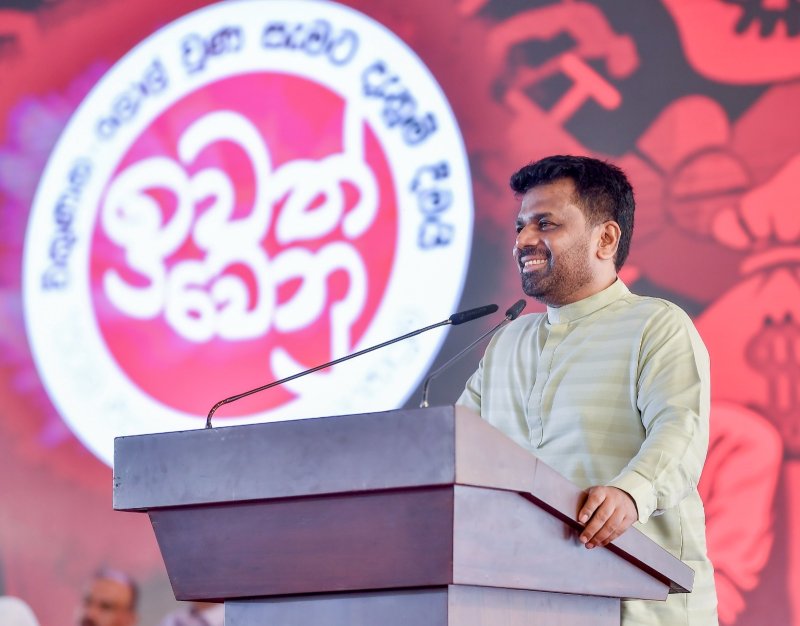










The President further stated that if the existing legal framework proves inadequate, steps would be taken to introduce new legislation. He stressed that the Government, religious institutions and the public must work continuously, with determination and vigilance, to defeat this menace, and invited everyone to join the effort.
President Anura Kumara Dissanayake made these remarks this afternoon (20) while attending the “ Ratama Ekata” Batticaloa District Programme aimed at defeating the narcotics menace, held at the Batticaloa Weber Stadium.
Addressing the gathering, the President further stated that significant progress had been achieved in narcotics-related raids and arrests during the six months since the launch of the “ Ratama Ekata” national operation.
The President also commended the officers of the Police Special Task Force in the Eastern Province for their exceptional contribution towards narcotics eradication operations.
The President’s full speech delivered at the event is as follows:
“Today, we have gathered with the objective of overcoming one of the most serious challenges facing our country. As a Government, we are focusing on several key challenges and are working with a firm determination to rebuild the nation.
Our first challenge is the task and journey of building a strong economy. Over the recent past, we have faced several challenges affecting our economy. Certain tax policies imposed by various countries had placed pressure on our economy.
Cyclone Ditwah became the disaster with the greatest economic impact in Sri Lanka’s recent history. Since it was an internal challenge, we were able to confront it with strength.
More recently, a war situation centred in the Middle East region has emerged. This has created economic challenges for all countries, regardless of whether they are considered developed nations or countries with weaker economies.
The economic challenges we are facing can mainly be divided into two categories. The first is earning sufficient revenue for the Treasury. We have managed this successfully. We now possess a Treasury account with the highest surplus in Sri Lanka’s history. As a result, we were able to allocate Rs. 500 billion to face the impact of Cyclone Ditwah. Likewise, because funds were available in the Treasury, we were able to intervene to mitigate the rise in fuel prices and electricity tariffs caused by the conflict in the Middle East. We have allocated a further Rs. 100 billion for that purpose. Last April, Rs. 20 billion was allocated for a fuel subsidy, and another Rs. 20 billion each will be provided for the next two months. Even today, the Government is providing a subsidy of Rs. 100 for every litre of fuel used by the public. This has been possible because the Treasury has sufficient funds.
Similarly, the increase in fuel prices compelled us to increase electricity tariffs to some extent. However, 95% of electricity consumers will not experience an increase in their electricity bills because the Government has decided to provide a subsidy. Therefore, during the most recent tariff revision, only around 5% of consumers experienced an increase. We will continue this subsidy until September. The Government is bearing an expenditure of Rs. 15 billion for this purpose. As a result of sound economic management, our Treasury possesses the financial strength necessary to face such disasters.
However, we are currently facing a crisis relating to the US dollar. In particular, the dollar has strengthened against other currencies, which has affected our rupee. One of our main sources of income is the tourism industry, which earns dollars. Compared to last April, tourist arrivals have declined by 29%, affecting our dollar inflow. Due to the global economic crisis, demand for our exports has also declined, leading to a shortage of export earnings in dollars. On the other hand, remittances sent by Sri Lankans working overseas have also declined this month.
At the same time, the increase in the value of the dollar has significantly raised the monthly cost of fuel imports. In February, fuel imports cost us US$98 million. In March, this increased to US$216 million, in April to US$368 million, and in May to US$522 million. The monthly fuel import bill has now exceeded US$500 million. This has placed pressure on the rupee and increased demand for dollars. Therefore, a number of measures are being prepared to address this crisis.
At present, we are managing the economy within the framework of the Extended Fund Facility programme linked to the International Monetary Fund.
Therefore, we are discussing with them the decisions that need to be taken, while also presenting our own proposals. We must control this short-term pressure on the dollar. To achieve this, we must reduce fuel consumption.
We must also pay greater attention to the use of imported goods and reduce import expenditure. I urge all citizens to think about how each of us can individually contribute towards reducing the outflow of dollars from the country. Let us face this short-term crisis with strength. I assure you that we will never allow the country to return to the destructive economic conditions of the past. That is the economic journey before us.
At the same time, we need a strong public service. We require a strong State service extending from the Police and the Tri-Forces to the District Secretaries and officials at every level. We are working towards that objective. Vacancies in the public service are being filled through relevant recruitment processes. We have already implemented salary increases in three stages, with another increase due next January. Nevertheless, many major issues still remain to be resolved.
Today, our ultimate objective is to free our motherland, our younger generation and our nation from the scourge of narcotic drugs. Narcotics have become a national disaster in our country. On the one hand, they are consuming our youth, causing immense suffering to parents. A generation lacking discipline and civility is emerging. The scale of this disaster is reflected daily in the news reports we receive. It has become a social tragedy. Therefore, we recognise ending this disaster as an extremely important and decisive task.
At one time, narcotics were largely confined to a few small towns centred around tourist zones. Today, this menace has spread to even the most remote villages. Our young men and women are falling victim to it. We launched this national campaign on 30 October last year, and six months have now passed. During these six months, 5,122 boys under the age of 21 and 128 girls have been arrested. Our Tri-Forces and Police are performing an honourable service, yet even some officers have been arrested in connection with narcotics. Public officials have also been arrested. This disaster has spread to the extent that no responsible or respected institution has remained untouched.
It has even spread into places of worship that we revere and worship. We are confronted with a frightening social reality. Regardless of age, social status, religion or whether one is an ordinary citizen, the narcotics menace has become a major disaster in our country. Should we not defeat it? We must free our people from this scourge. We have arrived at a firm determination to defeat this menace.
Four main factors contributed to this disaster growing to such proportions. The first was political protection. Drug traffickers and the narcotics trade flourished under political patronage. During the last Presidential Election, the people of this country gave us a historic mandate. I can assure you of one thing: we have now completely eliminated the political protection previously enjoyed by drug traffickers. No official is now subjected to pressure.
We provide the necessary support for officials to carry out their responsibilities with dignity, and results are now being achieved.
In recent months, our Navy has seized large consignments of narcotics. The Police have conducted raids day and night. As a result, during the past six months alone, 1,943 kilogrammes of heroin, 2,008 kilogrammes of crystal methamphetamine (“ice”) and 40,755 kilogrammes of cannabis have been seized.
We are confronted with a major disaster. The first step in defeating it was to remove drug traffickers from political protection, and we have done that. At the same time, proper recognition is being given to all those dedicated to this task, especially the Tri-Forces and the Police. All mechanisms involved in suppressing this menace, including the Tri-Forces, Police, Customs and the Department of Immigration and Emigration, have now been brought under a unified operation. This is a significant step. Arrests have increased substantially.
Criminal gangs linked to this narcotics menace have also emerged. During recent times, there have been incidents of shootings, many of which were conflicts related to the drug trade, resulting in armed clashes. We must completely eradicate the underworld. Already, we have arrested and brought back to Sri Lanka 28 underworld members who had been overseas.
These underworld leaders had operated under various aliases. More arrests will follow shortly. Some had even directed operations from within prisons. We have now taken steps to transfer these groups to special detention camps. Instead of ordinary prisons, special detention facilities have been established for them. If we are to defeat this menace, the underworld must be crippled.
I ask the officers of the Police and the Tri-Forces, who have been entrusted with responsibilities under the law: are you not capable of suppressing these underworld networks operating under various aliases? I invite you to join this effort.
During these six months, 83 T-56 firearms, 118 pistols, 75 revolvers and hand grenades have been seized. Weapons belonging to the underworld have been confiscated. If this narcotics trade is to be suppressed, the underworld must also be suppressed.
At the same time, the rule of law must prevail equally over everyone. From myself to a Pradeshiya Sabha member, from the President’s Secretary to a Grama Niladhari, from the city to the village, everyone must be equal before the law. We must build a country where no one is above the law.
Some people cannot tolerate such a country because they are not accustomed to living in one. Some believe they are above the law. There was a period when such attitudes prevailed, but we are ending that era. Whatever privileges or advantages one may have enjoyed in the past, or whatever one’s family background may be, none of that matters before the law. Everyone is equal before the law. This is especially important in combating narcotics. However, when the law begins to reach those who once considered themselves above it, they become unsettled because they are not accustomed to respecting the law.
We harbour no hatred or anger towards anyone. We have simply been entrusted by the people with a responsibility. We must build a society where everyone lives within the boundaries of the law. Therefore, no amount of shouting, protesting or bringing crowds before law enforcement institutions will weaken the implementation of the law. They must understand that the law cannot be bent. The law will be enforced equally. Much more will happen in the future. The Criminal Investigation Department, the Colombo Crimes Division, the Financial Crimes Investigation Division and the Narcotics Bureau are all conducting investigations. Some individuals have already been arrested, while investigations are continuing against others.
Cases have already been filed against some individuals and those cases are currently before the courts. Each institution will be vested with the authority required within its legal mandate. No one will interfere in your investigations. However, we trust that the institutions concerned will properly fulfil the responsibilities entrusted to them. I especially tell the officers of the Tri-Forces and the Police that we have created an environment where you can work with dignity and confidence. You are accountable only to the legal framework under which you operate.
As President, I understand the responsibilities and limitations attached to my office, and I will not exceed them. Likewise, you too understand the limits within which you are empowered to act under the law. Operate within those limits. If those limits prove inadequate for certain tasks, we will expand them through legislation. We intend to pass special laws in Parliament to suppress organised armed criminal gangs. If the law is insufficient, we will strengthen it.
There has also been significant debate regarding narcotics seized by the authorities, whether they return to the market or whether they are destroyed. However, all such matters fall within a legal framework. We are now taking steps to introduce legislation to ensure that seized narcotics are destroyed within a very short period of time. Discussions on this are currently at the final stage. There were previously areas into which no one could enter.
For instance, there were officials at the airport who could not be checked. We have changed that. Everyone must now use the identification issued by the airport authorities. There were also restrictions preventing entry into ports and Customs areas. If there is intelligence information, we will grant investigative officers the authority to enter those areas. We will strengthen these laws. Let us fulfil this responsibility.
The public also has a major role to play. You know who in your village sells drugs and who is addicted. We need the support of ordinary citizens. Therefore, come forward. Let us defeat this menace. If we continue this effort with persistence, vigilance and unwavering determination, we can defeat it. I invite everyone to join this cause.”
Minister of Public Security and Parliamentary Affairs Ananda Wijepala, Minister of Industry and Entrepreneurship Development Sunil Handunnetti, Eastern Province Governor Dr Jayantha Lal Ratnasekera, Deputy Minister of Foreign Employment and Foreign Affairs Arun Hemachandra, Members of Parliament Kandasamy Prabhu, Roshan Akmeemana, M.L.A.M. Hizbullah and Secretary to the Governor's Office of the Eastern Province J.S. Arulraj, along with several public representatives, Secretary to the Ministry of Defence Air Vice Marshal Sampath Thuyacontha, Secretary to the Ministry of Public Security and Parliamentary Affairs Ravi Seneviratne, Inspector General of Police Priyantha Weerasooriya, other State officials and heads of the security forces were also present at the occasion.

