
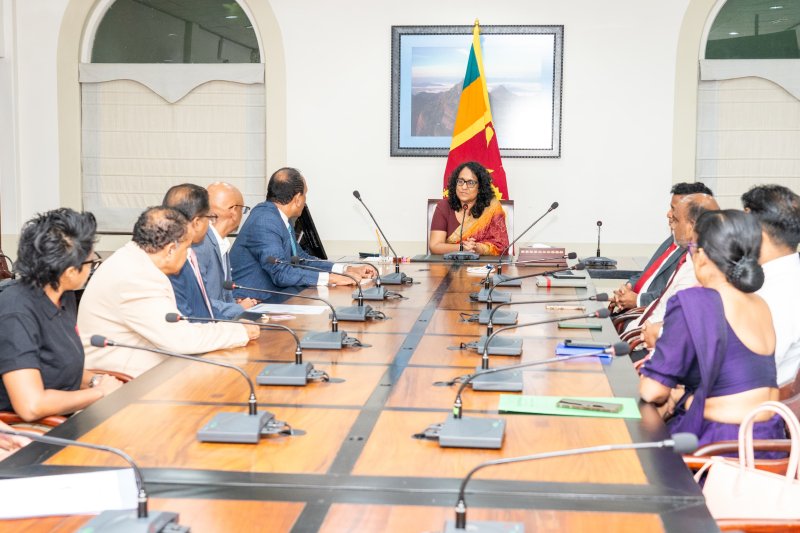










The Prime Minister made these remarks during a discussion held at the Prime Minister’s Office with representatives of Rotary International and a group of professionals from Sri Lanka’s software industry, facilitated by the Digital Task Force.
The Prime Minister pointed out that smart classrooms should not be limited to merely displaying YouTube videos, but must instead focus on creating high-quality digital educational content aligned with the national curriculum. She further stressed the importance of delivering all educational materials through an official government platform such as “e-Thaksalawa,” rather than through various private platforms, ensuring consistency and quality standards.
Prime Minister Dr. Amarasuriya also highlighted the need to implement digital training programmes centered around the 20 National Colleges of Education responsible for teacher training. She noted that familiarizing approximately 6,000 trainee teachers annually with digital technology could bring about a qualitative transformation within the school system.
During the discussion, it was revealed that steps are being taken to establish smart classrooms in 100 selected schools. Under the first phase, facilities will be provided to 50 schools, while the remaining 50 schools will receive the facilities in a later phase. Representatives of Rotary International stated that they are prepared to provide digital learning platforms to the Government free of charge and support the creation of educational content using modern technologies such as Artificial Intelligence (AI).
Attention was also drawn to the importance of establishing a formal agreement-based mechanism between the Government and the private sector to ensure the long-term sustainability of these projects. Both parties held discussions on managing practical challenges such as electricity costs and internet connectivity expenses in schools while implementing the process in a systematic manner.
The Prime Minister further stated that a five-year plan for the digital transformation of the education system will be finalized in the near future and requested Rotary representatives to contribute in line with the priorities identified within the plan.
The discussion was attended by the Secretary to the Prime Minister, Mr. Pradeep Saputhanthri, Additional Secretary to the Prime Minister A.B.M. Ashraf, officials from the Ministries of Education, Higher Education and Vocational Education, representatives of the Digital Task Force, and officials from Creative Software and Cambio Software Engineering.