
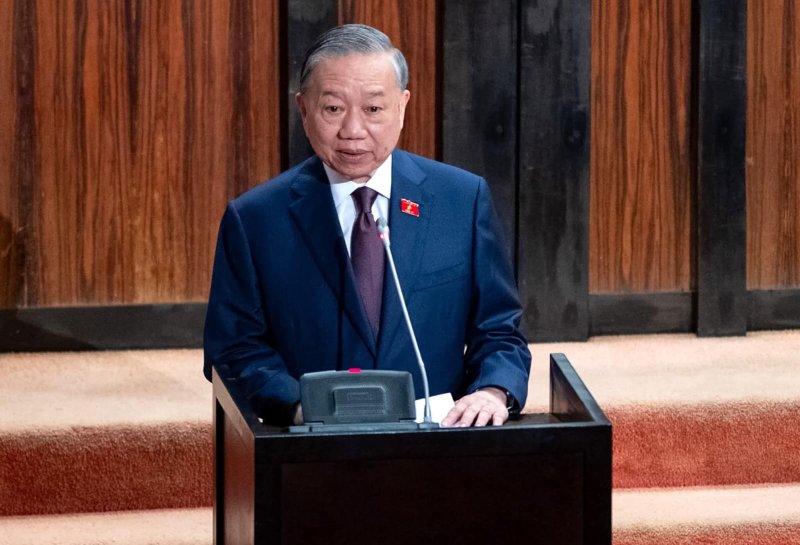











Upon his arrival at the Parliament of Sri Lanka, the President of the Socialist Republic of Viet Nam was received by Speaker of Parliament Dr. Jagath Wickramaratne and Secretary General of Parliament Mrs. Kushani Rohanadeera. PMD reported.
Thereafter, President To Lam signed the visitors’ commemorative book and engaged in a cordial discussion with Speaker Dr. Jagath Wickramaratne.
President To Lam made history as the first Head of State to address the Parliament of Sri Lanka after a lapse of 11 years.
Prime Minister Dr. Harini Amarasuriya and Opposition Leader Sajith Premadasa also delivered remarks expressing their appreciation for President To Lam’s address to Parliament.
Address Delivered by H.E. To Lam, President of the Socialist Republic of Viet Nam
“It is a great honour for me to address the Parliament of Sri Lanka today, the supreme legislative body of your country, representing the aspirations, expectations and advancement of the people of Sri Lanka. On behalf of the Party, State and people of Viet Nam, I wish to extend our warm greetings and sincere fraternity to you, Honourable Speaker, Honourable Members of Parliament and the people of Sri Lanka.
I express my heartfelt gratitude to the Parliament, Government and people of Sri Lanka for the gracious, generous and brotherly reception extended to the Vietnamese delegation.
I commend the efforts and achievements of the Government, Parliament and people of Sri Lanka in strengthening national stability, recovery and development. Given the long-standing traditions of your civilisation, Sri Lanka’s strategic location in the Indian Ocean, the determination of your people and the commitment of your leaders, we are confident that Sri Lanka will continue to move forward in building a nation of peace, stability and prosperity.
Sri Lanka occupies a special place in the historical memory and hearts of the Vietnamese people. President Ho Chi Minh stayed here on three occasions during his revolutionary journey. His statue in Colombo, unveiled in 2013, has become a symbol of the affection the Sri Lankan people hold for the Vietnamese people.
For the Vietnamese people, this represents not only the journey of a national leader in the struggle for independence, but also the natural meeting point of two nations that cherish freedom, peace, humanity and justice. As President Ho Chi Minh once said: ‘If the nation is independent, but the people are unable to enjoy happiness and freedom, then that independence is meaningless.’ This sentiment resonates strongly with the aspirations of your people for an independent, peaceful and prosperous nation.
Although Viet Nam and Sri Lanka are geographically distant, our histories, cultures and development aspirations are closely connected. Both nations possess long-standing traditions and value compassion, tolerance and harmony. Buddhism and Eastern cultural values have helped nurture peace, fraternity, collectivism and humanism.
Since the establishment of diplomatic relations on 21 July 1970, our ties have continued to grow for more than half a century. Last year, we celebrated the 55th anniversary of diplomatic relations and President Anura Kumara Dissanayake visited Viet Nam and attended the International Vesak Day celebrations in Ho Chi Minh City.
These events demonstrate that our relationship has been built not merely on diplomatic documents, but also on mutual understanding and trust between our peoples. Today, before the Parliament of Sri Lanka, allow me to share Viet Nam’s development journey, particularly the past 40 years of the Doi Moi reforms.
Forty years ago, when Doi Moi (Renewal) began in 1986, Viet Nam was facing immense challenges. With infrastructure devastated by war, an economy in decline and people suffering severe hardship, we chose a new path.
Doi Moi was fundamentally a new way of thinking. We realised that national development required confronting reality, reforming outdated institutions, harnessing the creativity of the people and encouraging the contribution of the business sector. We therefore transitioned from a centrally planned, subsidy-dependent economy to a socialist-oriented market economy. In doing so, the Government acted as regulator, guide and facilitator of development while respecting market principles and maintaining international engagement.
In the agricultural sector, Viet Nam not only achieved self-sufficiency, but also transformed itself from a country facing food shortages into one of the world’s leading agricultural exporters.
By opening our doors to foreign investment and developing industry and services, we became integrated into global value chains.
Throughout this process, maintaining self-confidence and independence remained essential. Viet Nam remains committed to being a responsible and trusted partner within the international community.
As a result of these reforms, Viet Nam has risen from being among the world’s poorest nations to becoming one of the world’s leading rice exporters and one of the 32 largest economies globally. By 2025, our GDP had reached US$514 billion, while per capita income exceeded US$5,000. We have entered into more than 20 free trade agreements and established economic links with over 60 major economies.
There are many lessons from our journey that may be valuable to developing nations. While we have emerged as one of the world’s leading investment destinations and established free trade agreements with more than 20 countries, we continue to strengthen economic ties with over 60 major economies and serve as a reliable partner in international cooperation.
We still face numerous challenges. Yet we continue to overcome global challenges and draw lessons from our experiences. For developing countries, it is essential to safeguard national independence and self-confidence while actively engaging with the world and strengthening domestic capabilities to attract foreign investment and expand trade.
Every nation must protect its legitimate interests and choose a development path suited to its own conditions. Independence and self-reliance must form the foundation of this process. Self-reliance does not mean isolation. Rather, it means possessing the confidence and strength to work with all partners on the basis of equality, mutual trust and respect. Viet Nam believes internal strength is decisive, while external resources are an important contributing factor. Internal strength lies in our institutions, culture, traditions, aspirations and the creativity of our people. External resources include knowledge, markets, technology, investment and managerial expertise from the international community. Development depends on harmonising these two forces. While international cooperation opens vast opportunities, internal strength continues to play a decisive role.
Although foreign investment is necessary for national development, it alone is not sufficient. Sustainable development requires stronger infrastructure, enhanced labour productivity and greater innovation. Viet Nam is striving to move away from traditional capital- and labour-intensive growth towards development driven by science, technology, digitalisation, green transition and a highly skilled workforce. In strengthening this growth, the rule of law, Parliament and effective national governance are essential.
Innovation must begin with ideas. Sustainable and inclusive development requires a stable and fair legal framework. When opening a new path, Parliament must ensure that it is guided by law, accountability and the will of the people.
Institutionalising development strategies, enacting laws, making decisions, ensuring competitiveness and carrying out oversight all constitute nationally important responsibilities. As I address the Parliament of Sri Lanka today, it is clear to me that legislative institutions play a vital role in building trust, implementing reforms and ensuring inclusive development. A sound policy framework can transform an entire sector, while correct development thinking can open a new path for an entire nation.
In Viet Nam, Doi Moi reforms represent not merely a series of open economic policies, but a transformation in how we view development and the role of the State, the market, the people and the business community. Implementation and review, regulation and improvement are all equally important. We continue to carry out Doi Moi reforms steadily and without extremism.
The lesson to be learned from Viet Nam is that we must respect objective legal and institutional systems.
The ultimate purpose of development is to place people at the heart of progress. Development is not measured solely by GDP, but by better living standards, quality education for children, stable employment opportunities, community safety and the trust placed in us by the people. For this reason, we consistently integrate economic growth with social welfare, education, healthcare and rural development. The people must not merely be beneficiaries, but innovators, participants and stakeholders in the development process.
We must recognise that agriculture, farmers and rural communities are fundamental to stability and development. For many developing countries, agriculture is not merely one economic sector among many, but a foundation for food security, livelihoods and social stability. Much of Viet Nam’s Doi Moi reforms began in agriculture and rural areas. From our experience, we understand the importance of securing farmers’ livelihoods, developing infrastructure, modernising agricultural production, improving post-harvest processing and building strong market brands.
Development is changing rapidly. Science, technology, artificial intelligence, digital transformation, climate change, supply chain shifts and strategic competition are creating both opportunities and challenges for nations.
We understand that aspirations can only be realised through international cooperation. Every country has its own history, culture, resources and choices. What we wish to share with you are both our successes and our shortcomings, with openness and a willingness to learn together.
As we speak about our long-standing relationship, we hope to open a deeper, more practical and more effective new chapter of cooperation with Sri Lanka. Based on our political trust, traditional friendship and growing cooperation, I am pleased to inform your Parliament and people that Viet Nam and Sri Lanka have agreed to elevate relations to a Comprehensive Partnership. This creates greater opportunities to strengthen cooperation in politics, economics, investment, agriculture, education, science, technology and digital transformation.
At the same time, we recognise that challenges such as labour productivity, climate change and digital transformation remain before us. Development is a continuous journey. From our experience, we have learned several key lessons:
1. National independence and global integration must go hand in hand. While attracting foreign investment, strengthening domestic capacity is essential.
2. The rule of law and good governance are critical for sustainable development. Transparent legal foundations and the role of Parliament are indispensable.
3. People-centred development is vital. Development should not be measured solely by GDP figures, but by the quality of life and happiness of the people.
4. Agriculture remains the foundation of food security and social stability for many developing nations.
Viet Nam aims to become an upper-middle-income country by 2030 and a developed high-income country by 2045. We look forward to opening a new chapter of cooperation with Sri Lanka. I am pleased to announce that our two countries have agreed to elevate bilateral relations to a Comprehensive Partnership.
Under this framework, cooperation will be expanded in the fields of politics, defence, trade, agriculture, education, science, technology and digital transformation. In particular, we hope to:
• Increase bilateral trade to US$1 billion
• Share experience in agriculture and food security
• Strengthen cooperation in digital transformation, artificial intelligence and green growth
• Promote tourism and Buddhist ties
• Work closely together at international forums and within the United Nations
Small and medium-sized countries should seek strength not through conflict, but through international law, cooperation and good governance. As a nation that has experienced the devastation of war, we understand the true value of peace.
From Hanoi to Colombo and from the East Sea to the Indian Ocean, we share a common belief: peace is our foundation, the people are at the centre and development is our goal.
May the Parliament of Sri Lanka continue to stand as a symbol of the aspirations of its people. May peace and prosperity prevail upon the Government and people of Sri Lanka. May the friendship between Viet Nam and Sri Lanka flourish forever.