
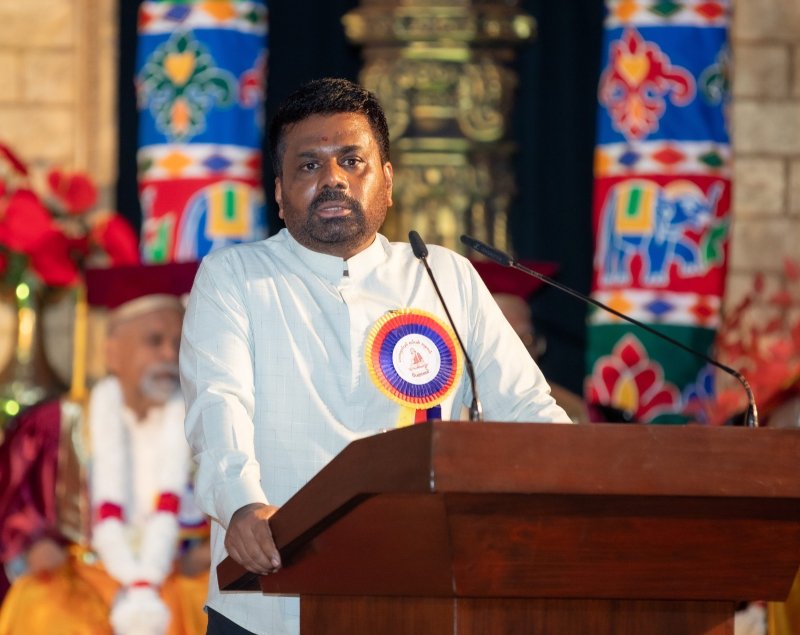







The President made these remarks while attending the “Kamban Festival” held at the Ramakrishna Hall in Wellawatte.
The President, who attended the Kamban Festival, one of the principal literary and cultural events of the Tamil community, was received in accordance with traditional Hindu rituals.
Addressing the event, the President further stated that literature and culture bear a significant responsibility in the creation of a new society that places humanity at its forefront.
In recognition of President Anura Kumara Dissanayake’s efforts to foster an environment in which all communities in the country can live together in unity and equality, he was conferred with the Kamban Award.
The All Ceylon Kamban Kazhagam was established in Jaffna in 1980 in the name of the great Tamil poet Kamban. The organisation aims to guide the younger generation along a righteous path rooted in culture and patriotism and it annually organises the Kamban Festival.
Individuals who have contributed to the advancement of Sri Lankan society are honoured at the event without distinction of ethnicity or religion. In previous years, many distinguished personalities from both India and Sri Lanka have been recipients of these awards.
Among those present at the occasion were Kurukkals, Fisheries, Aquatic and Ocean Resources Minister, Ramalingam Chandrasekaran, former Malaysian Minister and Member of Parliament, M. S. Aravanan, former State President of the Bharatiya Janata Party in India K. Annamalai, internationally renowned liver transplant specialist Dr. Mohamed Rela, Court of Appeal Judge P. Sasimahendran, and Colombo Kamban Kazhagam patron and former Court of Appeal Judge Vishvanadan, among others.
President Anura Kumara Dissanayake, further addressing the gathering, stated that…
I am deeply grateful for the invitation extended to me to attend this Kamban Festival, as well as for the affection and respect you have shown towards me. I understand that this year’s festival is being held over a period of four days.
I believe that in our struggle to recover from the profound tragedy that has befallen our society, a significant responsibility rests upon the literary and cultural spheres.
Around the 12th century, the poet Kamban succeeded in reinterpreting and recreating the Ramayana. It is understood that this work represents a reimagining of the Ramayana originally composed by Valmiki. Each year, the Kamban Association continually discusses his poetry and literary contribution, as well as the themes of social justice and righteous living embedded within his work, thereby deepening public understanding of these values.
Today, as a society, we are facing a profound crisis. Within our education system and broader social structure, a framework has emerged that increasingly reduces our children to the status of machines. We believe that a child’s education is dependent on providing a good formal education and parents make immense sacrifices to ensure this. But what outcome does this burden ultimately produce for our children? A child who wakes up at dawn, goes to school half-asleep, attends additional tuition classes after school and studies late into the night with books in hand has become a common reality today. Are we raising our children as if they are merely nuts and bolts of a machine? Whether we accept it or not, a large number of our children are increasingly becoming components within a mechanical system. What kind of future can we expect from children who have been reduced to such roles? We are witnessing the emergence of a generation lacking emotional warmth, affection and empathy for others. In such a society, many of the fundamental values of human relationships are being eroded and, in effect, frozen out.
What defines value in today’s society? Large vehicles, big houses and the accumulation of wealth have increasingly come to be seen as symbols of worth. Therefore, our society urgently needs to rediscover a sense of values and a moral framework. We must nurture children who possess emotional sensitivity, children who are empathetic, loving, and compassionate towards others. We believe that the Kamban Festival plays a highly significant role in this endeavour. Over the past several days, you and your children have come together to explore the depth of literature and poetry, particularly the Kamban Ramayana, sharing experiences that reinforce these values and integrating them into our way of life.
Today, most of our research and learning is increasingly directed towards technology. Children with mobile phones in their hands have, in many cases, become absorbed into a single application or digital space. Therefore, we must create a broader and more expansive world for our children. That wider world should be one rooted in literature, art, emotional sensitivity and love values that must form the foundation of the environment we build for them.
Our society had become a fragmented one, where people looked at one another with suspicion, hatred, and anger. We were confronted with a society in which the Sinhalese people in the South viewed the Tamil people in the North with suspicion, hostility and resentment.
Similarly, the Tamil community in the North viewed the Sinhalese community in the same manner. What does such a society, filled with hatred, ultimately leave us with? It leaves no victory for either the North or the South. What remains is only destruction and tragedy.
In war, it is humanity that perishes first. In literature, it is humanity that is first revived. That is why literature is essential. We carry a deeply tragic past that, in many respects, still remains unresolved. I still reflect on how a library could be set on fire in the name of an election. One might understand the burning of an election office during an election, but why would a library be set ablaze in such a context?
There is an organic connection between the people of the North and books. In that context, for a community that has embraced reading as a way of life and a culture, people who enter libraries with their footwear removed, the most devastating way to inflict harm is to burn a library. Our society has, therefore, experienced profoundly tragic and harrowing episodes of this nature.
Therefore, we need a country in which all our people, Sinhalese, Tamil, Muslim, Burgher, and Malay can live together in brotherhood. I am aware that we have not yet fully resolved all our issues and that further progress is still required to achieve lasting reconciliation. However, we have already taken a firm and decisive step towards national unity. I assure you that the steps already taken will not, under any circumstances, be reversed. We will not allow any space for racism or extremism to re-emerge in our country.
Our generation experienced conflict, but we must not allow our children to inherit the same circumstances. We need a country where all people live together in brotherhood. Division and exclusion have taken us decades backwards. The history of separation is long, and therefore we must take meaningful steps towards unity. First and foremost, it is essential to recognise and respect the culture of others.
The Sinhalese people have their own distinct identity and culture. The Tamil people likewise possess a unique cultural heritage and the Muslim community also has its own distinct cultural traditions. We need a society in which every culture is treated with respect and dignity.
At this moment, I am reminded of Mr. R. Sampanthan. On one occasion, he told me: “Anura, I am proud to say to the world that I am a Sri Lankan, but I do not wish to live in Sri Lanka as a second-class citizen.” If any community feels that they are treated as second-class citizens in this country, I am not the one to make that judgement for you. I am not your judge. It is for you to be convinced that you are a citizen of this country with equal rights and dignity.
Therefore, everyone who is born in this country, contributes to its economy and belongs to this land must feel a sense of belonging that this is our motherland. Without this, we cannot build national unity. In achieving this task, literature, the arts, sport, education, as well as politics, all have a significant role to play.
Throughout history, we have been shaped by divisive politics, politics that elevated rights to the forefront and fought in their name and politics that stirred opinion against the other.
We do not need divisive politics. We need a united political approach that transcends the North, East and West without distinction. The seeds of racism are deeply embedded within politics itself. If existing laws are not sufficient to defeat racism, we will formulate new laws and ensure that racism is decisively defeated.
Today, we are bringing about a significant transformation within the country. This transformation will deliver a major victory for the people of Sri Lanka. We have a vision of a society in which Sinhalese, Tamil and Muslim communities live together in unity. To achieve this, a renewed vibrancy in the fields of art and literature is essential.
We must incorporate the values of righteous living found in the Kamban Ramayana into our own lives. Let us also embrace the aesthetic richness it offers. We must transform ourselves from merely mechanical beings into true human beings. Even though we breathe and speak, humanity has, in many respects, been diminished. Therefore, in the creation of a new society that places humanity at its forefront, literary festivals hold a highly important place. I would like to express my sincere gratitude to all members of the Kamban Kazhagam for organising this event. What we need is a strong Tamil literary tradition in Sri Lanka, along with strong poets and filmmakers. A significant revival of Tamil arts and culture in Sri Lanka is essential. If there are any organization or associations working towards this goal, we, as the Government, will extend our fullest support.