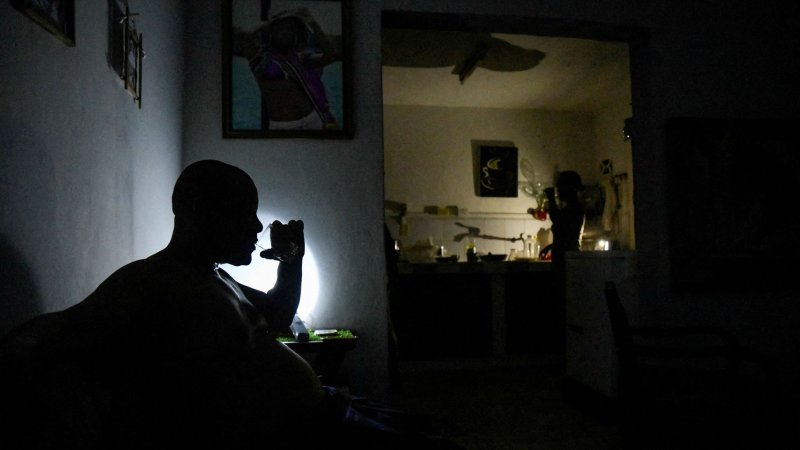
Much of the island including the capital, Havana, was plunged into darkness, with streets only illuminated by headlamps and battery-powered lights on Monday.
UNE, Cuba's grid operator, said early on Tuesday morning that it was gradually restoring electricity to provinces and cities around the country.
It is the latest in a series of widespread blackouts to hit the Caribbean island, where aging electricity infrastructure and chronic fuel shortages have been exacerbated by a US blockade on oil shipments to the communist-run nation.
oupled with shortages of food and medicine, the situation has triggered rare public dissent in the form of street protests, which continued with people banging pots and pans in central Havana on Monday.
Unauthorised demonstrations are illegal in Cuba and those who defy the ban risk being jailed.
"It is not just the blackout," 26-year-old Havana resident Lázaro Hernández told news agency Reuters.
"There is no water because there is no electricity to run the pumps. There is no electricity, no food, no oil, no fuel, and private businesses have high prices because everything is going up now, since they have to move their goods by truck and transport. All of this is really very bad."
Meanwhile, Dayana Machin, also 26 and from Havana, was unsurprised by the blackout. "We're already used to living with this," she said.
Cuba, an island of around 10 million people, relies heavily on fuel imports.
Its regional ally Venezuela was believed to have sent around 35,000 barrels of oil a day - about half Cuba's oil needs - until its supplies were cut off following the seizure of Venezuelan President Nicolás Maduro by the US in early January.
US President Donald Trump has also threatened tariffs on any country supplying oil to Cuba.
It has been three months since the nation has received an oil shipment, Cuba's president, Miguel Díaz-Canel, said on Friday.
With the government in Venezuela now appearing to co-operate with the US, the Trump administration has turned its attention to the Latin American nation the US has shared the most animosity with since its revolution in 1959.
Trump told reporters at the White House on Monday that he believed he would have the "honour of taking Cuba".
"Whether I free it, take it, I could do anything I want with it, you want to know the truth," he said. "They're a very weakened nation right now."
He previously threatened a "friendly takeover" of Cuba and has urged it to "make a deal" or face unspecified consequences.
Díaz-Canel confirmed last week that his government was in the initial stages of talks with the Trump administration to resolve their differences.
At the same time, the Cuban government released 51 prisoners in what it described as a demonstration of "goodwill".
To mitigate the impact of the severe fuel shortage - that has also affected air travel and, with it, tourism to the island - Cuba has increased production of domestic crude and gas, as well as solar generation.
But its actions have yet to quell protests among Cubans, for whom power cuts have been a persistent source of public discontent.