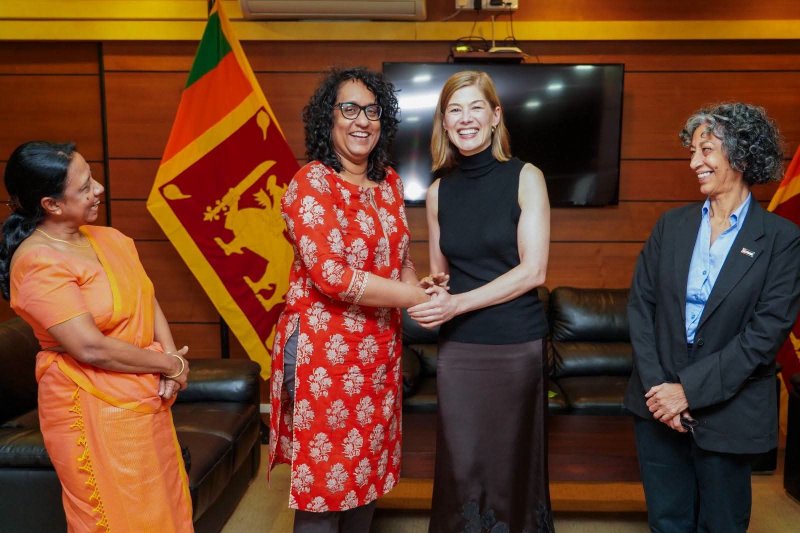
Prime Minister Dr. Harini Amarasuriya said that the exclusion of women from decision-making is not accidental but structurally embedded within gendered power hierarchies, calling for institutional transformation to enable women to lead with confidence and authority.
The Prime Minister made these remarks while participating in the World Woman Davos Agenda 2026 held on January 21 at the World Woman House, on the sidelines of the 56th Annual Meeting of the World Economic Forum in Davos-Klosters, Switzerland.
Addressing a high-level forum under the theme “Women Leading the Changing Global Order,” Dr. Amarasuriya noted that despite women increasingly asserting agency in political, economic and social spheres worldwide, their contributions continue to be systematically undervalued—particularly in unpaid care work, informal labour and agriculture
“From a political standpoint, the exclusion of women from decision-making is not incidental; it is structurally maintained through gendered power hierarchies,” the Prime Minister said. She highlighted that women in leadership, especially in politics, often face harassment, character assassination and systemic marginalisation, which discourages participation and reinforces entrenched patriarchal systems.
Dr. Amarasuriya stressed that addressing these barriers is not about protecting women, but about transforming institutions and power structures to create enabling environments where women can exercise leadership with autonomy, authority and confidence.
Referring to Sri Lanka’s recent political progress, the Prime Minister said the country has demonstrated what is possible when political commitment aligns with public resilience. “For the first time, 20 women have been elected to Parliament,” she noted, adding that this reflects a tangible shift toward more inclusive governance under the current administration.
Concluding her address, Dr. Amarasuriya said leadership is not merely about occupying seats at existing tables, but about reshaping systems themselves. She reaffirmed Sri Lanka’s commitment to feminist and intersectional leadership and called on global stakeholders to ensure that women and marginalised communities are not just participants, but key architects of policies shaping the future global order.