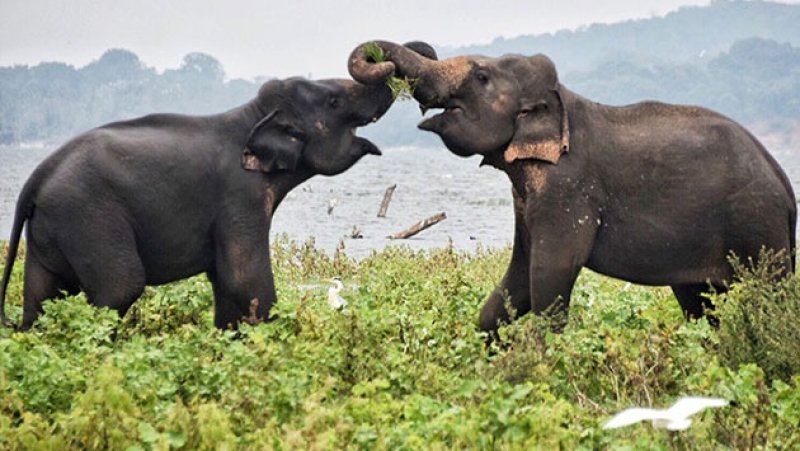
Sri Lanka has seen a significant rise in young male elephants over the past three national elephant surveys, a trend that has contributed to increased elephant–elephant conflict, Acting Director General of the Wildlife Conservation Department Ranjan Marasinghe said yesterday.
He said the male-to-female elephant ratio has narrowed steadily over the years. In 1993, the ratio stood at 1:1.8, but it dropped to 1:1.09 in 2011 and further to 1:1.04 in the 2024 survey.
Marasinghe noted that female herds are far less destructive compared to male-dominated groups. “The percentage of crop damage, loss of life, and property damage is significantly lower from female herds than from male elephant herds,” he said.
The surveys also show a marked increase in juvenile elephants. Juveniles accounted for 11% of the elephant population in 1993, decreased to 8.4% in 2011, and then rose sharply to 17.6% in 2024.
According to the 2024 National Elephant Survey, a minimum of 7,451 elephants were recorded across Sri Lanka — a substantial increase compared to 1,967 in 1993 and 5,879 in 2011.
However, the proportion of calves has declined over time. Calves made up 23% of the population in 1993, 18.8% in 2011, and 16% in 2024. In contrast, the number of adult elephants has continued to rise, from 52.8% in 1993 to 55.9% in 2011 and 61% in the latest survey.
Wildlife officials say these shifting age and gender dynamics highlight the need for updated conservation and conflict-management strategies as Sri Lanka’s elephant population continues to grow.